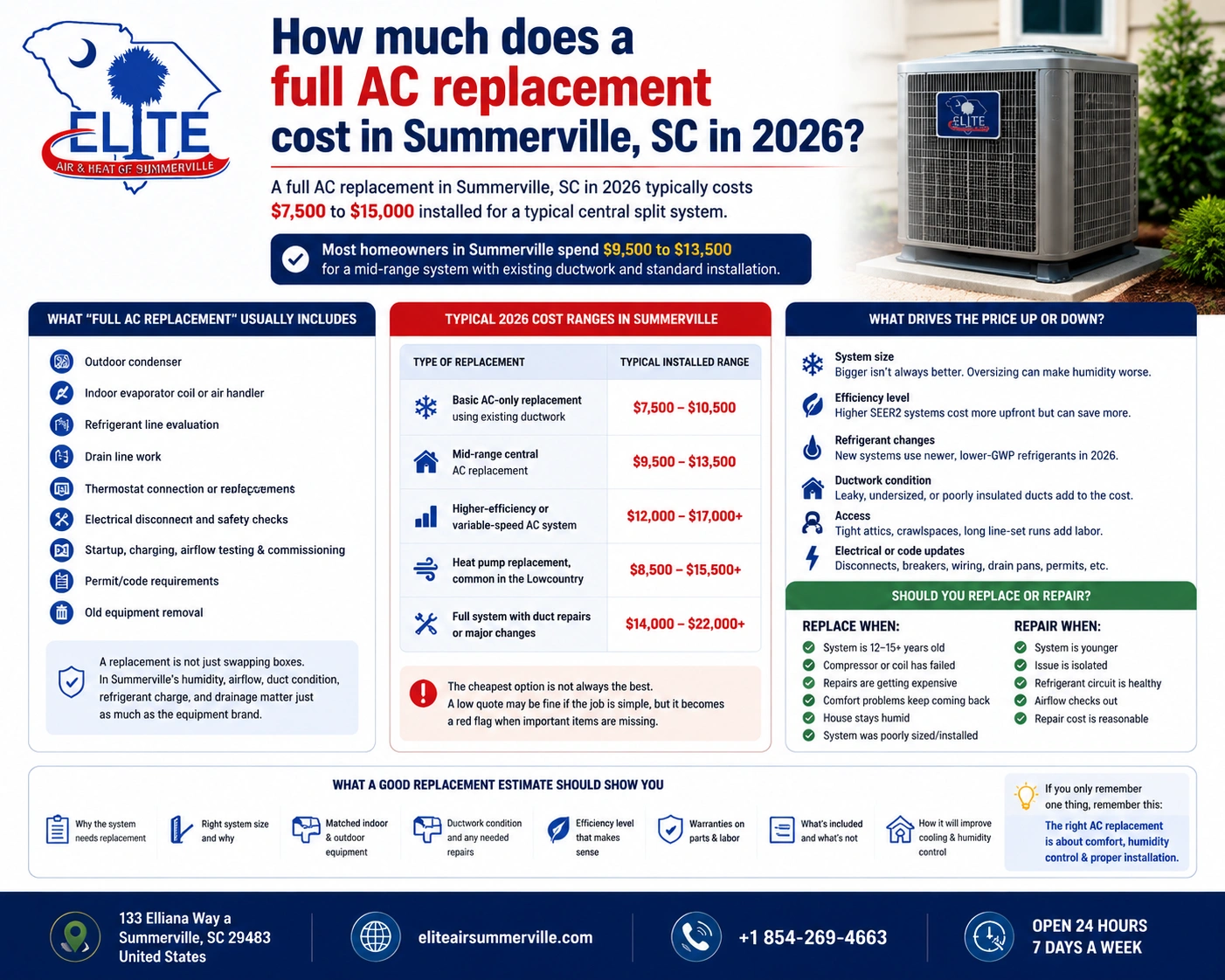

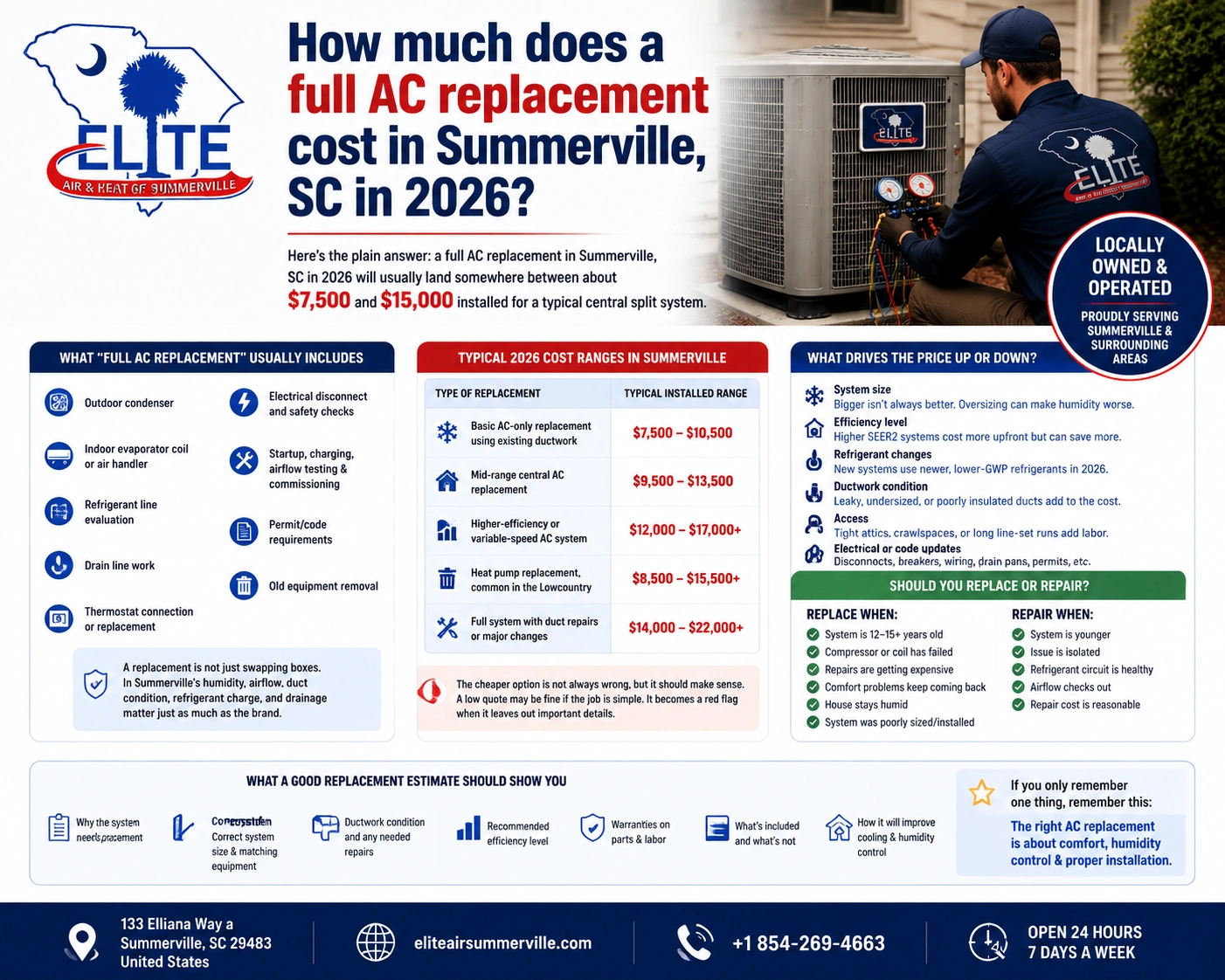
Here’s the plain answer: a full AC replacement in Summerville, SC in 2026 will usually land somewhere between about $7,500 and $15,000 installed for a typical central split system.
For many Summerville-area homes, a realistic middle-of-the-road replacement is often around $9,500 to $13,500, especially if you are replacing the outdoor condenser and indoor coil or air handler, using existing ductwork, and not making major electrical or duct changes.
That range lines up with current South Carolina and national 2026 pricing: South Carolina HVAC replacements are commonly reported around $5,200 to $13,500, while a 3-ton AC and furnace system in South Carolina is estimated around $10,800 to $13,800 installed. Broader 2026 central AC replacement ranges commonly run from about $5,300 to $17,300+ depending on efficiency and complexity.
How Much Should You Budget for a New AC System?
Avoid surprise costs with upfront AC replacement insights tailored for Summerville homeowners looking for comfort, efficiency, and dependable cooling.
What “full AC replacement” usually includes
A proper full AC replacement may include:
- Outdoor condenser
- Indoor evaporator coil or air handler
- Refrigerant line evaluation
- Drain line work
- Thermostat connection or replacement
- Electrical disconnect and safety checks
- Startup, charging, airflow testing, and commissioning
- Permit/code requirements where applicable
- Old equipment removal
The important part is this: a replacement is not just swapping boxes. In Summerville’s humidity, airflow, duct condition, refrigerant charge, and drainage matter just as much as the equipment brand.
Typical 2026 cost ranges in Summerville
Type of replacement | Typical installed range |
| Basic AC-only replacement using existing ductwork | $7,500–$10,500 |
| Mid-range central AC replacement | $9,500–$13,500 |
| Higher-efficiency or variable-speed AC system | $12,000–$17,000+ |
| Heat pump replacement, common in the Lowcountry | $8,500–$15,500+ |
| Full system with duct repairs or major changes | $14,000–$22,000+ |
The cheaper option is not always wrong, but it should make sense. A low quote may be fine if the job is simple. It becomes a red flag when it leaves out duct issues, permits, drain safety, warranty details, startup readings, or whether the indoor and outdoor equipment are properly matched.
What drives the price up or down?
The biggest cost drivers are:
System size. A 2-ton system costs less than a 4- or 5-ton system. But bigger is not automatically better. Oversizing can make humidity worse, especially in the Lowcountry.
Efficiency level. Higher SEER2 systems cost more upfront. In South Carolina, new split AC systems installed in the Southeast region have had to meet updated regional efficiency standards since 2023, with requirements based on the date of installation.
Refrigerant changes. By 2026, many new systems use newer lower-GWP refrigerants because EPA rules restricted higher-GWP refrigerants in new residential/light commercial AC products starting January 1, 2025. Existing R-410A systems can still be serviced, but new equipment choices may affect price and compatibility.
Ductwork condition. Bad ducts can make a new AC perform like an old one. If ducts are undersized, leaking, sweating, moldy, or poorly insulated, the quote may need to include repairs.
Access. Tight attics, crawlspaces, long line-set runs, or difficult equipment locations can add labor.
Electrical or code updates. Disconnects, breakers, wiring, float switches, drain pans, and permits can change the final number.
Should you replace the AC or repair it?
That does not automatically mean you need a replacement.
Replacement starts making more sense when:
- The system is 12–15+ years old
- The compressor or coil has failed
- The unit uses older refrigerant and repairs are getting expensive
- Comfort problems keep coming back
- The house stays humid even when the AC runs
- Repair costs are approaching a large share of replacement cost
- The system was poorly sized or poorly installed from the beginning
Repair may still make sense when the system is younger, the issue is isolated, the refrigerant circuit is healthy, and airflow checks out.

Why is My HVAC System Blowing Warm Air? (Causes + Fixes)
Nothing’s worse than turning on your AC and feeling warm air instead of cool relief. If your system isn’t doing…
One 2026 note on tax credits
Homeowners should be careful with old online advice about federal HVAC tax credits. The IRS says the Energy Efficient Home Improvement Credit applied to qualifying improvements made through December 31, 2025. For a new system installed in 2026, do not assume the old federal credit still applies unless a tax professional or current rebate program confirms it.
What a good replacement estimate should show you
A good technician should be able to explain:
- Why the system needs replacement
- Whether the indoor and outdoor equipment will be matched
- What size system is recommended and why
- Whether ducts are good enough for the new system
- What efficiency level makes sense for your home
- What warranties apply to parts and labor
- What is included and what is not
- Whether humidity control will improve or just cooling capacity
If you only remember one thing, remember this: the right AC replacement in Summerville is not just about cold air. It is about cooling, humidity control, airflow, and whether the whole system is installed correctly.
If your quote is under about $7,500, ask what is missing. If it is over $15,000, ask what problem the higher price is solving. A good contractor should be able to show you the difference clearly.
Thinking About Upgrading Your Air Conditioner?
See what homeowners in Summerville are paying for AC replacement in 2026 and find out which systems deliver the best long-term value.