

Here’s the plain answer: your new home may feel sticky because it is built tighter than older homes, and the AC may not be running long enough to pull moisture out of the air.
That does not automatically mean something is “wrong” with the house.
It also does not automatically mean your AC is broken.
But it does mean the home’s cooling, airflow, ventilation, and humidity control need to be looked at as one system.
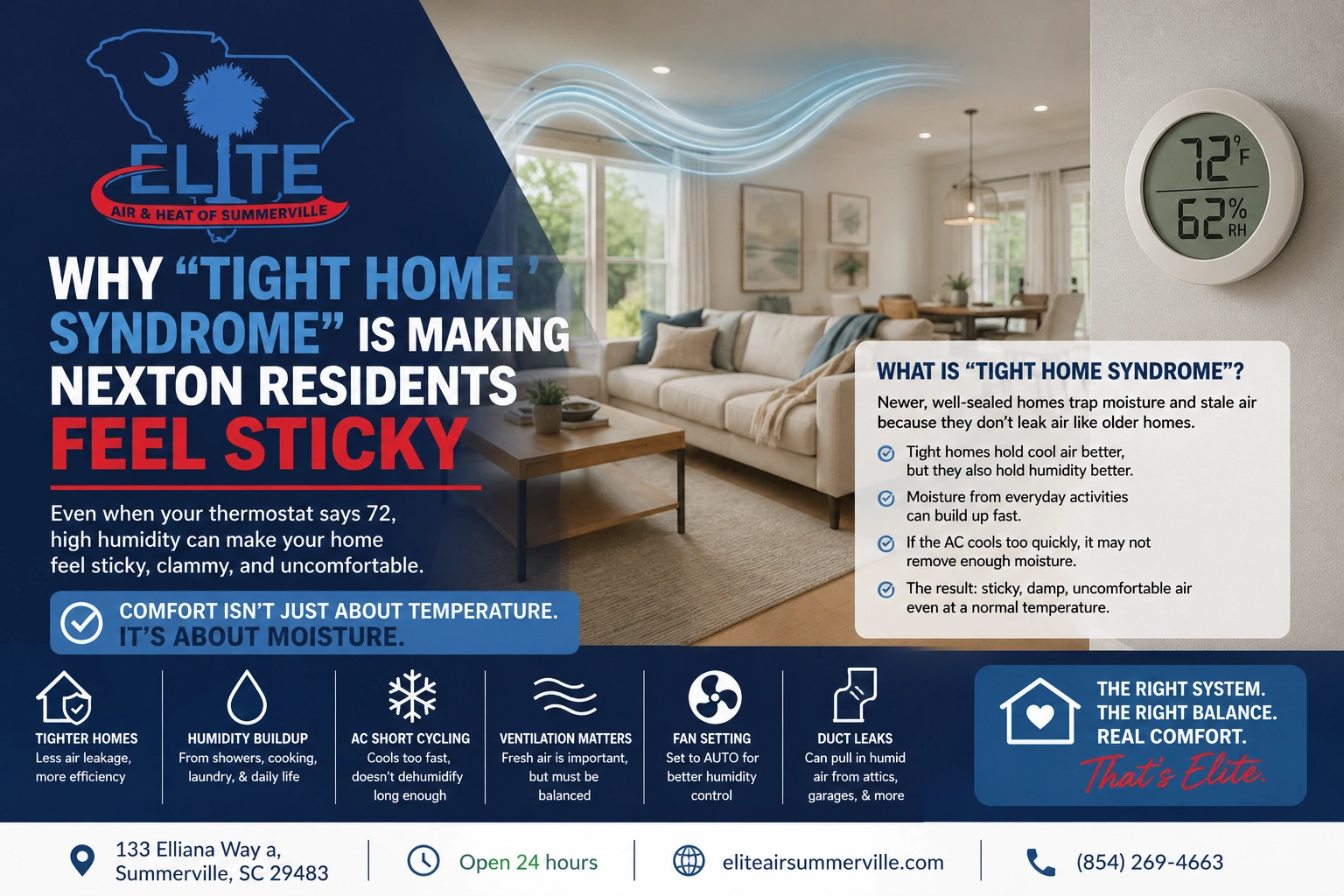
In a new sealed home, comfort is not just about temperature. You can have the thermostat set to 72 and still feel damp, clammy, or sticky if the indoor humidity is too high.
New Home, Sticky Air? Let’s Fix That
If your Nexton home feels humid or uncomfortable, our team can help improve airflow, comfort, and indoor air quality.
Why newer homes can feel more humid
Many newer homes in communities like Nexton are built much tighter than older Lowcountry homes.
That usually means:
- Better insulation
- Better windows
- Less air leakage
- More efficient construction
- Lower cooling load compared with an older drafty home
Those are good things.
But there is a tradeoff: less air leakage also means moisture has fewer ways to escape.
Older homes leaked air constantly. That was not efficient, but it did allow some natural drying and air exchange. A newer sealed home holds conditioned air better, but it can also hold moisture better if the HVAC system and ventilation strategy are not dialed in.
The AC may be cooling faster than it dehumidifies
This is one of the most common reasons a new home feels sticky.
Your AC removes humidity only while it is running. Warm, humid indoor air passes over the cold evaporator coil. Moisture condenses on that coil, drains away, and the air comes back cooler and drier.
But that process takes runtime.
If the AC cools the house too quickly, it may satisfy the thermostat before it removes enough moisture.
So the thermostat says, “We’re good.”
Your body says, “Why does the house feel damp?”
That is especially common when the system is oversized.
Oversized equipment is a big humidity problem
A bigger AC is not always better.
In Summerville’s hot, humid climate, an oversized system can create comfort problems because it short-cycles. That means it turns on, blasts cold air for a few minutes, shuts off, and repeats.
The house may hit the temperature setpoint, but humidity stays high.
That can leave you with:
- Sticky rooms
- Clammy sheets
- Musty smells
- Sweating vents
- Condensation around supply registers
- Rooms that feel cold and damp at the same time
This is where homeowners sometimes get into trouble. They assume the AC is not “strong enough,” when the real issue may be that it is too large, moving too much air, or not running long enough.
Your thermostat may be hiding the real problem
Most homeowners watch the temperature.
In sealed homes, you also need to watch relative humidity.
A comfortable indoor humidity range is often around 45%–55%. Once indoor humidity is regularly above 60%, the home can start to feel sticky, and moisture-related problems become more likely.
A smart thermostat or standalone hygrometer can help you see what is actually happening.
For example:
| Thermostat reading | Humidity reading | How it may feel |
| 72°F | 45% | Comfortable |
| 72°F | 55% | Usually okay |
| 72°F | 62% | Sticky or damp |
| 70°F | 65% | Cold but clammy |
If your house feels sticky, do not only ask, “What is the temperature?”
Ask, “What is the humidity?”

Top 5 HVAC systems for Summerville homes in 2026
Here’s the plain answer: for most Summerville homes in 2026, the best HVAC system is a properly sized variable-speed or…

Ventilation can add moisture if it is not controlled well
Newer homes often include mechanical ventilation because the house is tighter.
That can be a good thing. Homes need fresh air.
But in the Lowcountry, outdoor air is often hot and humid. If outside air is being brought into the home without proper control, the AC has to remove that extra moisture.
Possible issues include:
- Fresh-air intake bringing in too much humid air
- Ventilation running at the wrong times
- ERV or ventilation settings not balanced properly
- Bath fans or kitchen exhaust creating pressure problems
- Leaky return ducts pulling humid attic or garage air into the system
A good technician should not just look at the outdoor unit and say, “It’s cooling.”
They should look at how the house is breathing.
Construction moisture can linger in a brand-new home
Brand-new homes can also carry moisture from construction.
Concrete, framing lumber, drywall compound, paint, flooring materials, and other building materials can release moisture after the home is finished.
That does not mean your builder did anything wrong. It means a new home may need time, airflow, and proper HVAC operation to dry out.
But if humidity stays high for weeks or months, or if you see condensation, musty odors, or mold-like growth, it should be checked rather than brushed off.
Ductwork matters more than most homeowners think
In a new home, the duct system should be clean, sealed, insulated, and sized correctly.
But if the ducts are not right, humidity problems can show up fast.
Common duct-related causes include:
- Return leaks pulling humid attic air into the system
- Supply leaks wasting dry conditioned air
- Poor airflow across the coil
- Ducts sweating in hot attic spaces
- Rooms not receiving enough supply air
- Unbalanced pressure between rooms
If one part of the house feels sticky while another feels fine, duct design or balancing may be part of the issue.
The AC fan setting can make humidity worse
Check your thermostat fan setting.
If the fan is set to ON, the blower may run even when the outdoor AC is off. That can re-evaporate moisture sitting on the indoor coil and push it back into the house.
For humidity control, AUTO is usually better.
That way, the blower runs with the cooling cycle instead of constantly circulating damp air.
This is one of the safe things homeowners can check themselves.
What you can safely check before calling anyone
Start simple.
Check:
- Indoor humidity reading with a hygrometer
- Thermostat fan setting: use AUTO, not ON
- Air filter condition
- Supply vents open and not blocked
- Return grilles clear
- Drain line not obviously backed up
- Bath fans turning off after use
- Any visible condensation around vents
- Whether the issue is whole-house or only certain rooms
Also write down when the stickiness happens.
Is it worse:
- In the morning?
- After rain?
- After showers?
- When cooking?
- In upstairs rooms?
- When the AC runs short cycles?
- When the outdoor temperature is mild but humid?
That information helps a good technician find the real cause faster.
What a professional should inspect
A proper humidity diagnosis should include more than checking refrigerant pressure.
A good technician should look at:
- Indoor humidity readings
- Temperature split across the coil
- System runtime and cycling
- Blower speed settings
- Static pressure
- Airflow across the coil
- Duct leakage or pressure issues
- Fresh-air ventilation settings
- Drainage and condensate removal
- Equipment size compared with the home’s actual load
- Thermostat setup and staging
- Signs of attic or crawlspace air being pulled into the system
A good technician should be able to show you why the home feels sticky, not just guess.
Do you need a whole-home dehumidifier?
Maybe.
A whole-home dehumidifier can be a good solution for tight, efficient homes in humid climates, especially when the AC load is low but moisture load is high.
That happens often during mild but humid weather. The AC does not need to run much to cool the house, but the air still carries a lot of moisture.
A whole-home dehumidifier may make sense if:
- Indoor humidity stays above 60%
- The AC is sized correctly but humidity remains high
- The home is very tight
- Ventilation brings in humid outdoor air
- You have recurring musty odors
- Certain rooms feel damp even at normal temperatures
- You want humidity control without overcooling the house
But it should not be used as a bandage for a bad install, oversized AC, duct leakage, or incorrect fan settings. The cause should be diagnosed first.
When not to DIY
Do not try to adjust refrigerant charge, blower speed, wiring, duct dampers, or ventilation equipment unless you are trained.
This is where homeowners can accidentally make the problem worse.
For example, lowering the thermostat to 68 may make the house colder, but it may not solve the humidity problem. It can also increase energy use and condensation risk.
Likewise, closing a bunch of vents to “push more air” somewhere else can increase pressure, reduce airflow, and create duct sweating or equipment strain.
What to ask your builder or HVAC contractor
For a brand-new Nexton home, ask direct questions:
- Was a Manual J load calculation done for this specific home?
- What size system was installed, and why?
- Is the system single-stage, two-stage, or variable-speed?
- What are the blower settings?
- Is there mechanical fresh-air ventilation?
- How is that ventilation controlled?
- Has the duct system been tested or balanced?
- What indoor humidity level is considered acceptable?
- Are any comfort complaints covered under the workmanship or builder warranty?
The goal is not to blame the builder, the HVAC company, or the equipment. The goal is to find the part of the system that is not matching the way the home actually performs.
The bottom line
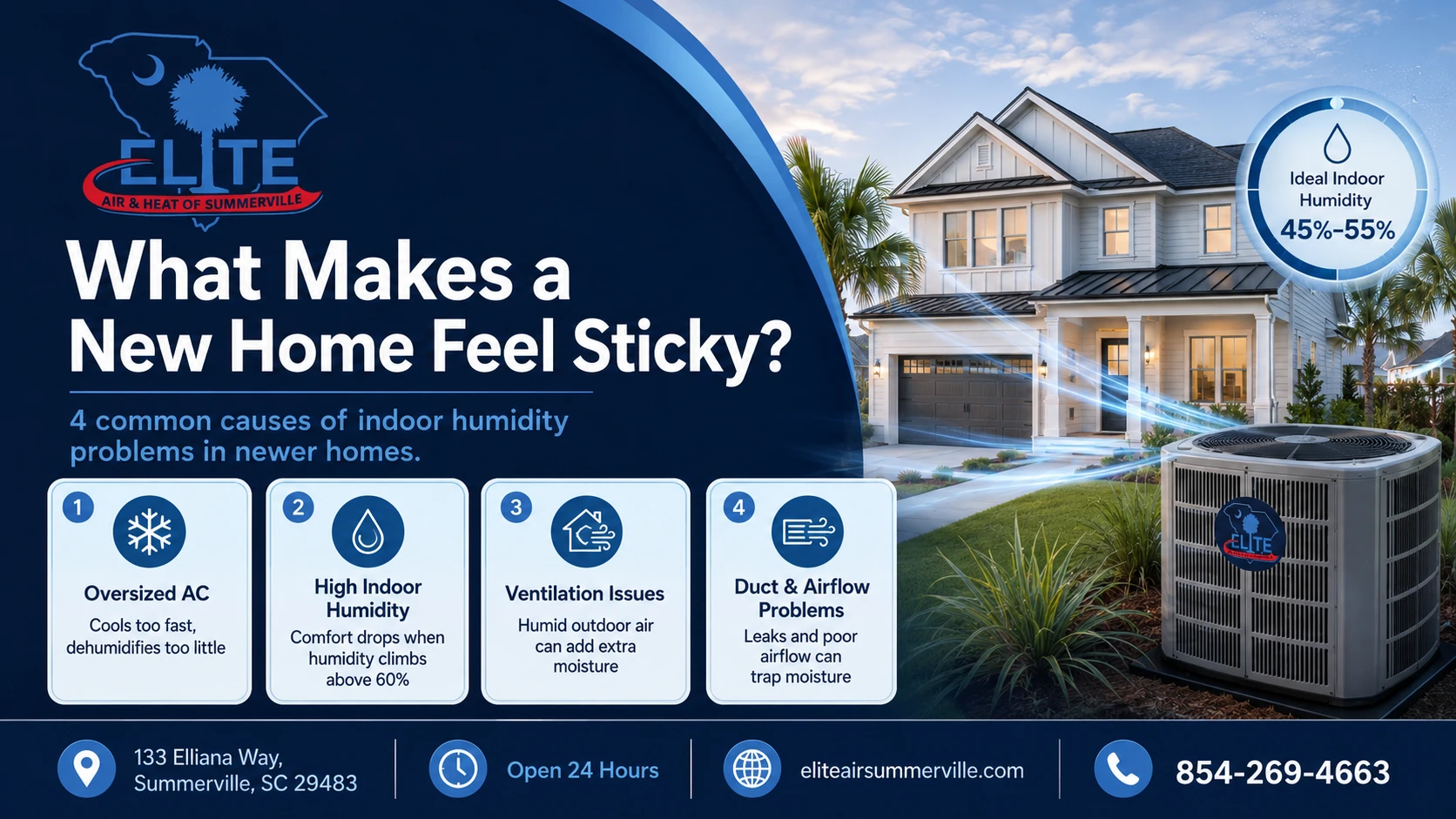
If your brand-new Nexton home feels sticky, the problem is usually one of four things:
- The AC is cooling too quickly and not dehumidifying long enough.
- Humid outdoor air is being introduced or pulled into the home.
- Airflow, ductwork, or fan settings are working against humidity removal.
- The home may need dedicated dehumidification because it is tight and efficient.
If you only remember one thing, remember this: in a sealed Lowcountry home, comfort is not just about the number on the thermostat. It is about moisture control.
A good technician should be able to explain whether your issue is equipment sizing, airflow, ventilation, drainage, duct leakage, or a true need for added dehumidification. That answer matters before you spend money on upgrades or start changing settings blindly.
Sticky Air in Your New Nexton Home? We Can Help
Discover why humidity builds up in newer homes and how our HVAC solutions can make your space feel fresh again.