

Most homeowners do not buy an HVAC maintenance plan because they are excited about maintenance.
They buy it because they are trying to avoid the bad stuff:
A no-cool call in July.
A heat pump problem during a cold snap.
A repair that could have been caught earlier.
A system that runs harder than it should because nobody has cleaned, tested, or checked it in months.
Here’s the plain answer: yes, a $180/year HVAC maintenance plan can be worth it for many homeowners, but only if it includes real maintenance, not just a quick filter check and a sales pitch.
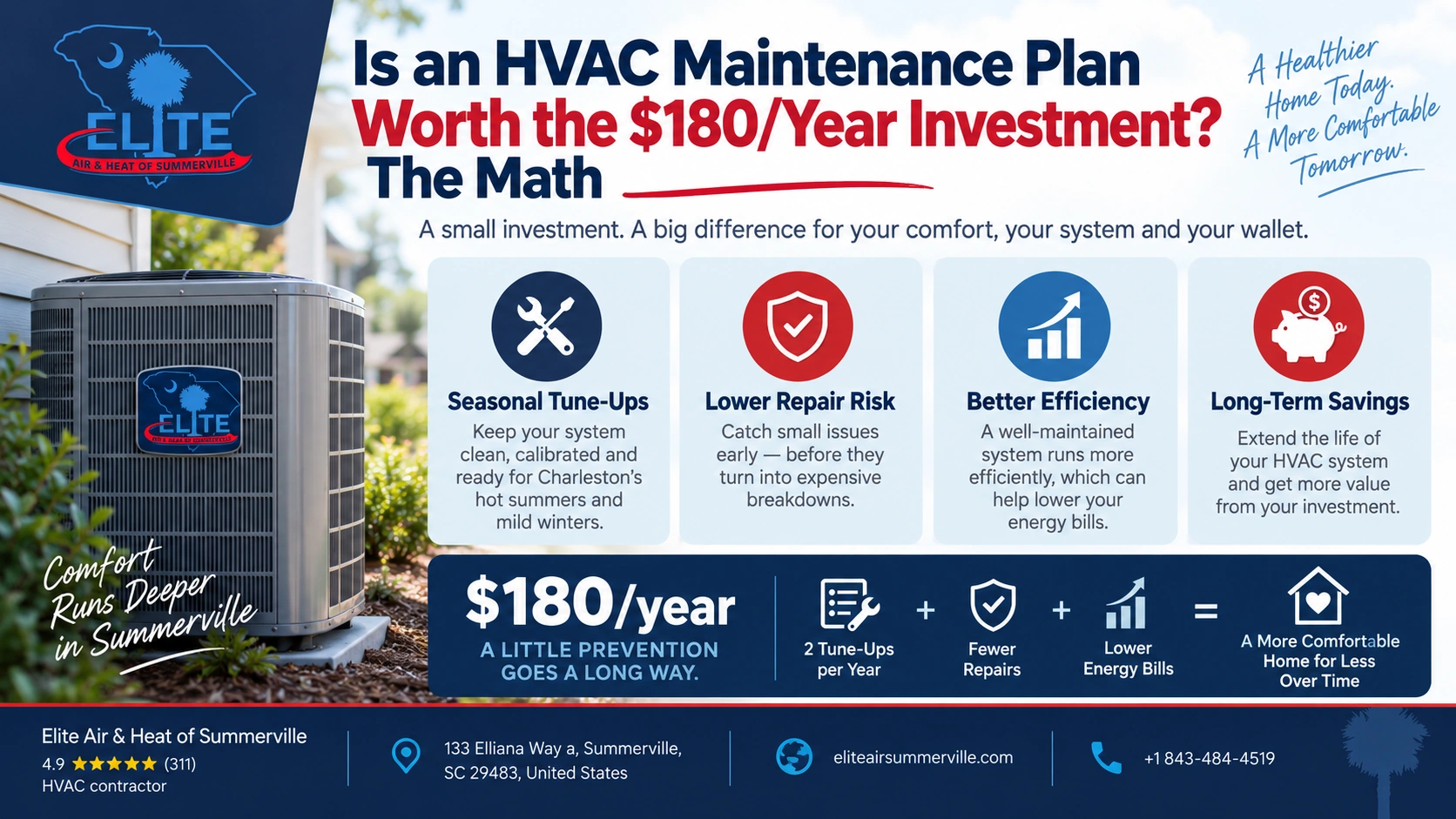
The math usually works when the plan includes seasonal tune-ups, priority scheduling, repair discounts, and a thorough inspection of the equipment.
It does not work as well if the plan is vague, rushed, or does not include meaningful checks.
The Simple Math
Let’s start with the easy part.
A $180/year maintenance plan costs:
$15 per month
That is less than many homeowners spend on streaming services, coffee, or one dinner out.
But the real question is not whether $180 sounds affordable.
The real question is:
Can that $180 help prevent, reduce, or delay costs larger than $180?
In many cases, yes.
What One Tune-Up Usually Costs Without a Plan
A single HVAC tune-up often costs somewhere around $75–$200 per visit, depending on the company, the system, and what is included.
If your maintenance plan includes two visits per year, usually one cooling visit and one heating visit, the math is pretty simple:
| Service | Typical Standalone Cost |
| Spring AC tune-up | $75–$200 |
| Fall heating tune-up | $75–$200 |
| Total if scheduled separately | $150–$400 |
| Annual plan cost | $180 |
If the $180 plan includes two real visits, the plan can pay for itself just on scheduled maintenance.
That is before you count repair discounts, priority service, or catching problems early.
Where the Plan Can Save Money
A maintenance plan usually saves money in four ways.
1. Lower Chance of Emergency Repairs
Maintenance does not make your system bulletproof.
No honest technician should promise that.
But maintenance can catch weak parts before they fail at the worst possible time.
Common issues found during maintenance include:
- Weak capacitors
- Dirty condenser coils
- Clogged drain lines
- Loose electrical connections
- Worn contactors
- Weak blower components
- Poor airflow
- Low refrigerant symptoms
- Thermostat or control issues
- Safety switch problems
A capacitor that is weakening during a tune-up may be a manageable repair.
A capacitor that fails on a 98-degree afternoon may become an emergency no-cool call.
Same part.
Different timing.
Different stress levels.
2. Better Energy Efficiency
In Summerville’s long cooling season, small efficiency losses can add up.
If your AC runs for months in heat and humidity, dirty coils, poor airflow, and clogged filters can make the system work harder than it should.
That does not always show up as one giant electric bill.
It often shows up as a steady increase over time.
For example, if your cooling-related energy use costs around $1,200 per year, even a modest efficiency improvement can matter:
| Efficiency Improvement | Approximate Annual Savings |
| 5% | $60 |
| 10% | $120 |
| 15% | $180 |
That does not mean every tune-up saves exactly 15%.
It means the dirtier, more neglected, or more airflow-restricted the system is, the more room there may be to improve.
If the system is already clean and running well, the energy savings may be smaller.
3. Repair Discounts
Many maintenance plans include a discount on repairs.
For example, if a plan includes a 10% repair discount, the savings may look like this:
| Repair Cost | 10% Discount |
| $250 | $25 |
| $500 | $50 |
| $900 | $90 |
| $1,500 | $150 |
A repair discount alone may not pay for the whole plan every year.
But when you combine it with the tune-ups, priority scheduling, and early problem detection, the math gets stronger.
4. Longer Equipment Life
This is the harder part to calculate, but it may be the most important.
HVAC replacement is expensive.
If regular maintenance helps delay replacement by even one year, that can matter.
For example, if a system replacement costs $10,000 and maintenance helps you avoid replacing it one year earlier than necessary, the value of that extra year is not small.
That does not mean maintenance can save a system that is already failing.
It means a clean, properly checked system usually has a better chance of lasting than one that is ignored until something breaks.
The goal is not to make old equipment new again.
The goal is to reduce unnecessary strain.
The Break-Even Point
Here is one simple way to look at the break-even math:
| Potential Value From Plan | Conservative Annual Value |
| Two seasonal visits compared to paying separately | $150–$400 |
| Possible energy savings | $50–$180 |
| Repair discount, if used | $25–$150+ |
| Avoided emergency fee or earlier repair catch | Varies |
| Annual plan cost | $180 |
If the plan includes two actual maintenance visits, the plan often breaks even before anything breaks.
If it includes one visit, the math depends more on repair discounts and energy savings.
If it includes only a light inspection, the value is weaker.
When a $180 Maintenance Plan Is Usually Worth It
A maintenance plan usually makes sense when:
- Your system is more than 3–5 years old
- You use your AC heavily during the summer
- You have a heat pump that runs for both heating and cooling
- You want seasonal reminders instead of having to remember
- You want priority scheduling during busy seasons
- You have had drain line, airflow, or humidity issues before
- You want small problems found before peak season
- Your manufacturer warranty expects routine maintenance
- You would rather plan maintenance than react to breakdowns
In a humid climate, comfort is not just about temperature.
A neglected system can cool poorly, run longer, leave the house sticky, or struggle to drain moisture properly.
When It May Not Be Worth It
A maintenance plan may not be worth it if:
- It only includes a very basic visual inspection
- You have a brand-new system with strong labor coverage and no plan benefits
- You are moving soon
- You never use the included visits
- The company uses maintenance visits mostly to push replacements
- The plan does not clearly explain what is included
- The technician does not actually test the system
The cheaper option is not always wrong, but it should make sense.
A $180 plan is only a good deal if the visit is thorough enough to matter.
What a Good HVAC Maintenance Visit Should Include
A good maintenance visit should be more than walking around the unit and saying, “Looks good.”
For cooling maintenance, a technician should typically check:
- Air filter condition
- Thermostat operation
- Electrical connections
- Capacitor readings
- Contactor condition
- Blower operation
- Indoor coil condition, where accessible
- Outdoor coil condition
- Refrigerant performance indicators
- Condensate drain line
- Safety switches
- Temperature split
- Airflow concerns
- System startup and shutdown
- Unusual noises or vibration
For heat pump systems, heating operation should also be checked before colder weather.
A good technician should be able to show you what they found, not just hand you a checklist.
What Homeowners Can Do Themselves
Some maintenance is safe for homeowners.
You can:
- Change or clean filters regularly
- Keep the outdoor unit clear of leaves and debris
- Make sure supply and return vents are not blocked
- Keep weeds and shrubs away from the condenser
- Watch for water around the indoor unit
- Listen for unusual noises
- Pay attention to rooms that suddenly feel warmer or more humid
These simple habits help.
But they do not replace a full system check.
Homeowners should not open electrical compartments, test capacitors, handle refrigerants, bypass safety switches, or keep resetting a breaker that trips repeatedly.
That is where DIY can become unsafe.
The Warranty Question
Many homeowners forget this part.
Some manufacturers expect routine maintenance if there is ever a warranty claim.
That does not mean every warranty claim will be denied without a maintenance plan.
But if a major part fails, having a record of professional maintenance can help show the system was being cared for.
That record can matter.
A maintenance plan gives you documentation, not just service.
The Bottom Line
A $180/year HVAC maintenance plan is often worth it if it includes real seasonal maintenance, clear documentation, priority service, and repair discounts.
The math is pretty straightforward:
If two tune-ups would normally cost $150–$400 on their own, then a $180 plan can already make sense.
If it also helps catch one weak part early, reduce one emergency visit, improve efficiency, or protect warranty documentation, the value becomes stronger.
If you only remember one thing, remember this:
Maintenance does not guarantee your HVAC system will never break. It gives the system a better chance to run safely, efficiently, and reliably when you need it most.
For Summerville homeowners, that matters because the AC does not get a short season. It works hard through long stretches of heat and humidity.
Elite Air & Heat of Summerville can help you understand what is included in the maintenance plan, what gets checked during each visit, and whether the plan makes sense for your system’s age, condition, and usage.