
Most homeowners judge their HVAC system by one number:
The thermostat temperature.
If it says 72 degrees, the assumption is that everything is working correctly.
But here’s the problem.
Two homes can both be 72 degrees and feel completely different.
One feels cool, comfortable, and crisp.
The other feels sticky, humid, and uncomfortable.
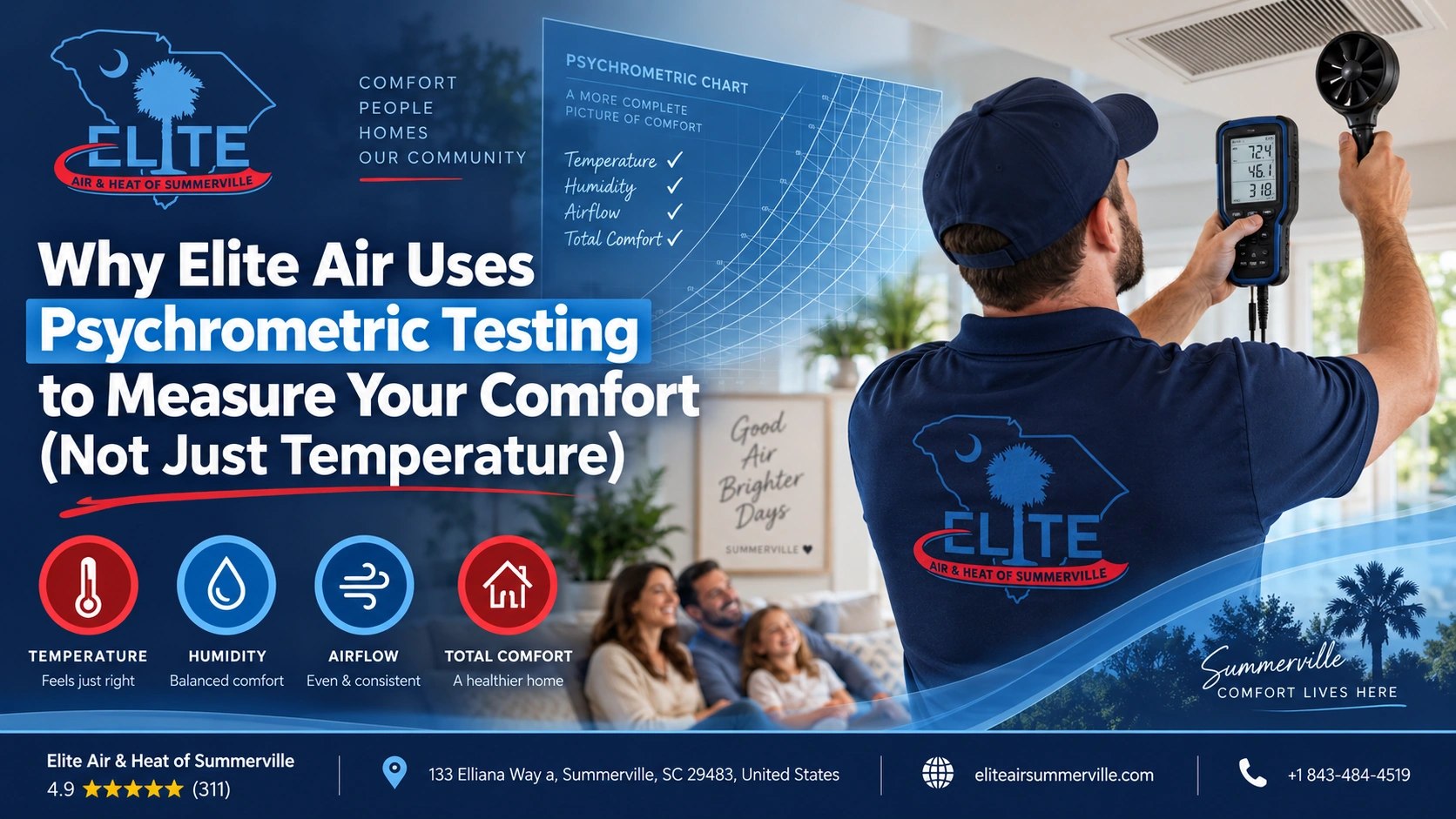
That’s why at Elite Air & Heat, we don’t look at temperature alone. We use psychrometric testing to understand what your home actually feels like.
What Is Psychrometric Testing?
Don’t worry about the technical name.
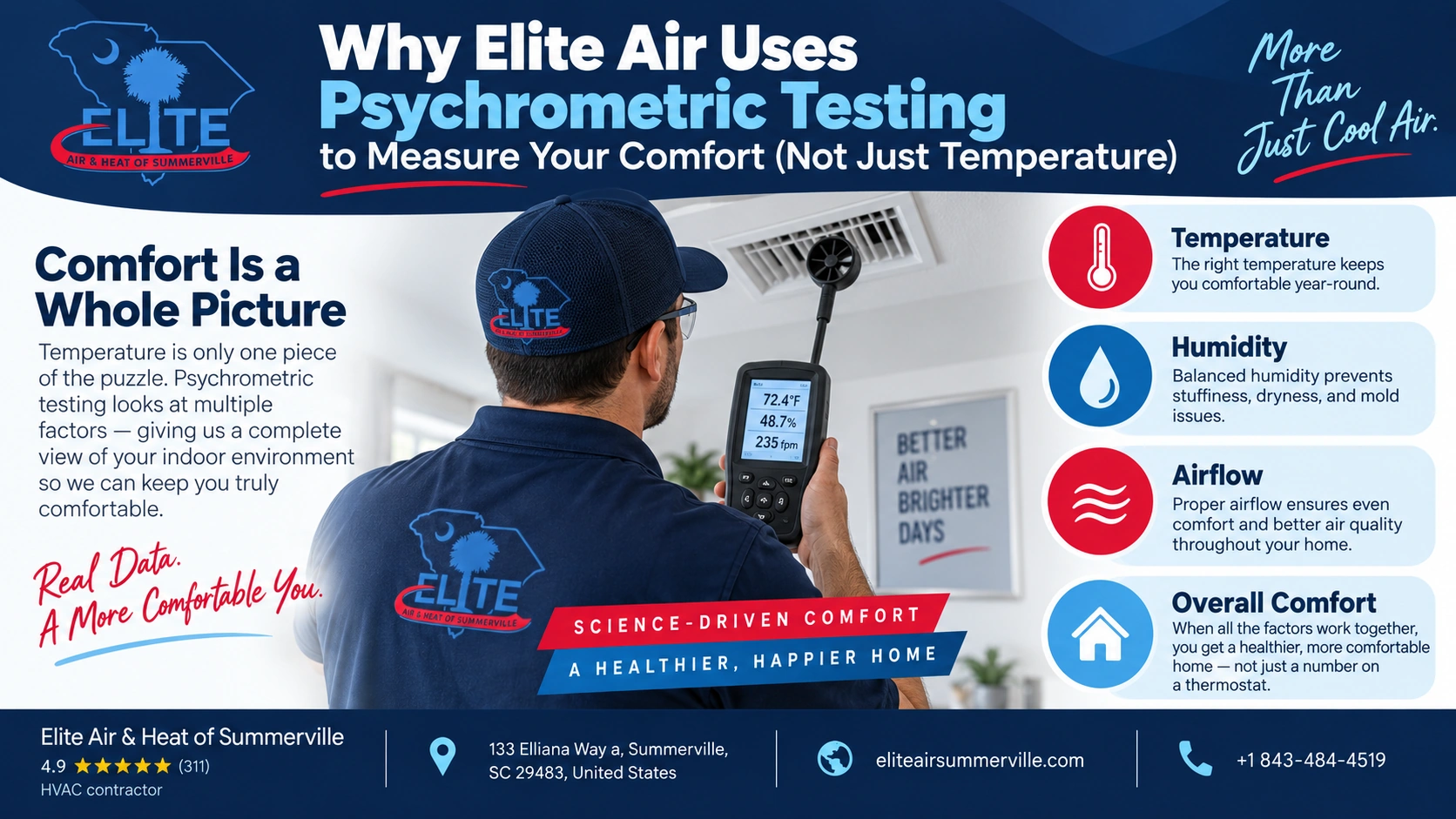
In simple terms, psychrometric testing measures how temperature and moisture work together inside your home.
A thermostat only tells us:
- Air temperature
Psychrometric testing tells us:
- Temperature
- Relative humidity
- Dew point
- Moisture content
- Cooling performance
- Comfort conditions
It gives a much clearer picture of what your HVAC system is actually doing.
Why Temperature Doesn’t Tell the Whole Story
Here’s a simple example.
Imagine two bedrooms.
Both are 72 degrees.
Bedroom A:
- 45% indoor humidity
Bedroom B:
- 65% indoor humidity
The thermostat reads the same.
Your comfort level does not.
Most people will describe Bedroom B as:
- Sticky
- Damp
- Muggy
- Hard to sleep in
In a humid climate, comfort is not just about temperature.
It’s about how effectively your HVAC system removes moisture from the air.
The Lowcountry Humidity Problem
Summerville and the surrounding Lowcountry experience:
- Long cooling seasons
- High outdoor humidity
- Heavy summer rainfall
- Extended periods of moisture
Many homeowners call because they think their AC isn’t cooling properly.
What we often discover is:
The temperature is fine.
The humidity isn’t.
This is where homeowners sometimes get into trouble.
They keep lowering the thermostat:
- 74 degrees
- 72 degrees
- 70 degrees
- 68 degrees
But the house still feels uncomfortable because the real problem is moisture, not temperature.
What Psychrometric Testing Helps Us Identify
Oversized HVAC Systems
Bigger is not always better.
An oversized system often:
- Cools quickly
- Shuts off quickly
- Removes less humidity
The house reaches the thermostat setting but never feels comfortable.
Psychrometric testing can reveal when short run cycles are creating humidity problems.
Airflow Issues
Poor airflow can prevent proper moisture removal.
Common causes include:
- Dirty coils
- Restrictive filters
- Undersized ductwork
- Duct leakage
- Blower problems
Psychrometric measurements help us see how these issues affect overall comfort.
Hidden Humidity Problems
Sometimes homeowners are surprised to learn that indoor humidity is running above recommended levels.
That can contribute to:
- Musty odors
- Mold concerns
- Condensation
- Poor sleep comfort
- Higher cooling costs
A thermostat alone cannot identify these problems.
The “72 Degrees but Uncomfortable” Diagnosis
One of the most common service calls we receive sounds like this:
“My AC is running and the temperature looks fine, but the house doesn’t feel comfortable.”
A temperature-only approach may suggest everything is normal.
Psychrometric testing often tells a different story.
It allows us to determine:
- Whether the system is removing enough moisture
- Whether airflow is adequate
- Whether humidity is within a healthy range
- Whether the equipment is operating as designed
The goal is not to guess.
The goal is to measure.
What a Good HVAC Technician Should Explain
If humidity or comfort issues are involved, a technician should be able to explain:
- Indoor humidity levels
- How the system is performing
- Whether moisture removal is adequate
- What measurements were taken
- What the readings mean
- What options exist to improve comfort
A good technician should be able to show you why a problem exists, not just tell you that it does.
When Psychrometric Testing Is Most Valuable
This type of testing is especially useful when homeowners experience:
- Sticky indoor air
- Uneven comfort
- High humidity
- Musty odors
- Mold concerns
- Hot upstairs rooms
- High energy bills
- Comfort complaints despite a functioning AC
These are often situations where temperature alone doesn’t tell the whole story.
The Bottom Line
If you only remember one thing, remember this:
Your thermostat measures temperature. Your comfort depends on temperature and humidity.
That’s why Elite Air uses psychrometric testing as part of a complete comfort evaluation.
Because the goal is not simply getting your home to 72 degrees.
The goal is helping your home actually feel comfortable at 72 degrees.
If your house feels sticky, humid, or uncomfortable even though the thermostat says everything is fine, a proper comfort evaluation should include more than temperature readings. It should include the measurements that explain what the air in your home is actually doing and what needs to change to make it feel better.