
If your thermostat says 72 degrees, but your house still feels sticky, damp, or uncomfortable, you’re asking the wrong question.
Most homeowners compare HVAC systems based on:
- SEER ratings
- Brand names
- Equipment size
- Price
But in the Lowcountry, one of the most important comfort questions is much simpler:
“How does the house feel?”
That’s where what I call the Sticky Home Test comes in.
Is Your AC Cooling but Still Feels Sticky?
Your system may not be controlling humidity effectively. Call today for professional HVAC solutions.
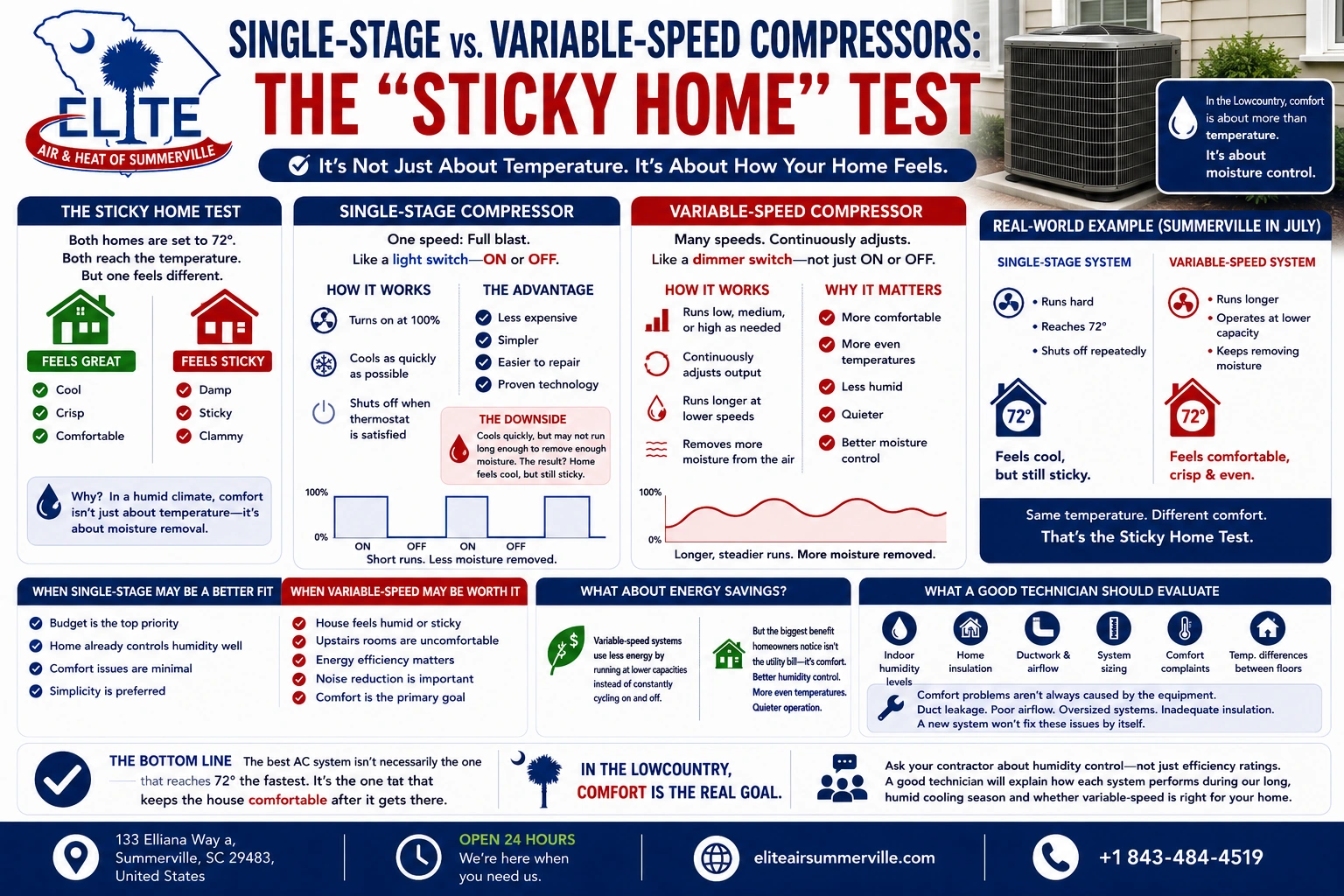
The Sticky Home Test
Imagine two homes.
Both are set to 72 degrees.
Both have functioning air conditioners.
Both technically reach the thermostat setting.
But one home feels:
- Cool
- Crisp
- Comfortable
The other feels:
- Damp
- Sticky
- Clammy
Even though the temperature is identical.
Why?
In a humid climate, comfort is not just about temperature.
It’s about moisture removal.
And that’s where the difference between single-stage and variable-speed systems becomes noticeable.
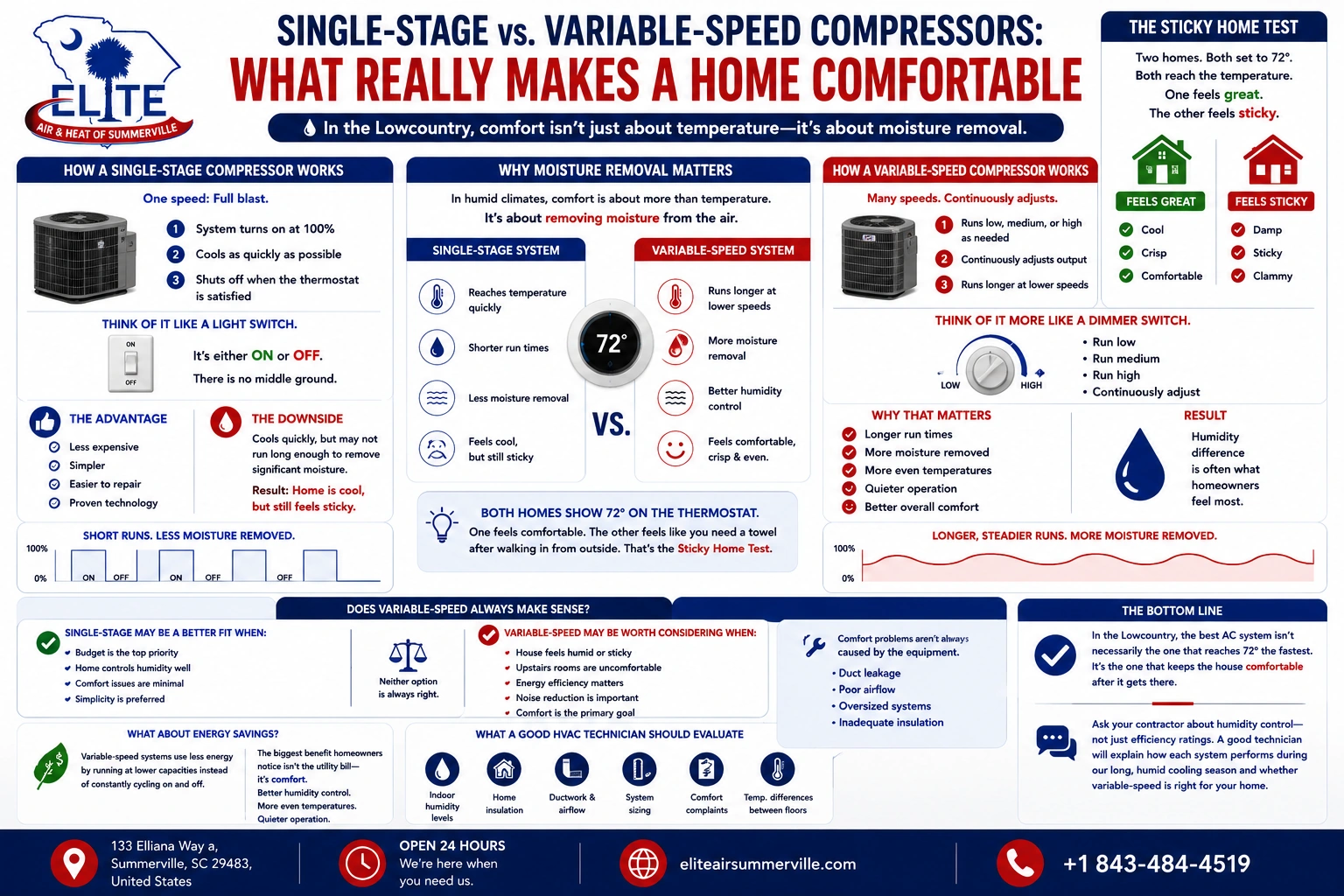
How a Single-Stage Compressor Works
A single-stage compressor has one speed:
Full blast.
When cooling is needed:
- The system turns on at 100%
- Cools as quickly as possible
- Shuts off when the thermostat is satisfied
Think of it like a light switch.
It’s either:
- On
- Off
There is no middle ground.
The Advantage
Single-stage systems are usually:
- Less expensive
- Simpler
- Easier to repair
- Proven technology
For many homes, they work perfectly well.
The Downside
This is where homeowners sometimes get into trouble.
Because the system cools quickly, it may not run long enough to remove significant moisture from the air.
The house reaches the temperature setting.
But the humidity remains.
The result?
A home that technically feels cool but still feels sticky.
How a Variable-Speed Compressor Works
A variable-speed compressor can operate across a wide range of capacities.
Instead of only running at 100%, it can adjust output based on actual demand.
Think of it more like a dimmer switch than a light switch.
It can:
- Run low
- Run medium
- Run high
- Continuously adjust
Most of the time, the system operates at lower speeds.
Why That Matters
Longer run times allow the indoor coil to remove more moisture from the air.
That’s often the secret behind why homeowners describe variable-speed systems as:
- More comfortable
- More even
- Less humid
- Quieter
The temperature may only change by a degree or two.
The humidity difference can be much more noticeable.
The Real-World “Sticky Home” Example
Let’s say it’s July in Summerville.
Outdoor conditions are:
- 94 degrees
- High humidity
A single-stage system may:
- Run hard
- Reach 72 degrees
- Shut off repeatedly
Meanwhile, a variable-speed system may:
- Run for longer periods
- Operate at lower capacity
- Continue removing moisture
Both homes show 72 on the thermostat.
One feels comfortable.
The other feels like you need a towel after walking in from outside.
That’s the Sticky Home Test.

Why is my brand-new Nexton home so sticky?
Here’s the plain answer: your new home may feel sticky because it is built tighter than older homes, and the…
Does Variable-Speed Always Make Sense?
No.
A variable-speed system is not automatically the right choice for every homeowner.
Single-Stage May Be a Better Fit When:
- Budget is the top priority
- The home already controls humidity well
- Comfort issues are minimal
- Simplicity is preferred
Variable-Speed May Be Worth Considering When:
- The house feels humid
- Upstairs rooms are uncomfortable
- Energy efficiency matters
- Noise reduction is important
- Comfort is the primary goal
Neither option is always right.
A good contractor should explain why they’re recommending one over the other.
What About Energy Savings?
Variable-speed systems can reduce energy usage because they spend much of their time operating at lower capacities rather than constantly cycling on and off.
However, this is where marketing sometimes gets ahead of reality.
The largest benefit many homeowners notice isn’t the utility bill.
It’s comfortable.
People often buy variable-speed systems expecting dramatic energy savings.
They end up happiest with:
- Better humidity control
- More consistent temperatures
- Quieter operation
What a Good HVAC Technician Should Evaluate
Before recommending equipment, a technician should look at:
- Indoor humidity levels
- Existing ductwork
- Home insulation
- System sizing
- Airflow performance
- Comfort complaints
- Temperature differences between floors
If the issue keeps coming back, replacing equipment blindly usually is not the answer.
Sometimes the problem is:
- Duct leakage
- Poor airflow
- Oversized equipment
- Inadequate insulation
A new variable-speed system won’t fix every comfort issue by itself.
The Bottom Line
If your home frequently feels cool but still sticky, humidity is likely part of the problem.
A single-stage system can cool a house effectively, but a variable-speed compressor often does a much better job controlling moisture because it runs longer and adjusts its output based on actual demand.
If you only remember one thing, remember this:
In the Lowcountry, the best AC system isn’t necessarily the one that reaches 72 degrees the fastest. It’s the one that keeps the house comfortable after it gets there.
If you’re comparing replacement options, ask your contractor about humidity control not just efficiency ratings. A good technician should be able to explain how each system will perform during South Carolina’s long, humid cooling season and whether the added investment in variable-speed technology is likely to solve the comfort issues you’re actually experiencing.
Stop That Sticky Indoor Feeling
Improve comfort with the right compressor setup. Call now for professional HVAC service.