

Here’s the plain answer: for most Summerville homes in 2026, the best HVAC system is a properly sized variable-speed or two-stage heat pump using a new Low-GWP refrigerant.
Not because it is trendy. Because Summerville has long cooling seasons, high humidity, and mild winters. The system that wins here is the one that can run long enough to pull moisture out of the air without overshooting the thermostat.
Also, 2026 is not a normal replacement year. New HVAC equipment has moved away from older high-GWP refrigerants, and EPA rules now restrict many new systems using higher-GWP HFC refrigerants. That is why many new systems use R-454B or R-32 instead of R-410A.
Find the Right HVAC System Before Prices Rise
Get expert insights on the top HVAC systems for Summerville homes and learn what features can save you money long term.
1. Best overall: Variable-speed heat pump system
Best for: homeowners replacing both AC and heat, newer homes, humidity-sensitive homes, and people who want the best comfort.
A variable-speed heat pump is usually the strongest all-around choice for Summerville.
Instead of turning fully on and fully off, it can ramp up and down. That matters because long, lower-speed runtimes usually help with humidity control better than short blasts of cold air.
Good fit when:
- The home feels sticky even when the thermostat says 72.
- You want quieter operation.
- You plan to stay in the home for a while.
- You are replacing both indoor and outdoor equipment.
- You want better comfort, not just a colder house.
Possible downside: higher upfront cost. This is not the cheapest system. But if humidity, noise, and uneven comfort matter, it is often the system homeowners wish they had chosen the first time.
Examples in this category include high-end variable-speed heat pumps such as Carrier’s Infinity variable-speed heat pump, which lists up to 20 SEER2 and 9.5 HSPF2, with variable-speed operation and humidity-control benefits.
2. Best value: Two-stage heat pump system
Best for: most standard Summerville homes where comfort matters, but the budget does too.
A two-stage heat pump is often the best middle ground.
It has a lower stage for milder days and a higher stage for hotter days. That gives you better runtime than a basic single-stage unit, but usually at a lower price than a full variable-speed system.
Good fit when:
- Your existing system is old but the ductwork is decent.
- You want better humidity control without buying the most expensive option.
- You have normal heating needs.
- You want a reliable central system for year-round comfort.
Possible downside: it is not as precise as variable-speed equipment. But for many Summerville homes, it is a smart balance.
Trane’s newer R-454B equipment lineup includes multi-speed heat pump options, and Trane describes its 17 multi-speed heat pump as offering up to 17.1 SEER2, up to 11 HSPF2, multiple speeds, and enhanced humidity removal.
3. Best for tight or newer homes: Inverter heat pump with dedicated humidity strategy
Best for: Nexton-style newer homes, well-sealed houses, spray foam homes, and homes that feel damp even with a newer AC.
This is where homeowners sometimes get into trouble. A new home can be efficient and still feel sticky.
A tight home may not need a lot of cooling at certain times of year, but it can still carry a lot of moisture. If the AC does not run long enough, humidity stays high.
The right answer may be:
- Variable-speed or inverter heat pump
- Correct blower setup
- Proper thermostat configuration
- Fresh-air ventilation check
- Duct leakage check
- Whole-home dehumidifier if needed
The system is only part of the answer. In a sealed Lowcountry home, the setup matters.
Good fit when:
- Indoor humidity often stays above 55%–60%.
- The home feels cold but damp.
- The system short-cycles.
- You have mechanical fresh-air ventilation.
- You want comfort without overcooling the house.
Possible downside: this type of system needs a better design conversation. If someone only quotes box size and brand, they may be missing the real issue.
4. Best for historic cottages, additions, garages, and problem rooms: Ductless mini-split heat pump
Best for: Flowertown cottages, room additions, converted porches, upstairs bedrooms, FROGs, detached offices, garages, and rooms with no good duct path.
Ductless mini-splits can be a great fit when central ductwork is the problem.
They avoid large duct runs, allow room-by-room control, and can work well in older homes where cutting up walls, ceilings, or plaster would create more problems than it solves.
Good fit when:
- One or two rooms never feel right.
- The home has no ducts.
- The ductwork is too expensive or invasive to fix.
- You want zoned comfort.
- You need cooling and heating for a detached or converted space.
Possible downside: indoor heads are visible, and each one needs maintenance. Drainage also has to be handled correctly. In Summerville humidity, a sloppy condensate drain can cause stains, odors, or water damage.
Daikin’s AURORA R-32 wall-mounted heat pump, for example, lists up to 21 SEER2, up to 10.5 HSPF2, inverter technology, and R-32 refrigerant.
5. Best for homes with existing gas: Dual-fuel heat pump system
Best for: homes that already have natural gas, homeowners who like gas heat, or houses with unusual heat-loss issues.
A dual-fuel system uses a heat pump most of the time and a gas furnace when conditions call for it.
For Summerville’s mild winters, most homes do not need dual fuel. A modern heat pump can usually handle normal Lowcountry heating. But if the home already has gas infrastructure and the homeowner prefers the feel of furnace heat, dual fuel can make sense.
Good fit when:
- You already have gas.
- Your furnace and AC are both aging.
- You want heat pump efficiency most of the year.
- You still want gas backup.
- Your home loses heat quickly.
Possible downside: added cost and complexity. In Summerville, dual fuel should solve a real problem, not just sound impressive.

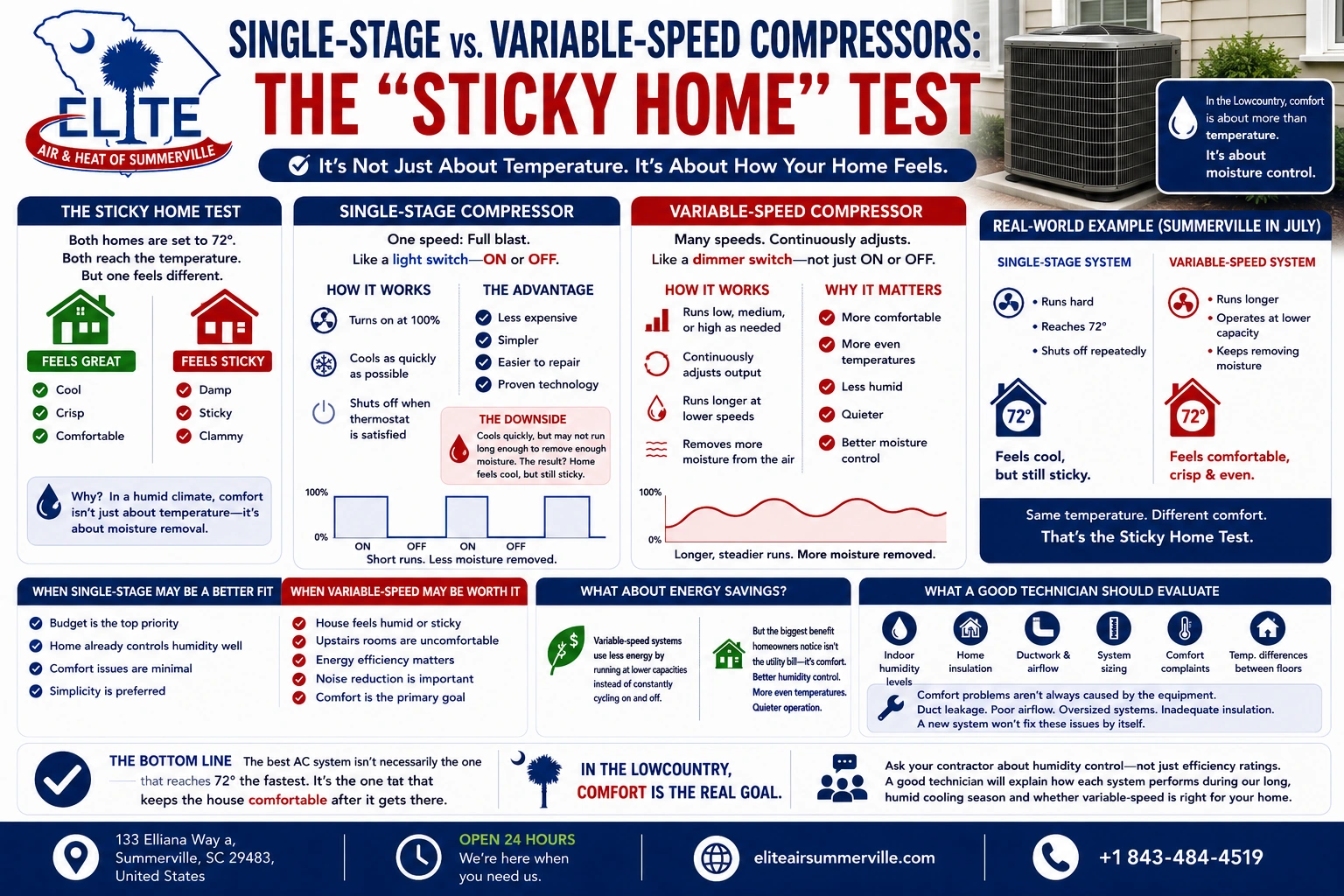
Single-Stage vs. Variable-Speed Compressors: The “Sticky Home” Test
If your thermostat says 72 degrees, but your house still feels sticky, damp, or uncomfortable, you're asking the wrong question.…
What I would not recommend for most Summerville homes
Basic single-stage AC if humidity is already a problem
A basic system can still be the right budget choice. But if your home already feels humid, sticky, or uneven, a basic single-stage system may repeat the same problem.
Oversized equipment
Bigger is not better in the Lowcountry. Oversized systems can cool the house quickly but fail to dehumidify well.
Brand-only buying
Carrier, Trane, Lennox, Daikin, Rheem, American Standard, Bosch, Mitsubishi, and others can all be good in the right application. The installation matters more than the badge.
A great system installed poorly can perform badly. A mid-range system installed correctly can be the better value.
What about tax credits in 2026?
Be careful here. A lot of old HVAC articles still talk about federal energy-efficiency tax credits as if they are automatically available.
The IRS states the Energy Efficient Home Improvement Credit applied to qualified improvements made through December 31, 2025. ENERGY STAR’s heat pump tax credit page also lists the same January 1, 2023 through December 31, 2025 window. Do not assume a 2026 installation qualifies without checking current tax guidance, utility rebates, or local programs.
My practical top 5 ranking for Summerville in 2026
| Rank | System type | Best fit |
| 1 | Variable-speed heat pump | Best overall comfort and humidity control |
| 2 | Two-stage heat pump | Best value for many homes |
| 3 | Inverter heat pump plus humidity strategy | Best for tight, newer homes |
| 4 | Ductless mini-split heat pump | Best for additions, cottages, and problem rooms |
| 5 | Dual-fuel heat pump/gas furnace | Best when gas backup truly makes sense |
What a good HVAC estimate should include
Before you approve a 2026 system, ask for more than the model number.
A good technician should explain:
- What refrigerant the new system uses
- Whether it is single-stage, two-stage, or variable-speed
- Why that size was chosen
- Whether the ductwork can handle it
- How the system will control humidity
- Whether the indoor and outdoor equipment are properly matched
- What warranty applies
- Whether drain safety, float switches, and code items are included
- What startup readings will be checked after installation
If you only remember one thing, remember this: the best HVAC system for Summerville is not the biggest system or the most expensive system. It is the one that is sized, installed, and set up to handle heat and humidity together.
Stay Cool All Year With the Right HVAC System
Discover the most reliable and energy-efficient HVAC systems for Summerville homes in 2026 before making your next upgrade decision.