
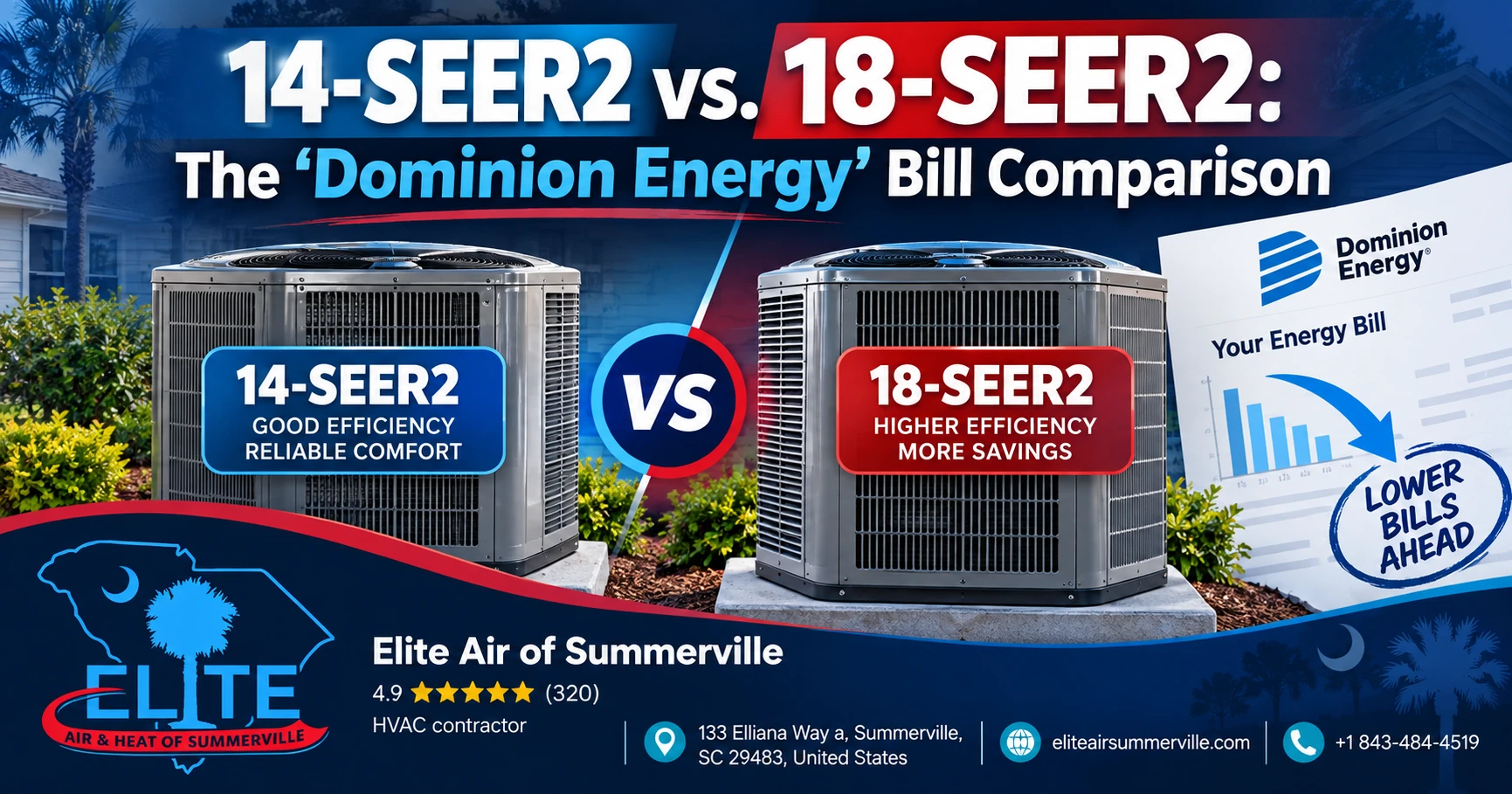

When homeowners in Summerville compare HVAC replacements, one of the easiest upgrades to sell is efficiency.
The basic pitch sounds reasonable:
“This one is 18 SEER2. That one is 14 SEER2. Spend more now and you’ll save it on your Dominion Energy bill.”
Sometimes that higher-efficiency system is absolutely worth it.
Sometimes the utility savings are not large enough to justify the price difference by themselves.
Here’s the plain answer.
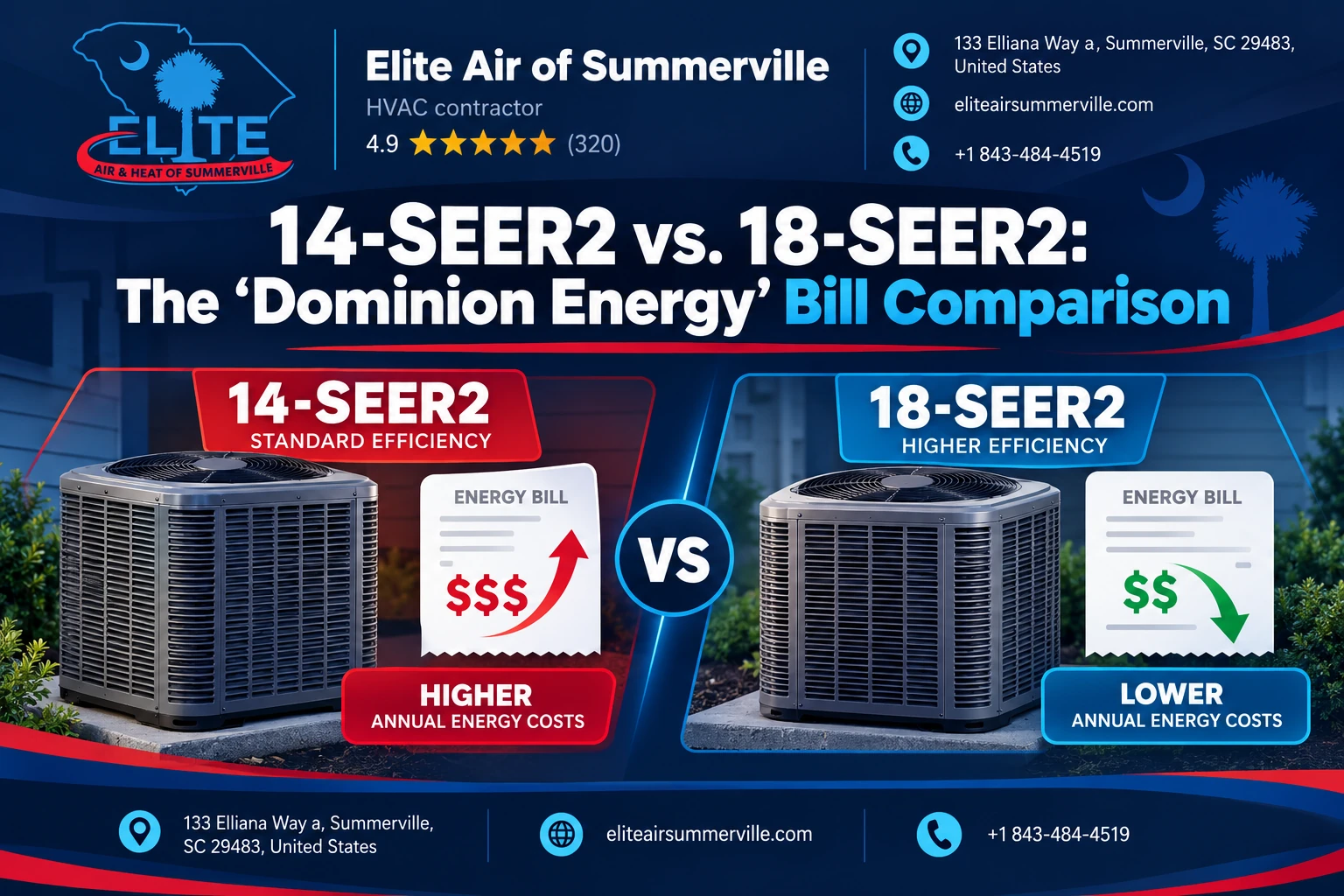
For the same amount of cooling, an 18-SEER2 system theoretically uses about 22% less cooling electricity than a 14-SEER2 system. But that does not mean your total Dominion Energy bill will fall 22%.
Your AC is only one part of that bill.
The right question is not simply, “Which SEER2 number is better?”
It is:
“How much extra am I paying for 18 SEER2, and how much can it realistically save in my house?”
Stop Overpaying for Cooling!
An energy-efficient AC system could help reduce your monthly bills. Call now to explore your upgrade options!
How Much More Efficient Is 18 SEER2 Than 14 SEER2?
SEER2 is a seasonal cooling-efficiency rating.
Higher is better, but there is an important math detail.
Going from 14 to 18 does not mean electricity consumption drops by 28.6% simply because 18 is 28.6% higher than 14.
For the same cooling output:
14 ÷ 18 = 0.778
So, theoretically, the 18-SEER2 system would need about 77.8% of the cooling electricity used by the 14-SEER2 system.
That works out to approximately:
22.2% less cooling electricity.
That is the useful comparison.
Real-world results can be different because weather, duct leakage, thermostat settings, sizing, maintenance, equipment staging, and installation quality all affect actual consumption.
What Is Dominion Energy Charging Summerville Homes Right Now?
As of September 2026, Dominion Energy South Carolina’s standard residential Rate 8 has these summer charges for May through September:
| Charge | Current summer Rate 8 |
| Basic facilities charge | $0.36164 per day |
| First 800 kWh | $0.15878/kWh |
| Usage above 800 kWh | $0.17442/kWh |
| Distributed Energy Resource charge | $1/month |
The current tariff took effect for bills rendered beginning with the first billing cycle of July 2026. Taxes, franchise fees, and certain other local charges can be added afterward.
That gives us something much more useful than a generic national savings estimate.
We can actually run the numbers.
What Would 14 vs. 18 SEER2 Save During a Hot Month?
Suppose a Summerville home’s AC would use 800 kWh in a hot summer month with a 14-SEER2 system.
An 18-SEER2 system providing the same amount of theoretical cooling would use:
800 × 14 ÷ 18 = about 622 kWh
Difference:
About 178 kWh saved.
If those saved kilowatt-hours would otherwise fall into Dominion’s current summer usage tier above 800 kWh, they are worth about 17.442 cents each.
That produces a savings of approximately:
178 × $0.17442 = $31
So an 18-SEER2 system might save around $31 for that particular high-use month.
Not $100.
Not 22% of the entire bill.
About $31 under those assumptions.
Here’s What That Could Look Like on the Full Dominion Bill
Let’s make the example more realistic.
Suppose the home consumes 800 kWh per month before cooling.
That includes the refrigerator, water heating, lights, appliances, electronics, and everything else.
With the 14-SEER2 system
Base household load: 800 kWh
Cooling load: 800 kWh
Total: 1,600 kWh
Using Dominion’s current summer Rate 8:
- First 800 kWh: about $127.02
- Next 800 kWh: about $139.54
- 30-day basic facilities charge: about $10.85
- DER charge: $1
Estimated total:
About $278.41 before applicable taxes and local fees.
With the 18-SEER2 system
Base household load: 800 kWh
Cooling load: about 622 kWh
Total: about 1,422 kWh
Estimated total under the same tariff:
About $247.40 before applicable taxes and local fees.
Estimated difference
About $31 for the month.
The cooling portion became roughly 22% more efficient.
But the entire hypothetical utility bill dropped only about 11%.
That is why whole-bill promises can be misleading.
What If Your AC Uses More or Less Electricity?
For a home already using more than 800 total kWh during the month, here’s a useful illustration at Dominion’s current summer marginal rate:
| Monthly cooling use at 14 SEER2 | Approx. use at 18 SEER2 | kWh saved | Approx. monthly savings* |
| 500 kWh | 389 kWh | 111 kWh | $19 |
| 800 kWh | 622 kWh | 178 kWh | $31 |
| 1,200 kWh | 933 kWh | 267 kWh | $47 |
*Illustrative calculation using $0.17442/kWh. Actual billing depends on the household’s total usage, rate plan, weather, fees, and other factors.
This is where the homeowner’s actual utility history becomes valuable.
Someone with a $500 summer electric bill has more potential savings available than someone whose bill rarely exceeds $180.
Why Doesn’t 18 SEER2 Cut the Whole Bill by 22%?
Because the new HVAC system does not make everything else in the house 22% more efficient.
Your electric bill may include:
- Water heating
- Refrigerator and freezer
- Clothes dryer
- Cooking
- Lighting
- Pool equipment
- Well pumps
- Computers and televisions
- Garage appliances
- EV charging
Dominion’s basic facilities charge also remains regardless of which AC you buy.
That is why a contractor should be careful saying:
“This system will save you 22% on your power bill.”
A better statement is:
“Under comparable conditions, it could use roughly 22% less electricity for cooling than the 14-SEER2 option.”
Those are not the same promise.
What Could the Annual Payback Look Like?
Now we get to the decision that matters.
Suppose the 18-SEER2 system costs $2,500 more than the lower-efficiency option.
And suppose, after looking at realistic cooling usage, you estimate the higher-efficiency system saves about $225 per year.
Simple payback:
$2,500 ÷ $225 = about 11 years
If the upgrade costs $4,000 and saves $175 per year:
About 23 years.
If it costs only $1,500 more and saves $300 per year:
About 5 years.
That is why there is no universal answer.
The cheaper option is not always wrong, and the expensive option is not automatically a better investment.
A Simple Payback Example
| Additional cost for 18 SEER2 | Estimated annual savings | Simple payback |
| $1,500 | $250 | 6 years |
| $2,000 | $250 | 8 years |
| $2,500 | $200 | 12.5 years |
| $3,500 | $200 | 17.5 years |
Those are examples, not quoted installation prices or guaranteed savings.
A good estimate should give you enough information to do this calculation with your actual upgrade price.
When 18 SEER2 Can Make More Sense in Summerville
Utility savings are only one reason homeowners choose higher-efficiency equipment.
In the Lowcountry, comfort can be just as important.
Many 18-SEER2 systems use technologies such as two-stage or variable-capacity operation.
Instead of operating at full output every time the thermostat calls, the equipment may be able to run at lower capacity for longer periods.
When correctly sized and configured, that can have some useful benefits.

Why Does My House Get Hot at Night? Causes and Smart Solutions
You check the weather app at 9:30 p.m. and it says 72 degrees outside. A breeze is moving through the…
Better humidity control
Longer cooling cycles can give the evaporator coil more time to remove moisture from indoor air.
That matters in Summerville.
A house can be 74°F and still feel uncomfortable if indoor humidity is high.
In a humid climate, comfort is not just about temperature.
More even temperatures
Modulating equipment can sometimes hold temperatures steadier instead of repeatedly cycling between full output and off.
Quieter operation
Running at lower capacity can mean less compressor and airflow noise much of the time.
These benefits may make an 18-SEER2 system worthwhile even if the electric-bill payback alone looks slow.
But 18 SEER2 Does Not Guarantee Better Humidity
This is where homeowners sometimes get into trouble.
You can buy premium equipment and still have humidity problems if the system is:
- Oversized
- Incorrectly configured
- Moving too much airflow
- Connected to leaking ductwork
- Short cycling
- Paired incorrectly
- Trying to condition a house with a major moisture-infiltration problem
We would rather see a properly sized, correctly installed lower-SEER2 system than an oversized 18-SEER2 system chosen simply because the efficiency number looked better.
The equipment still has to match the house.
Don’t Ignore the Ductwork
Imagine spending several thousand dollars to improve equipment efficiency while the supply ducts are leaking cooled air into a 130°F attic.
That is not a very good investment.
Before paying a significant premium for higher SEER2, a technician should pay attention to:
- Duct leakage
- Duct insulation
- Static pressure
- Return-air sizing
- Supply airflow
- Attic conditions
- Equipment sizing
The goal is not to install the most efficient machine in the neighborhood.
The goal is to make the whole system operate efficiently.
Heat Pump Owners Need to Look Beyond SEER2
This is especially important around Summerville because heat pumps are common.
SEER2 measures cooling efficiency.
It does not tell you the complete story about heating efficiency.
For a heat pump, you should also look at HSPF2, heating performance, auxiliary heat controls, and how the equipment performs at different outdoor temperatures.
Two systems could both be advertised as 18 SEER2 but have different heating characteristics.
If you’re comparing year-round Dominion Energy costs, the heating side matters too.
Could the 18-SEER2 System Qualify for a Dominion Rebate?
Potentially—and this can change the payback calculation.
Dominion Energy South Carolina currently offers $400 to $500 rebates on qualifying ENERGY STAR/AHRI-rated replacement central air conditioners and heat pumps. Its published program says 15.2 SEER2 is the minimum efficiency level for the program, and the current rebate application lists $400 and $500 tiers depending on the certified equipment rating. Equipment must meet eligibility requirements and be installed by a licensed mechanical contractor.
That means a base-efficiency system may not qualify while an 18-SEER2 matched system may.
But do not assume the outdoor unit’s advertised SEER2 automatically guarantees the rebate.
Ask for the AHRI number for the complete matched system.
Dominion says the application must generally be submitted with the detailed installation invoice within 90 days.
Why the AHRI Rating Matters
The efficiency number on the outdoor-unit brochure is not necessarily the exact efficiency of every possible system combination.
The condenser, evaporator coil or air handler, blower, and other components are tested as matched combinations.
A good replacement proposal should identify the actual certified combination being installed.
Ask for:
“What is the AHRI-rated SEER2 of the complete system you’re quoting me?”
That is a better question than:
“What SEER is the condenser?”
A good technician should be able to show you why.
When We’d Lean Toward the Lower-Efficiency Option
A 14-ish-SEER2 system can make good financial sense when:
- The upgrade to 18 SEER2 is expensive
- Your cooling bills are fairly modest
- You expect to move within a few years
- You prioritize lower upfront cost
- The higher-tier system adds features you do not value
- The home needs ductwork or insulation improvements first
There is nothing inherently wrong with buying closer to minimum efficiency.
Sometimes putting $3,000 into duct corrections produces a better comfort result than putting the same $3,000 into a higher SEER2 number.
When We’d Lean Toward 18 SEER2
Higher efficiency becomes easier to justify when:
- Your summer usage is consistently high
- You expect to stay in the home for many years
- The upgrade price is reasonable
- A rebate reduces that price difference
- Humidity control is important
- Variable-capacity operation is included
- Quieter operation matters to you
- The ductwork and house are already in good condition
In those cases, you are not simply buying an efficiency rating.
You may be buying a different level of comfort and system operation.
What Should You Ask Before Approving the Upgrade?
If someone wants you to spend thousands more on 18-SEER2 equipment, ask them to walk through four numbers:
- What is the actual price difference?
- What is the AHRI-certified efficiency of each option?
- Based on my utility use, what is a realistic annual savings range?
- What do I get besides efficiency—staging, humidity control, noise reduction, warranty, or other features?
If those answers make sense, the upgrade may be worth it.
If the sales pitch is simply:
“Your bill will be 20% lower,”
there is more explaining to do.
The Bottom Line: Is 18 SEER2 Worth It on a Dominion Energy Bill?
An 18-SEER2 system is meaningfully more efficient than a 14-SEER2 system, but the difference on the whole Dominion Energy bill is usually smaller than the headline percentage suggests.
For equal cooling output, the theoretical cooling-energy reduction is about 22%.
Using Dominion Energy South Carolina’s current summer Rate 8, saving 178 kWh in a high-use month is worth roughly $31 at the current rate above 800 kWh.
That can add up over many Summerville cooling seasons.
But it may or may not repay a large installation premium quickly.
If you only remember one thing, remember this:
Don’t buy 18 SEER2 because someone says it will slash your Dominion bill. Buy it when the energy savings, comfort improvements, rebate, equipment features, and upgrade cost make sense together.
If you are comparing replacement quotes, Elite Air & Heat of Summerville can help you look at the actual system matches, your home’s cooling demands, ductwork, humidity concerns, and the price difference between options before you approve the upgrade.
Want to Lower Your Dominion Energy Bill?
Compare 14-SEER2 and 18-SEER2 AC systems to find the right balance of comfort and energy savings. Call today!