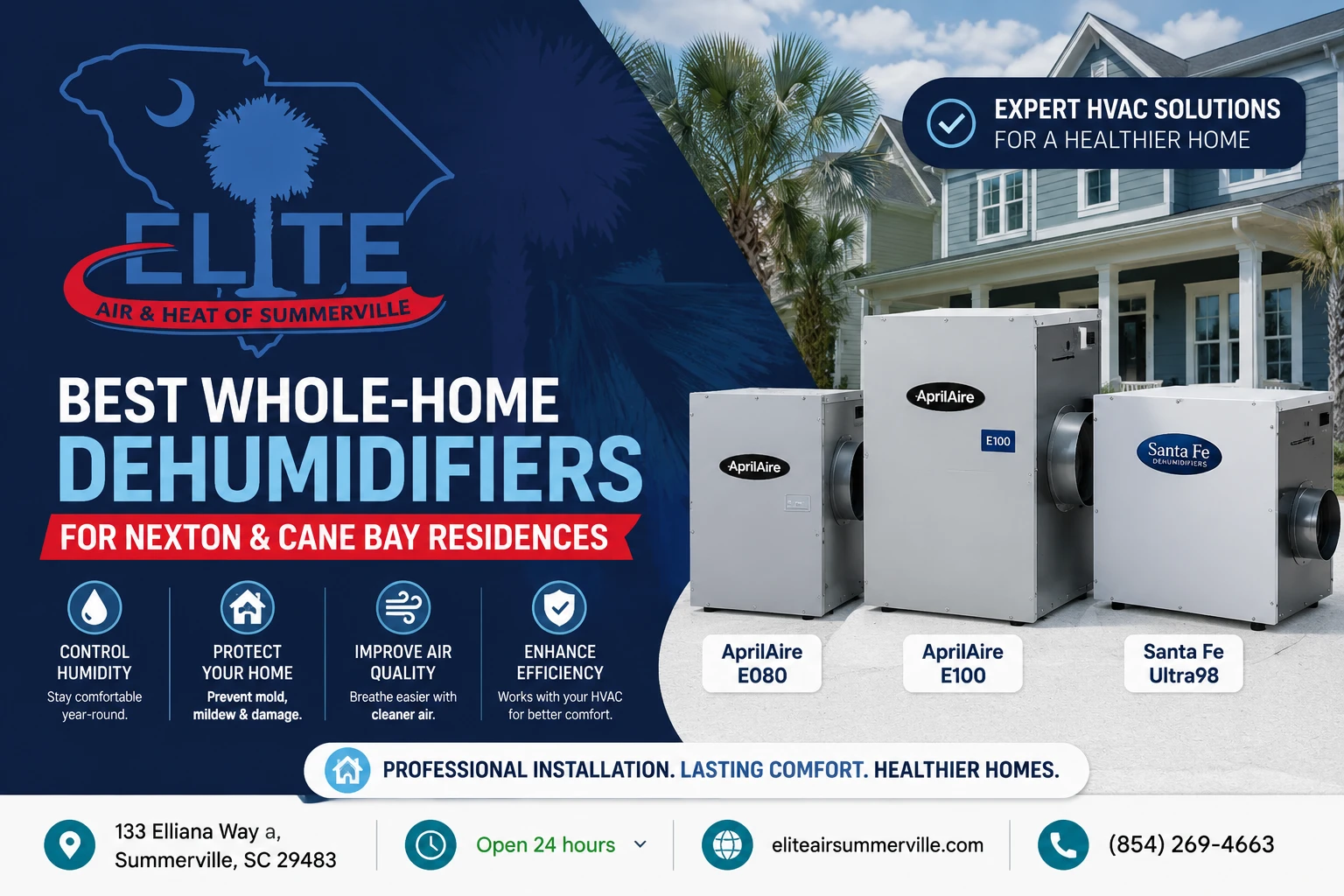

Here’s the plain answer: for many newer Nexton and Cane Bay homes, the best whole-home dehumidifier is usually an 80- to 100-pint ducted unit installed with the HVAC system, not a portable unit sitting in a hallway.
That said, the “best” unit depends on the house. A tight 1,900-square-foot home with short AC runtimes does not always need the same dehumidifier as a larger two-story home with ventilation, attic ductwork, and humidity problems upstairs.
- AprilAire E100 Whole-House Dehumidifier
Price not available•Whole-house dehumidifier for optimal moisture control.
- Santa Fe Ultra98 Whole-Home Dehumidifier
Price not available•Ideal for strong indoor air quality in large spaces.
- AprilAire E100 Dehumidifier
Price not available•Suitable for large homes needing effective humidity management.
- AprilAire E100 Specification Sheet
Price not available•Reference sheet for AprilAire E100 specifications.
Need better humidity control at home?
Get expert whole-home dehumidifier solutions for Nexton & Cane Bay residences. Call now for cleaner, drier indoor comfort.
The short list
| Best fit | Whole-home dehumidifier type |
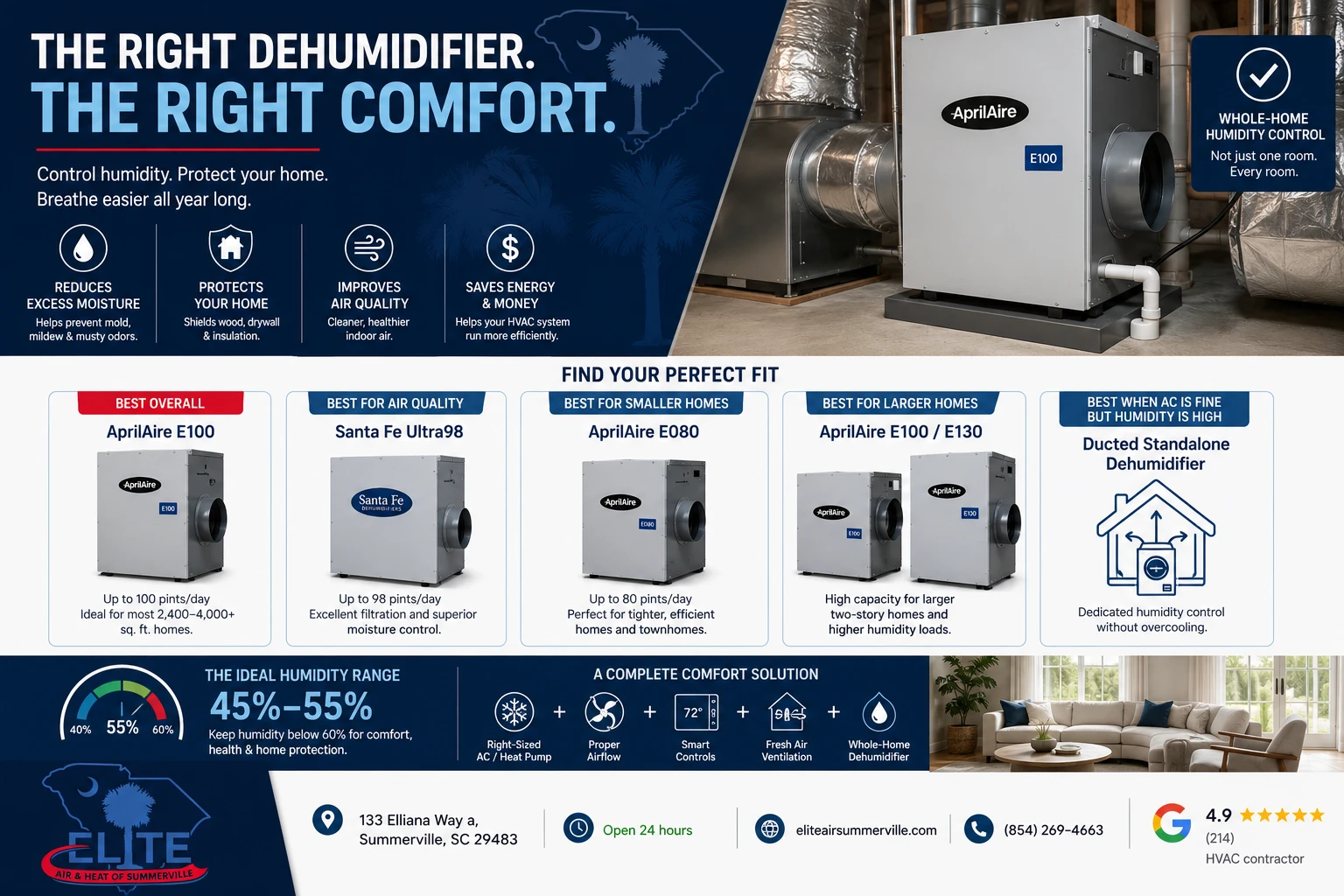
| Best overall for many newer homes | AprilAire E100 |
| Best for air quality and serious humidity | Santa Fe Ultra98 |
| Best for smaller/tighter homes | AprilAire E080 or Santa Fe Ultra70 |
| Best for larger homes | AprilAire E100 / E130 range |
| Best when the AC is fine but humidity is high | Ducted standalone whole-home dehumidifier |
1. Best overall: AprilAire E100
Best for: many 2,400–4,000+ sq. ft. newer Lowcountry homes, depending on layout and humidity load.
The AprilAire E100 is a strong “middle-heavy” option because it removes up to 100 pints per day and is commonly used as a ducted whole-home dehumidifier. It is often a good match when a newer home is efficient enough that the AC does not run long enough to dry the air. AprilAire lists the E080 as an 80-pint professional-grade whole-house unit, and the E100 is the next common step up for larger or wetter homes.
Why it fits Nexton and Cane Bay homes:
- Good capacity for larger modern homes
- Can be tied into ductwork
- Helps control humidity without overcooling
- Works well when the AC satisfies temperature too quickly
- Cleaner solution than portable room dehumidifiers
Possible downside: it still needs proper duct design. If it is just “stuck into the system” without thinking through airflow, return air, supply location, and controls, it may not perform the way homeowners expect.
2. Best for air quality and heavy humidity: Santa Fe Ultra98
Best for: homes with persistent humidity, musty odors, sealed crawlspace concerns, or homeowners who care about filtration and moisture control.
Santa Fe’s Ultra line is well-known in the building science and moisture-control world. The Santa Fe Ultra70 removes up to 70 pints per day, is designed for tight installation spaces, and includes MERV-13 filtration; the Ultra98 is the larger step-up option often compared with the AprilAire E100 for whole-home humidity control.
Why it fits:
- Strong choice for humidity-heavy homes
- Good filtration focus
- Useful where moisture control is more than a comfort issue
- Often a good fit for sealed crawlspace or dedicated ducted applications
Possible downside: Santa Fe systems can cost more depending on model and installation design. The higher price may be justified, but the contractor should be able to explain why.
3. Best for smaller or tighter homes: AprilAire E080 or Santa Fe Ultra70
Best for: smaller Nexton or Cane Bay homes, townhomes, efficient single-story homes, or homes where humidity is moderate but persistent.
Not every home needs a 100+ pint unit.
The AprilAire E080 removes up to 80 pints per day, and Santa Fe’s Ultra70 removes up to 70 pints per day. Santa Fe describes the Ultra70 as a compact whole-house ventilating dehumidifier for tight, low-clearance applications.
These can make sense when:
- The home is not huge
- Humidity is usually in the high 50s or low 60s
- The AC works well otherwise
- You need moisture control, not a massive drying system
- Installation space is tight
The risk is undersizing. If a home has a high moisture load from ventilation, duct leakage, crawlspace issues, or frequent door openings, a smaller unit may run too often and still struggle.
4. Best for larger homes: AprilAire E100 or E130 class
Best for: larger two-story homes, homes with open floor plans, multiple zones, high ceilings, or recurring humidity above 60%.
Larger homes often need more moisture removal, but size alone is not the whole story. A 3,500-square-foot home with good ducts and low infiltration may need less dehumidification than a smaller home with duct leaks pulling attic air.
A larger AprilAire unit can make sense when the moisture load is confirmed and the duct design supports it. AprilAire’s product line includes higher-capacity whole-home units, and retail listings for the E080 describe whole-house/basement/crawlspace applications with humidity targets in the 40%–60% range.
5. Best “system” for newer sealed homes: AC plus dedicated dehumidifier plus ventilation check
For Nexton and Cane Bay residences, the best answer is often not just a brand.
It is the combination of:
- Properly sized AC or heat pump
- Correct blower speed
- Thermostat set up for humidity control
- Duct leakage check
- Fresh-air ventilation review
- Whole-home dehumidifier
- Drain safety and float switch protection
Newer homes are tighter, which is good for efficiency. But tight homes can hold moisture if the HVAC system cools faster than it dries. In that case, a whole-home dehumidifier can maintain comfort without forcing you to set the thermostat to 68 just to feel dry.

What Size HVAC System Do You Need for Your Home?
Bigger doesn’t always mean better, especially when it comes to your HVAC system. Choosing the right size can make a…
What humidity level should you aim for?
For most homes, a practical target is around 45%–55% relative humidity.
Once indoor humidity regularly stays above 60%, the home can start feeling sticky, and moisture-related problems become more likely. ASHRAE materials commonly use 60% relative humidity as an important upper boundary when discussing indoor dampness and mold prevention.
A good homeowner test is simple: put a few inexpensive hygrometers around the house for a week.
Check:
- Upstairs bedrooms
- Main living area
- Owner’s suite
- Near the thermostat
- Any room that feels sticky
- Any room with musty odor
Do not rely only on the thermostat reading.
When a whole-home dehumidifier makes sense
It is worth considering when:
- Indoor humidity stays above 55%–60%
- The house feels sticky at normal temperatures
- The AC runs short cycles
- You have musty smells
- Vents sweat
- The home feels cold but damp
- Humidity is worse during mild, rainy weather
- You have a sealed crawlspace or spray foam attic
- The home has mechanical fresh-air ventilation
This is common in efficient newer homes. The AC may be doing its cooling job, but the home still needs a separate moisture-control strategy.
When a dehumidifier may not be the right first fix
This is where homeowners sometimes get into trouble.
A whole-home dehumidifier should not be used to cover up:
- Oversized AC equipment
- Leaky return ducts
- Poor ventilation setup
- Bad blower speed settings
- Clogged drain lines
- Wet crawlspace problems
- Missing bath fan use
- Construction moisture in a very new home
A good technician should check the cause first. Otherwise, you may spend money on a dehumidifier when the real problem is humid attic air being pulled into the duct system.
What installation should include
A proper whole-home dehumidifier install should cover:
- Correct unit sizing
- Return and supply duct strategy
- Dedicated drain line or condensate pump
- Float safety protection
- Humidistat or thermostat integration
- Service access
- Filter access
- Noise and vibration control
- Airflow verification
- Setup so it does not fight the AC system
The drain matters. In Summerville humidity, these systems can remove a lot of water. That water needs to leave the house safely every day.
My practical recommendation
For many Nexton and Cane Bay homes, I would start the conversation here:
Best overall: AprilAire E100
Best premium moisture/IAQ choice: Santa Fe Ultra98
Best smaller-home option: AprilAire E080 or Santa Fe Ultra70
Best large-home direction: AprilAire E100/E130 class, confirmed by moisture load
Best first step: measure humidity for a week before buying anything
If you only remember one thing, remember this: a whole-home dehumidifier should solve a measured humidity problem, not just a comfort complaint.
If your home is staying above 60% humidity, feels sticky, or smells musty even when the AC is cooling, the next step is a full humidity diagnosis before guessing at equipment.
Too much moisture in your home?
Protect your comfort and air quality with professional whole-home dehumidifier installation. Schedule service today.