
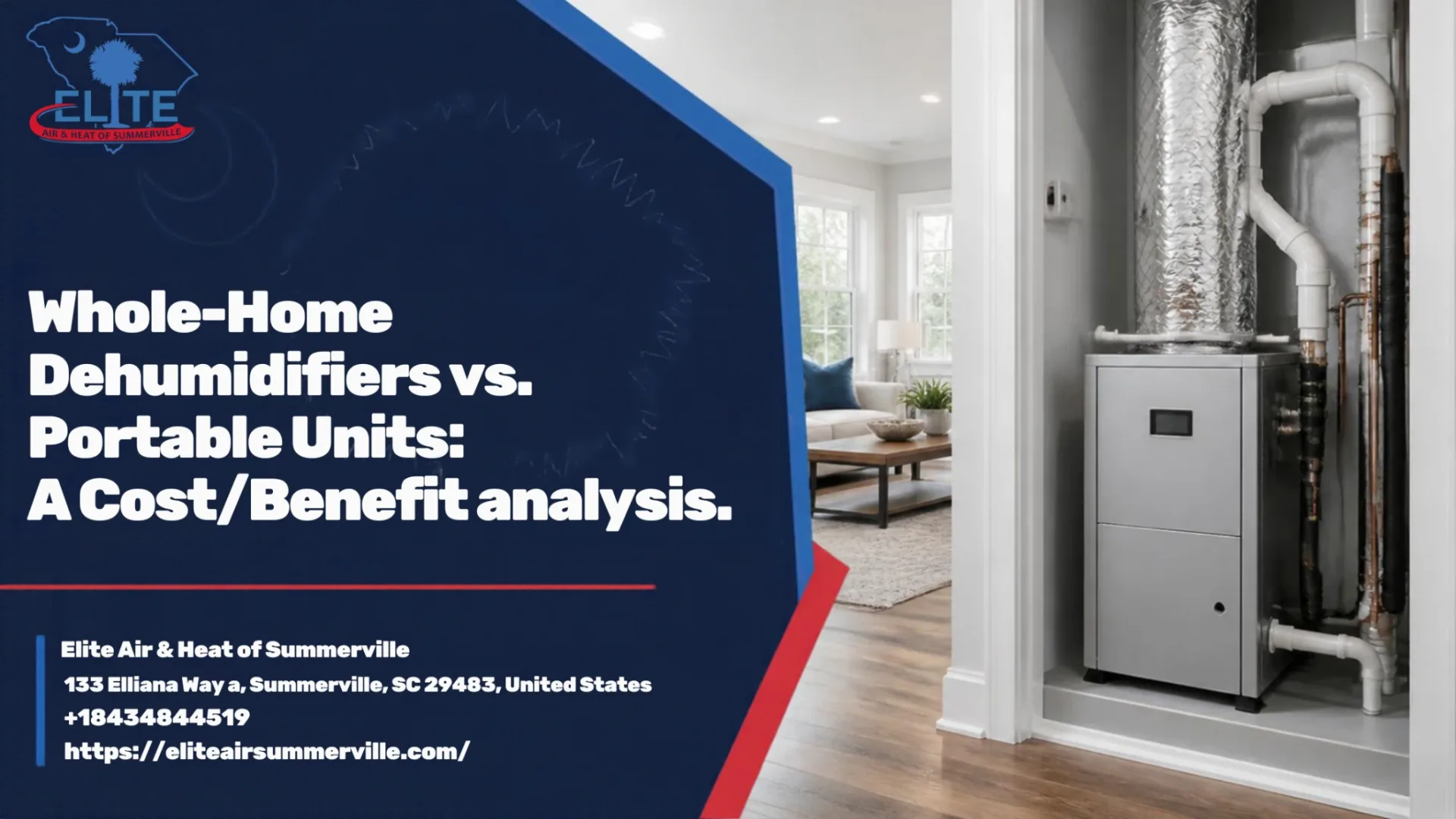

Whole-home dehumidifiers generally cost more upfront than portable units, but they may offer better long-term value when humidity affects several rooms throughout a house. Portable dehumidifiers are more affordable and practical for isolated moisture problems, while whole-home systems provide centralized humidity control with less daily involvement. The right investment depends on your home’s size, moisture levels, energy use, and maintenance requirements. At Elite Air & Heat, LLC in Summerville, SC, we help homeowners understand their humidity problems and evaluate solutions that improve comfort without creating unnecessary expenses.
Tired of High Indoor Humidity?
Keep your home comfortable with a whole-home dehumidifier. Call now for expert installation and pricing!
Whole-Home vs. Portable Dehumidifiers: Which Is Better?
A whole-home dehumidifier is generally the better option when excess moisture affects multiple rooms and requires consistent control. A portable dehumidifier may be sufficient when humidity is concentrated in one bedroom, basement, or other enclosed space.
The difference comes down to coverage, convenience, installation requirements, and long-term operating costs.
Both systems remove moisture from indoor air by drawing humid air across a cold surface. Water condenses, collects, and drains away while drier air returns to the space.
However, they distribute that air differently.
Here is a comparison of whole-home and portable dehumidifiers:
| Feature | Whole-Home Dehumidifier | Portable Dehumidifier |
| Typical upfront cost | 1,300–2,800 installed | 150–550 per unit |
| Coverage | Multiple rooms or entire home | Usually one room or area |
| Installation | Usually requires professional installation | Usually plug-and-play |
| Drainage | Typically permanent drain connection | Removable tank or drainage hose |
| Noise | Often located away from living spaces | Operates inside the room |
| Maintenance | Periodic professional and homeowner maintenance | Frequent tank and filter attention |
| Humidity control | Centralized, depending on system design | Individual controls for each unit |
| Portability | Permanently installed | Can be moved between rooms |
| Best use | Widespread or recurring humidity | Localized or occasional humidity |
These are approximate national market costs, not fixed quotes from Elite Air & Heat. Larger homes, additional ductwork, electrical work, and specialized equipment can increase installation expenses.
Before choosing either system, homeowners should determine how much moisture is present and where it originates.
How Does a Whole-Home Dehumidifier Work?
A whole-home dehumidifier removes moisture from air serving multiple rooms, typically through dedicated ductwork or connections to the existing HVAC distribution system.
Unlike portable equipment, it is generally installed in a mechanical space, attic, or another suitable location.
The system uses a humidistat to monitor moisture levels and activate dehumidification when necessary.
Centralized Humidity Control
A properly designed whole-home system can maintain more consistent humidity levels across the areas it serves.
Instead of operating individual units in several rooms, homeowners can manage moisture through one central control system.
Some systems can operate independently of an air conditioner’s cooling cycle, although their performance depends on the installation design.
This is especially useful during humid weather when indoor temperatures are already comfortable but moisture remains excessive.
Continuous Water Removal
Whole-home dehumidifiers typically discharge collected water through a permanent condensate drain.
Depending on the location, a condensate pump may be necessary.
This eliminates the need to empty individual water buckets every day.
However, the drainage system still requires inspection and maintenance to prevent blockages or water leaks.
Does It Replace Your Air Conditioner?
No. A dehumidifier controls moisture but does not replace equipment designed to cool the home.
Both types of dehumidifiers also release heat during operation. A whole-home installation must account for where that heat enters the building.
A properly designed system can complement your air conditioner by addressing humidity independently when appropriate.
How Does a Portable Dehumidifier Work?
A portable dehumidifier operates within the room where it is placed.
It draws moisture from the surrounding air and collects condensed water in a removable reservoir or sends it through an optional drainage hose.
Portable units are widely available in different sizes and capacities.
Why Homeowners Choose Portable Units
The main advantage is affordability.
A homeowner can purchase a portable unit without making major changes to the home’s existing HVAC system.
Other benefits include:
- Lower initial purchase cost
- No permanent ductwork modifications
- Flexible placement between rooms
- Independent humidity settings
- Straightforward cleaning and basic maintenance
- Suitability for occasional moisture problems
Portable units can be particularly effective in enclosed areas where the humidity problem is limited.
What Are the Limitations?
A portable unit primarily controls moisture in the space where it operates.
Air movement between rooms may spread some of its effect, but a single unit generally cannot provide uniform humidity control throughout a large house.
Other limitations include operating noise, floor space requirements, and regular reservoir emptying.
A unit may also stop removing moisture once its collection tank is full.
Models with continuous drainage can reduce this inconvenience, provided an appropriate drain is available.
How Much Does a Whole-Home Dehumidifier Cost?
Whole-home dehumidifier installation commonly costs approximately $1,300 to $2,800, based on published 2026 national estimates.
More complex systems can cost $4,500 or more when extensive duct modifications, electrical upgrades, or high-capacity equipment are required.
The final price depends on the equipment and installation conditions.
Factors That Affect Installation Cost
System capacity: Larger homes or properties with substantial moisture loads may require higher-capacity equipment.
Ductwork configuration: Existing HVAC ducts may need modifications, or dedicated duct connections may be necessary.
Electrical requirements: Some installations require additional wiring or electrical work.
Drainage: A gravity drain may be straightforward, while a condensate pump or additional piping adds expense.
Controls: Advanced humidistats and integrated HVAC controls may influence pricing.
Installation access: Limited attic or mechanical-room access can increase labor requirements.
A professional assessment should determine whether the selected equipment can effectively serve the intended areas.
How Much Does a Portable Dehumidifier Cost?
Portable dehumidifiers generally range from about $150 to $550, depending on capacity, efficiency, drainage features, and other functions.
Smaller models may cost less, while specialized or larger-capacity units can cost more.
Although the initial investment is substantially lower, purchasing multiple units increases the total.
For example, three portable dehumidifiers costing $250 each would require a $750 initial investment.
That amount does not include electricity, maintenance, or future replacement.
The more rooms that require treatment, the more important it becomes to compare the full cost of both options.
Which Type of Dehumidifier Uses Less Electricity?
Neither system is automatically more energy-efficient in every situation.
Electricity consumption depends on equipment efficiency, moisture-removal capacity, runtime, indoor conditions, and the number of units operating.
A single portable dehumidifier may consume less electricity than a large whole-home system simply because it treats a smaller area.
However, several portable units operating throughout the house may use more energy than one appropriately sized centralized system.
Understanding Dehumidifier Energy Ratings
ENERGY STAR evaluates dehumidifier efficiency using the Integrated Energy Factor, or IEF.
This measures how many liters of moisture a unit removes per kilowatt-hour of electricity.
A higher rating generally indicates that the dehumidifier removes more water for a given amount of energy.
ENERGY STAR reports that certified dehumidifiers use approximately 20% less energy than comparable conventional models.
However, portable and whole-home equipment have different testing categories and operating conditions, so comparing their published ratings requires care.
Calculating Operating Costs
Homeowners can estimate electricity expenses using three basic figures:
- Equipment power consumption in kilowatts
- Average operating hours
- Electricity rate per kilowatt-hour
For example, a 500-watt portable dehumidifier running six hours daily consumes approximately 90 kilowatt-hours over 30 days.
At an assumed electricity rate of $0.16 per kilowatt-hour, that equals approximately $14.40 for the month.
This is only an illustration.
Actual consumption depends on how frequently the compressor operates and how much moisture the equipment must remove.
The most useful cost comparison evaluates similar amounts of moisture removal across the same area rather than comparing equipment wattage alone.
Which Option Has Lower Long-Term Maintenance Costs?
Portable dehumidifiers may have lower individual repair costs, but several units require more frequent attention.
Whole-home systems reduce some daily maintenance tasks while introducing periodic professional service requirements.
Portable Dehumidifier Maintenance
Routine maintenance usually includes:
- Emptying and cleaning the water reservoir
- Washing or replacing filters as instructed
- Cleaning accessible air intake surfaces
- Inspecting drainage hoses
- Checking for unusual noises or leaks
- Keeping air intake and discharge openings unobstructed
Standing water and poorly maintained reservoirs can contribute to unpleasant odors or microbial growth.
Homeowners should follow the manufacturer’s cleaning recommendations.
Whole-Home Dehumidifier Maintenance
A professionally installed system may require:
- Filter cleaning or replacement
- Condensate line inspection
- Drainage system cleaning
- Humidity control calibration or verification
- Checking electrical and mechanical components
- Inspecting duct connections
- Evaluating overall system operation
Although maintenance may be less frequent, repairs can involve more expensive components.
Long-term ownership costs also depend on system lifespan, warranty terms, replacement parts, and service accessibility.
Can a Dehumidifier Lower Your AC Bills?
A dehumidifier can improve comfort by reducing excess indoor moisture, but it does not automatically lower electricity bills.
This distinction matters because dehumidifiers consume electricity and release heat while operating.
Why Humidity Makes a Home Feel Warmer
High humidity reduces how effectively perspiration evaporates from the skin.
As a result, a room may feel uncomfortable even when the thermostat indicates a reasonable temperature.
Reducing humidity can improve perceived comfort without necessarily lowering the actual air temperature.
Some homeowners may then feel comfortable using a slightly higher thermostat setting.
Whether this reduces total electricity consumption depends on the added dehumidifier energy use, the AC system, and household behavior.

The Hidden Risk of A2L Refrigerants: Are the New AC Gases “Mildly Flammable”?
Here’s the plain answer: Yes. Many new HVAC refrigerants are classified as A2L, which means lower toxicity and lower flammability.…

When Additional Dehumidification Helps
A separate dehumidifier may be useful when the air conditioner reaches its temperature setting before adequately removing moisture.
This can happen during mild but humid weather or when cooling equipment is oversized.
In these situations, supplemental moisture control can address discomfort without relying entirely on additional cooling cycles.
However, dehumidification is not a substitute for correcting an incorrectly sized system, insufficient airflow, or moisture entering through building defects.
At Elite Air & Heat, we recommend understanding your existing cooling system’s performance before investing in additional equipment.
What Indoor Humidity Level Should You Maintain?
The U.S. Environmental Protection Agency recommends keeping indoor relative humidity below 60%, ideally between 30% and 50% when practical.
A target near 50% can be reasonable for many humid-climate homes, although seasonal conditions and building characteristics matter.
Maintaining indoor moisture within an appropriate range can reduce conditions that encourage mold and dust mites.
Signs Your Home Has Excessive Humidity
Common warning signs include:
- Condensation collecting on windows
- A persistent musty odor
- Rooms that feel clammy despite adequate cooling
- Visible moisture on certain walls or surfaces
- Repeated dampness in closets
- Humidity readings consistently above recommended levels
These symptoms may indicate a moisture problem, but a dehumidifier is not necessarily the complete solution.
For example, a plumbing leak may cause localized moisture even when indoor humidity is otherwise acceptable.
Measure Before Buying
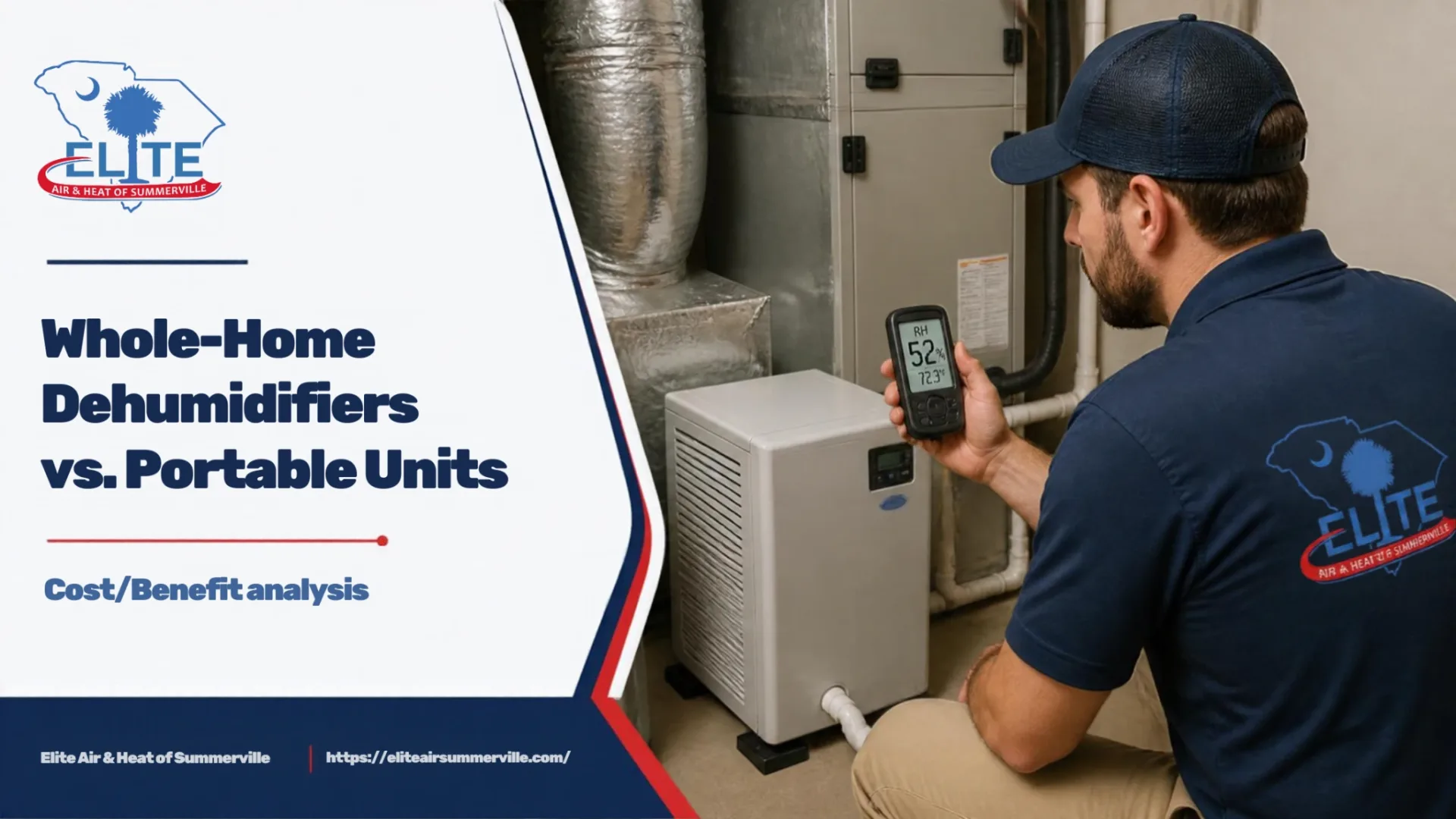
A digital hygrometer provides a practical way to monitor relative humidity.
Place one in an area where you frequently notice discomfort and take readings at different times.
If several rooms appear affected, measure each location rather than relying entirely on one reading.
Recurring high measurements provide a stronger reason to investigate whole-home moisture control than occasional discomfort alone.
Why Humidity Control Matters in Summerville, SC
Summerville and surrounding Lowcountry communities experience warm, humid conditions for much of the year.
Outdoor moisture can enter homes through air leaks, poorly sealed ducts, ventilation pathways, and normal household activity.
Even when an air conditioner maintains comfortable temperatures, indoor humidity may remain elevated.
Moisture Can Enter Through Attics and Crawlspaces
Many Lowcountry homes have ductwork located in attics or other spaces outside the conditioned living area.
Leaking return ducts can draw humid air into the HVAC system.
Unsealed penetrations and building-envelope leakage may also increase indoor moisture loads.
In these situations, improving duct sealing and building air sealing may reduce the amount of moisture a dehumidifier must remove.
Newer Homes Can Experience High Humidity Too
Older properties are not the only homes affected by moisture problems.
Newer, well-insulated houses may have relatively low cooling demand during mild weather.
If the air conditioner operates only briefly, it may not remove as much moisture as occupants would prefer.
However, high humidity in a new home should not automatically be blamed on short AC cycles.
Ventilation design, construction moisture, air leakage, and equipment setup may also contribute.
An inspection can help identify the contributing factors.
When Is a Portable Dehumidifier the Better Investment?
Portable equipment is often the most practical choice when the problem is limited, manageable, or temporary.
For example, a homeowner may notice excessive humidity in one spare bedroom while the rest of the house remains comfortable.
Purchasing a whole-home system for that isolated concern may not provide reasonable value.
A portable unit may be appropriate when:
- Humidity is concentrated in one enclosed room.
- You rent your home and cannot modify the HVAC system.
- You need temporary moisture control.
- Your budget does not support permanent installation.
- The equipment will only operate occasionally.
- You want to monitor whether localized moisture removal improves comfort.
Portable dehumidifiers also offer flexibility when household needs change.
However, if the same moisture problem repeatedly affects multiple rooms, it may be time to consider a more comprehensive solution.
When Is a Whole-Home Dehumidifier Worth the Investment?
A whole-home dehumidifier may offer stronger value when indoor humidity is consistently elevated across the house.
This is especially relevant for homeowners who already operate several portable units or frequently struggle to maintain comfortable moisture levels.
Situations That Favor Whole-Home Equipment
Consider a whole-home system when:
- Multiple rooms regularly exceed recommended humidity levels.
- Your existing AC cannot adequately control humidity under certain conditions.
- You want centralized operation without managing several water tanks.
- Portable units create unwanted noise in occupied rooms.
- You plan to remain in your home long enough to benefit from permanent equipment.
- A professional evaluation confirms that centralized dehumidification is appropriate.
The main advantage is consistent coverage and convenience, not a guaranteed reduction in utility expenses.
What If You Already Own Multiple Portable Units?
Compare the combined operating cost, equipment age, and maintenance requirements before replacing them.
If two portable dehumidifiers are meeting your needs, a whole-home installation may not be financially justified.
However, if you need several units running continuously and humidity still remains elevated, centralized equipment may be worth evaluating.
A properly sized system should be selected according to the home’s actual moisture load and airflow characteristics.
What Should You Check Before Installing Either System?
Dehumidification should not become a way to conceal an unresolved water problem.
If moisture is entering through a roof leak, plumbing failure, foundation issue, or damaged drainage system, that source should be corrected.
Otherwise, the dehumidifier may run continuously without resolving the underlying concern.
Before selecting equipment, consider these questions:
- Where is the moisture coming from? Identify possible plumbing leaks, roof problems, and humid outdoor air infiltration.
- How many rooms are affected? Localized moisture and widespread humidity require different approaches.
- Is the AC functioning correctly? Poor airflow, incorrect sizing, or other performance problems can affect moisture removal.
- Are the ducts properly sealed? Return-side leakage may introduce unnecessary humidity.
- Is ventilation appropriate? Bathroom exhaust fans, kitchen ventilation, and other systems should be operating correctly.
- What are the actual humidity readings? Measure the conditions before selecting a target capacity.
An HVAC inspection can clarify whether dehumidification alone is sufficient or whether other improvements should come first.
Improve Your Home’s Humidity Control With Elite Air & Heat, LLC
Persistent indoor humidity can make your home uncomfortable even when the air conditioner appears to be working normally.
At Elite Air & Heat, LLC, we help homeowners in Summerville, SC, and surrounding communities evaluate heating, cooling, and indoor air quality concerns.
Our approach begins with understanding the conditions inside your home.
How We Evaluate Indoor Humidity Problems
When reviewing humidity concerns, we consider factors such as your existing HVAC equipment, airflow, ductwork condition, and the areas where moisture problems occur.
Depending on the findings, we can discuss:
- HVAC performance and cooling operation
- Airflow adjustments
- Duct sealing or repair
- Humidity control options
- Appropriate equipment selection
- Maintenance concerns
- Additional moisture issues that require attention
We want you to understand whether a portable dehumidifier is sufficient or whether a more comprehensive humidity control solution deserves consideration.
You can learn more about our humidity control solutions in Summerville, SC and explore our indoor air quality services.
Find the Right Moisture Control Solution for Your Home
Before investing in multiple portable dehumidifiers or a permanently installed system, find out why your home is holding excess moisture.
At Elite Air & Heat, we can evaluate your HVAC system, discuss the conditions affecting indoor comfort, and help you identify appropriate next steps.
Whether your concerns involve one damp room or persistent humidity throughout the house, our team can explain the available options without assuming the most expensive equipment is necessary.
Call Elite Air & Heat at (854) 269-4663 or schedule an HVAC consultation online.
Our office is located at 133 Elliana Way, Unit A, Summerville, SC 29483.
The best humidity control investment is one that addresses your home’s actual moisture problem while balancing comfort, installation cost, and long-term operating expenses.
Frequently Asked Questions
Is a whole-home dehumidifier worth the money?
A whole-home dehumidifier may be worthwhile when excess humidity affects several rooms consistently. It provides centralized control and typically uses permanent drainage. However, a portable unit is often more economical when the problem affects only one area.
How much does a whole-home dehumidifier cost to install?
Published national estimates commonly place installation between $1,300 and $2,800, although complex installations can cost more. Equipment capacity, ductwork requirements, drainage, electrical work, and accessibility influence the total price.
Do whole-home dehumidifiers use more electricity than portable units?
Not necessarily. A whole-home unit may draw more power than one portable unit, but it also serves a larger area. Comparing electricity use requires considering moisture-removal capacity, runtime, efficiency, and the number of portable units needed.
Can a portable dehumidifier control humidity throughout an entire house?
A portable dehumidifier primarily treats the surrounding area. Its effectiveness across several rooms depends on airflow and the layout of the home. For widespread humidity, multiple units or a centralized system may be more appropriate.
Will a whole-home dehumidifier prevent mold?
Controlling excess humidity can reduce conditions that encourage mold growth, but no dehumidifier guarantees mold prevention. Plumbing leaks, water intrusion, existing mold, and other moisture sources must also be addressed.
Can I use a whole-home dehumidifier without running my AC?
Many whole-home dehumidifiers can remove moisture independently of the AC cooling cycle, depending on their installation and controls. However, they release heat during operation, so the overall HVAC design matters.
Should I run my dehumidifier all day?
A properly sized dehumidifier with automatic humidity controls should operate according to the moisture level rather than continuously without reason. If it runs constantly and cannot reach the target humidity, investigate possible moisture sources, sizing issues, or equipment problems.
Stop Fighting Humidity Room by Room!
Upgrade to whole-home humidity control. Call today to find the best solution for your home!