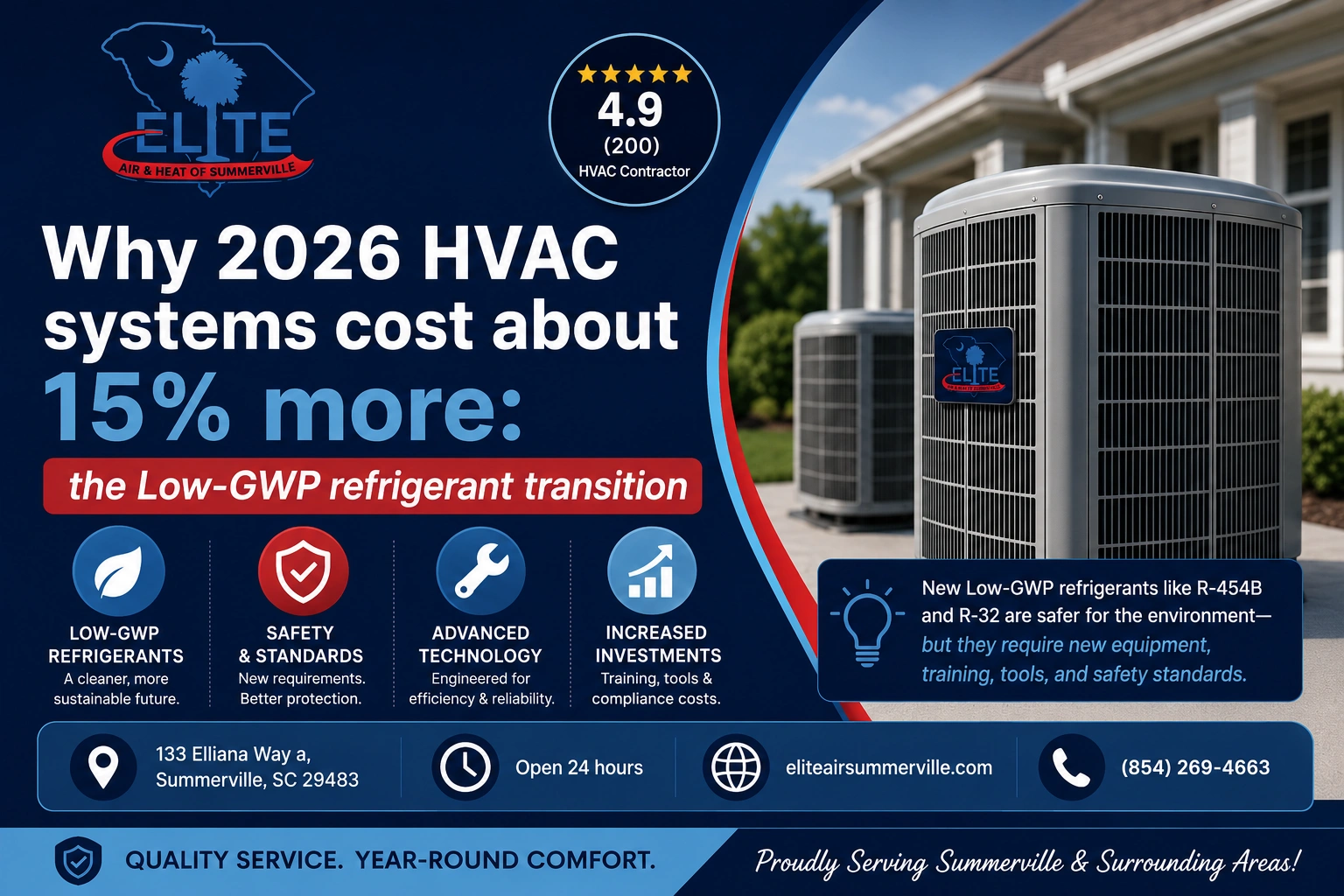

Here’s the plain answer: 2026 HVAC systems cost more because the industry is no longer just selling the same equipment with a different refrigerant inside.
The move from older high-GWP refrigerants like R-410A to newer Low-GWP refrigerants has changed the equipment, the safety requirements, the tools, the training, the supply chain, and the way systems are installed.
For many homeowners in Summerville, that can show up as roughly a 10%–20% increase compared with similar replacement quotes from a few years ago. Fifteen percent is a reasonable middle estimate, but it is not a fixed rule. Some systems may increase less. Higher-end equipment, heat pumps, difficult installs, or duct/electrical changes can push the total higher.
2026 HVAC Price Increase Coming? Act Now.
Schedule trusted HVAC service today and avoid surprises from the Low-GWP refrigerant shift.
What changed with refrigerants?
For years, most residential AC and heat pump systems used R-410A. It worked well, but it has a high global warming potential, or GWP.
GWP is basically a measure of how much heat a refrigerant can trap in the atmosphere if it leaks. The newer refrigerants are designed to lower that environmental impact.
Under the EPA’s HFC phasedown rules, new residential and light commercial AC and heat pump equipment has been moving away from higher-GWP refrigerants. The EPA’s technology transition rule restricts systems using refrigerants above certain GWP limits, with major deadlines affecting new residential AC and heat pump equipment in 2025 and 2026.
The common replacements are refrigerants like:
- R-454B
- R-32
These are often called A2L refrigerants.
That matters because A2L refrigerants are mildly flammable, which does not mean they are unsafe when installed correctly. It does mean the equipment and installation standards are different. AHRI, the HVAC industry trade group, describes this as a “safe refrigerant transition” tied to the AIM Act and next-generation lower-GWP refrigerants.3
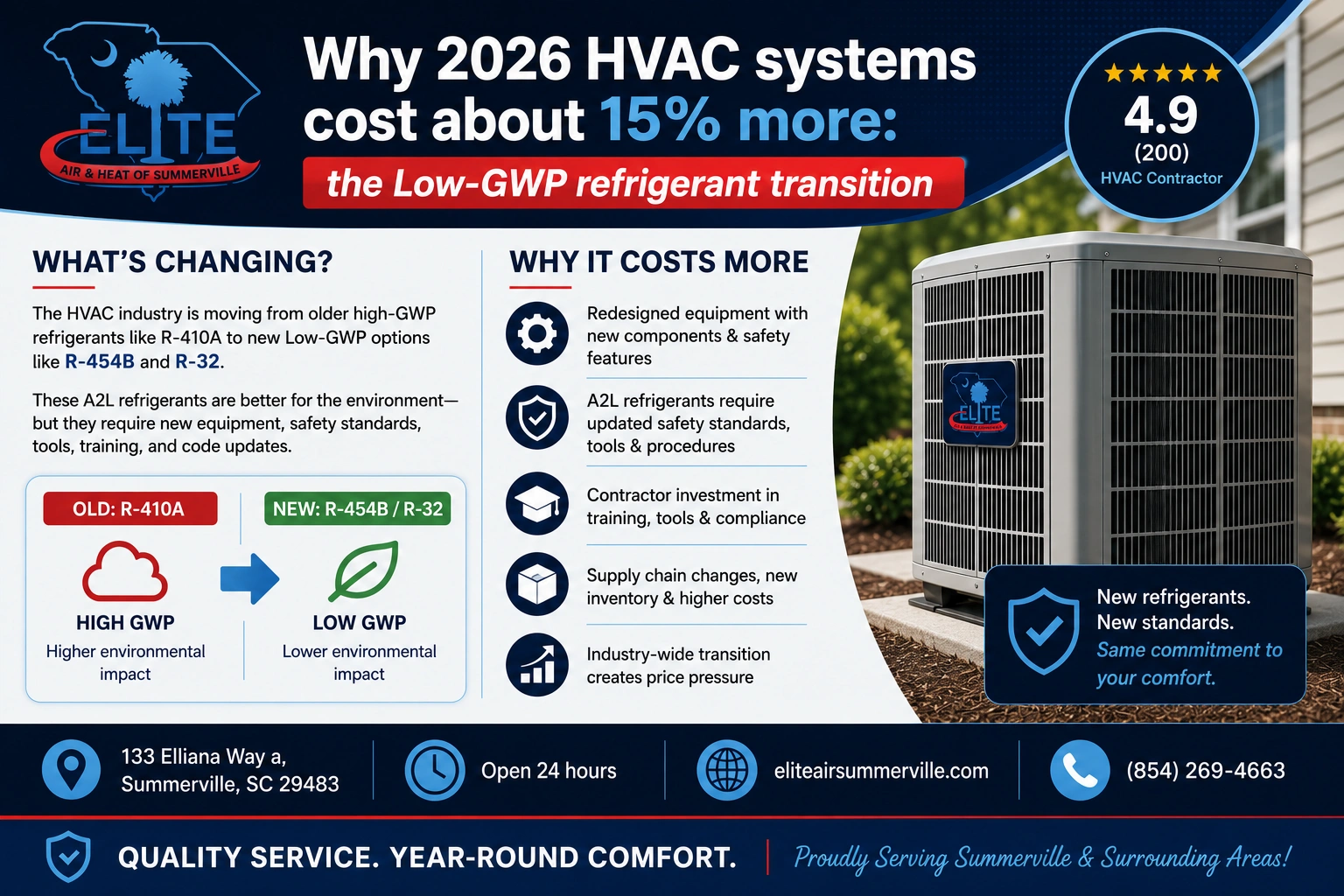
Why does that make HVAC systems more expensive?
1. The equipment itself changed
A 2026 AC or heat pump is not always the same cabinet with a new refrigerant label.
Manufacturers have had to redesign and test equipment around the new refrigerants. That can include changes to:
- Compressors
- Coils
- Refrigerant controls
- Sensors
- Control boards
- Safety labeling
- Leak mitigation features
- Installation instructions
That added engineering and manufacturing cost gets passed through the supply chain.
2. A2L systems require different safety practices
This is where homeowners sometimes get confused.
A2L refrigerants are not “dangerous” in the way people sometimes imagine. But they do require technicians to follow updated procedures.
That may include:
- Updated recovery machines
- A2L-rated gauges and hoses
- Proper storage and transportation practices
- Different leak detection practices
- Additional ventilation and ignition-source awareness
- Updated code and manufacturer installation requirements
The International Mechanical Code and related standards had to account for new safety protocols tied to A2L refrigerants, because the newer refrigerants have different handling requirements than older nonflammable refrigerants.
That adds cost not because contractors are trying to pad the job, but because doing the job correctly takes updated tools, training, and time.
3. Contractors had to invest before the homeowner ever calls
A good HVAC company had to prepare for this transition before installing the first new system.
That means investing in:
- Technician training
- New tools
- Updated refrigerant recovery equipment
- New inventory
- Updated installation procedures
- Safety documentation
- Code compliance
- Supplier coordination
Those costs do not show up as one line item on your quote, but they are built into the cost of doing the work correctly.
The goal is not just to install a system that turns on. The goal is to install one that is safe, code-compliant, properly charged, and supported for the long run.
4. Supply chain changes raised equipment costs
When an entire industry changes refrigerants, manufacturers, distributors, and contractors all have to manage old inventory, new inventory, new parts, and new compatibility rules at the same time.
That kind of transition usually creates price pressure.
Industry reporting for 2026 points to a mix of factors behind HVAC price increases, including the completed A2L refrigerant transition, tariff pressure, inflation, equipment costs, parts pricing, and supply chain disruption.
So, while Low-GWP refrigerants are a major reason systems cost more, they are not the only reason.
5. Older R-410A systems are not always a simple match
This is important for homeowners.
If your outdoor AC condenser fails, you may hope to replace just the outdoor unit. Sometimes that is possible. Sometimes it is not the right answer.
A new Low-GWP outdoor unit may not properly match an older indoor coil designed for R-410A. Mismatching equipment can create performance problems, warranty issues, efficiency losses, or premature failures.
That is one reason more homeowners are seeing quotes for a full matched system replacement instead of a simple equipment swap.
A good technician should explain whether your existing indoor coil, air handler, refrigerant lines, thermostat, and ductwork can support the new system.

Review: Why the “Trane Coastal” is a Game-Changer for the Lowcountry
If you live near the coast, you already know the challenges: hot, humid summers, high pollen, and salt air that…

Why 15% is a reasonable estimate, but not a guarantee
A 15% increase is a useful planning number because many homeowners are seeing higher replacement quotes compared with pre-transition systems.
But the actual increase depends on the job.
A basic, accessible replacement may only rise modestly. A higher-efficiency heat pump, variable-speed system, difficult attic installation, or system needing duct/electrical updates can rise more.
For example, if a full AC replacement might have cost around $10,000 before the transition, a 15% increase puts that same general job around $11,500.
But that does not mean every $11,500 quote is fair, and it does not mean every $10,000 quote is suspicious. The quote still has to make sense.
What homeowners should ask before approving a 2026 HVAC quote
Ask these questions:
- What refrigerant does the new system use?
- Is this a matched indoor and outdoor system?
- Does my existing ductwork support the new system?
- Are any A2L safety requirements included?
- Does the quote include permit/code requirements?
- What labor warranty is included?
- What manufacturer warranty is included?
- Are startup readings and airflow measurements included?
- Is this system sized for humidity control, not just temperature?
In Summerville’s climate, that last question matters. Comfort is not just about cold air. A system that is oversized or poorly set up may cool the house quickly but leave it damp, sticky, and uncomfortable.
Does this mean you should replace your AC before it fails?
Not automatically.
If your current system is working well, not leaking refrigerant, cooling evenly, and controlling humidity, you do not need to panic-replace it just because the industry changed refrigerants.
Replacement becomes more reasonable when:
- The system is 12–15+ years old
- The compressor or coil has failed
- Refrigerant repairs are getting expensive
- Humidity problems keep coming back
- The system uses aging components with poor availability
- Repair costs are getting close to replacement cost
- You are already facing major indoor and outdoor equipment work
The goal is not to buy the biggest repair. The goal is to understand the actual problem.
The bottom line
2026 HVAC systems cost more because the Low-GWP refrigerant transition changed the entire replacement process, not just the refrigerant.
The newer systems require updated equipment design, safer installation procedures, trained technicians, new tools, new parts, and better attention to compatibility.
If you only remember one thing, remember this: a higher 2026 HVAC quote should come with a better explanation. A good technician should be able to show you what changed, what is included, why the system is being recommended, and what happens if you choose a lower-cost option.
Need HVAC Help Before Prices Climb?
Get professional HVAC inspection, repair, or replacement advice today and stay ahead of the 2026 refrigerant transition.