
Here’s the plain answer: no, your current AC is not automatically obsolete just because refrigerant rules changed.
If your existing system uses R-410A, you do not have to replace it simply because the HVAC industry is moving to newer Low-GWP refrigerants like R-454B and R-32.
The bigger change is this: new residential AC and heat pump equipment is moving away from higher-GWP refrigerants. Existing systems can still be serviced, repaired, and maintained as long as parts and refrigerants are available. The EPA’s HFC rules focus heavily on phasing down production/consumption of certain refrigerants and transitioning new equipment, not forcing homeowners to rip out working systems overnight.
Worried Your Current AC May Be Obsolete?
Call now for expert HVAC advice on the 2026 refrigerant changes.
What changed in 2025 and 2026?
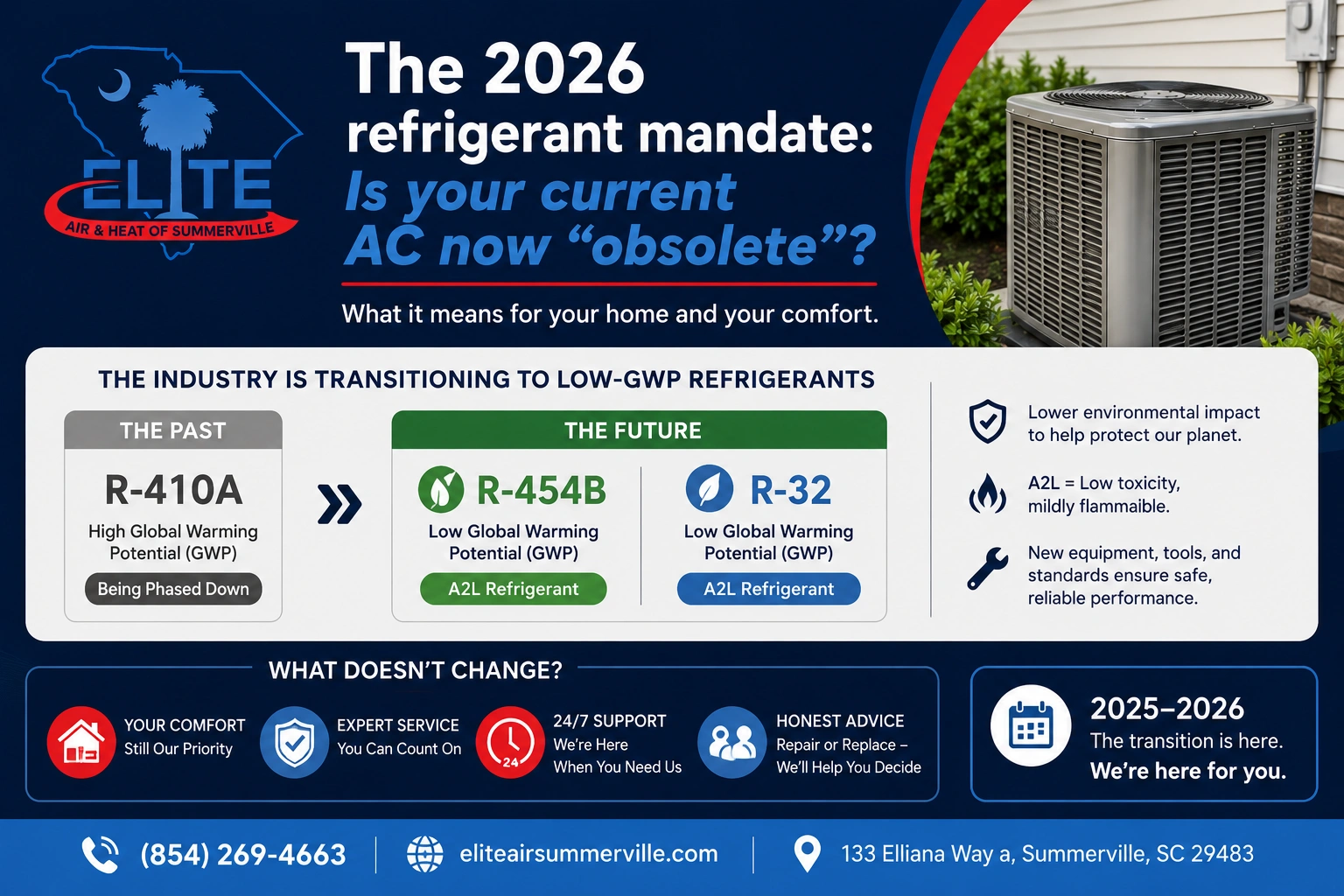
The EPA’s refrigerant transition is tied to the AIM Act, which phases down hydrofluorocarbons, or HFCs. R-410A is one of those higher-GWP refrigerants.
For homeowners, the practical change is that manufacturers have been shifting new residential AC and heat pump systems to lower-GWP refrigerants. EPA guidance shows restrictions beginning as soon as January 1, 2025, and EPA also allowed certain higher-GWP residential/light commercial equipment manufactured or imported before January 1, 2025, to be installed until January 1, 2026 to avoid stranded inventory.
That is why 2026 matters. By 2026, most homeowners shopping for a new central AC or heat pump will be looking at equipment designed for newer refrigerants.
Does this ban your existing R-410A system?
No.
This is where homeowners sometimes get bad information.
The transition does not mean:
- Your current AC is illegal.
- You must replace a working R-410A system.
- Contractors can no longer service R-410A equipment.
- Your system has zero value.
- Every refrigerant leak means automatic replacement.
What it does mean is:
- New equipment options are changing.
- R-410A equipment availability is shrinking.
- R-410A refrigerant may become more expensive over time.
- Matching old indoor and outdoor components may get harder.
- Big repairs on older systems deserve a closer cost-versus-replacement discussion.
That is a different conversation than “your AC is obsolete.”
What does “Low-GWP” mean?
GWP stands for global warming potential. It measures how much heat a refrigerant can trap in the atmosphere if it leaks.
R-410A has a much higher GWP than the newer refrigerants now being used in many new systems. The common replacements are:
- R-454B
- R-32
These are classified as A2L refrigerants, which means they are low-toxicity and mildly flammable. That does not mean they are unsafe when installed correctly. It means the equipment, tools, handling practices, and safety standards are different. AHRI describes this as an industry-wide transition to next-generation lower-GWP refrigerants under the AIM Act and related climate rules.

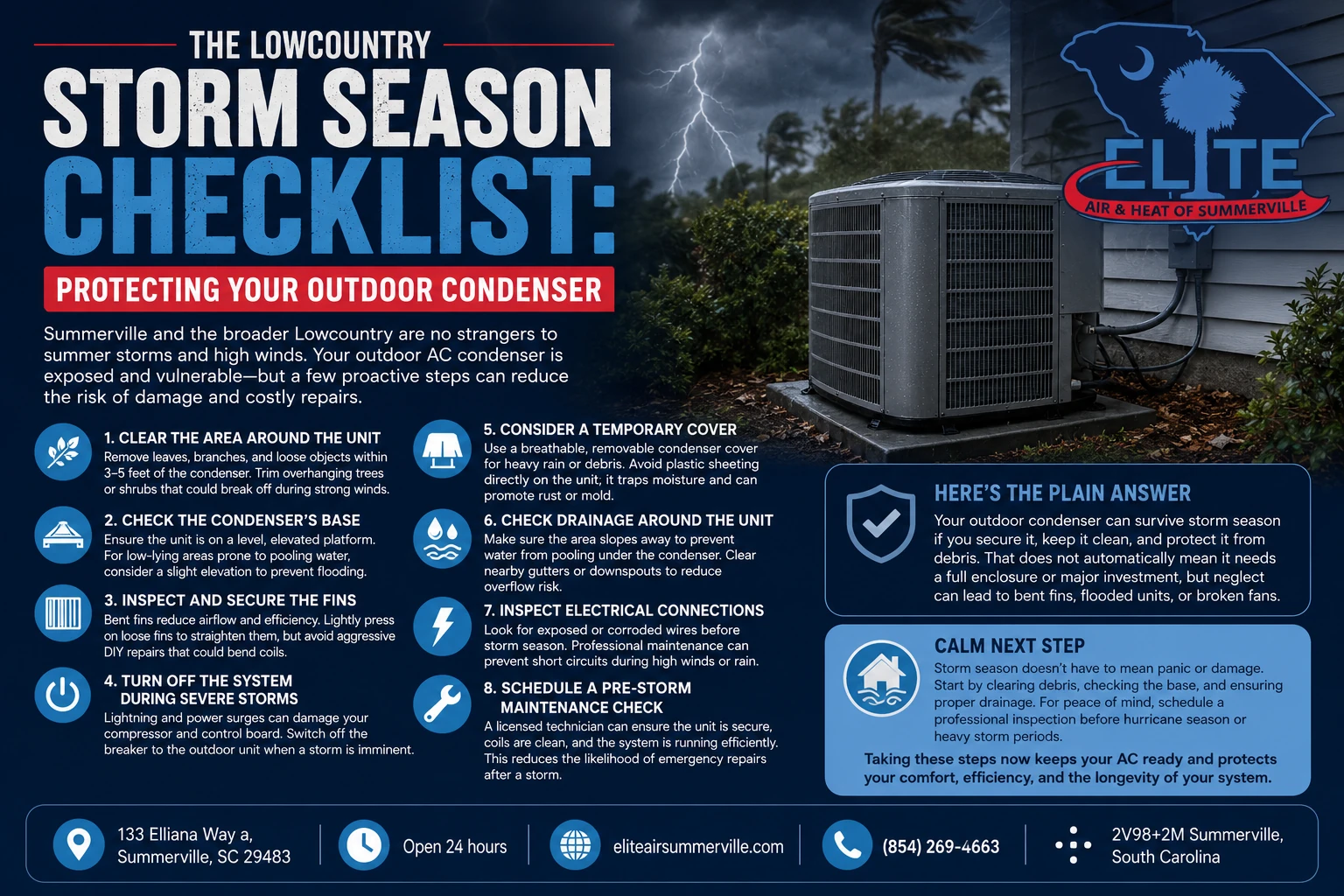
The Lowcountry Storm Season Checklist: Protecting Your Outdoor Condenser
Summerville and the broader Lowcountry are no strangers to summer storms and high winds. Your outdoor AC condenser is exposed…
Can your current AC still be repaired?
In many cases, yes.
If your R-410A system has a bad capacitor, contactor, blower motor, drain issue, thermostat problem, or airflow issue, the refrigerant transition may not matter much at all.
Those repairs do not automatically require replacing the system.
Even refrigerant-related repairs may still be possible, depending on:
- System age
- Leak location
- Refrigerant availability
- Coil condition
- Compressor health
- Labor cost
- Warranty status
- Whether the repair is likely to last
A good technician should not use the refrigerant mandate as a scare tactic. They should show you what failed, what refrigerant your system uses, what the repair costs, and how that compares with replacement.
When does the refrigerant transition matter most?
The refrigerant transition matters most when your system needs a major repair.
For example:
| Situation | What it usually means |
| Bad capacitor or clogged drain | Usually not a refrigerant-mandate issue |
| Dirty coil or airflow problem | Diagnose before discussing replacement |
| Small repair on a newer R-410A system | Repair may still make sense |
| Refrigerant leak in an older coil | Replacement conversation becomes more reasonable |
| Failed compressor on a 12–15-year-old system | Replacement may make more sense than repair |
| Outdoor unit fails but indoor coil is older | Matching equipment may be harder |
| Multiple recurring repairs | Do not keep replacing parts blindly |
The mandate does not make your system obsolete. Age, condition, repair cost, refrigerant leaks, and comfort problems are what matter.
Why repairs may feel more expensive now
Even though your system is not automatically obsolete, the market around it is changing.
As HFC production is phased down, refrigerants like R-410A may become more costly and less convenient to source. New equipment lines, parts inventory, technician training, A2L-rated tools, and updated installation practices also add cost to the industry.
That is one reason homeowners may see higher replacement prices in 2026.
But again, higher cost does not mean every older system should be replaced immediately.
Should you repair or replace an R-410A AC in 2026?
Here’s a practical way to think about it.
Repair may make sense if:
- The system is under 10 years old.
- The repair is minor.
- There is no major refrigerant leak.
- The compressor and coils are in good shape.
- The system still cools and dehumidifies well.
- The repair is covered by warranty.
- The ductwork and airflow are healthy.
Replacement may make more sense if:
- The system is 12–15+ years old.
- It has a major refrigerant leak.
- The compressor has failed.
- The indoor coil is leaking.
- Repairs are becoming frequent.
- The home still feels humid or uneven.
- The system is oversized or poorly installed.
- Repair cost is getting close to replacement cost.
That does not mean replacement is always the right answer. It means you should slow down and compare the numbers.
Can you mix old R-410A parts with new Low-GWP equipment?
Usually, you should be very careful.
A new R-454B or R-32 outdoor unit is not meant to be casually matched with an old R-410A indoor coil. Refrigerants, metering devices, oils, pressures, ratings, and safety requirements all have to line up.
Mismatching equipment can lead to:
- Poor humidity control
- Lower efficiency
- Warranty problems
- Compressor damage
- Refrigerant charge issues
- Failed inspections or code issues
A good estimate should clearly state whether you are getting a matched system and which refrigerant it uses.
What should Summerville homeowners watch for?
In the Lowcountry, this is not just about refrigerant.
A new system needs to handle:
- Long cooling seasons
- High humidity
- Heavy pollen and indoor air quality concerns
- Attic heat
- Drain line issues
- Duct leakage
- Mold and moisture risk
- Salt-air exposure closer to coastal areas
A system that is technically “new” but oversized or poorly commissioned can still leave the house sticky. In a humid climate, comfort is not just about temperature.
Questions to ask before approving repair or replacement
Ask your technician:
- What refrigerant does my current system use?
- Is the failed part related to refrigerant or something simpler?
- Is there a confirmed leak, or are we guessing?
- How old is the system?
- What is the repair cost versus replacement cost?
- Will this repair likely last?
- Is the indoor coil compatible with any proposed outdoor unit?
- Does the quote include a matched system?
- What refrigerant will the new system use?
- What warranties apply?
- Will you check ductwork, airflow, static pressure, and drainage?
A good technician should be able to show you why.
The bottom line
Your current AC is not obsolete just because of the 2026 refrigerant transition.
But the rules do change the math on older systems. Minor repairs may still be perfectly reasonable. Major refrigerant repairs on aging equipment deserve a serious replacement conversation.
If you only remember one thing, remember this: the refrigerant mandate affects new equipment and long-term repair economics. It does not automatically condemn a working AC system.
The goal is not to panic-replace your system. The goal is to understand whether your current AC is still a smart system to keep maintaining.
Is Your AC Ready for the 2026 Refrigerant Mandate?
Get professional AC inspection and upgrade guidance before costly issues start.