
Here’s the plain answer: your current AC is not automatically obsolete, illegal, or unsafe because of the 2026 refrigerant transition.
But if you are replacing an AC or heat pump in 2026, you are likely buying a different kind of system than homeowners bought a few years ago.
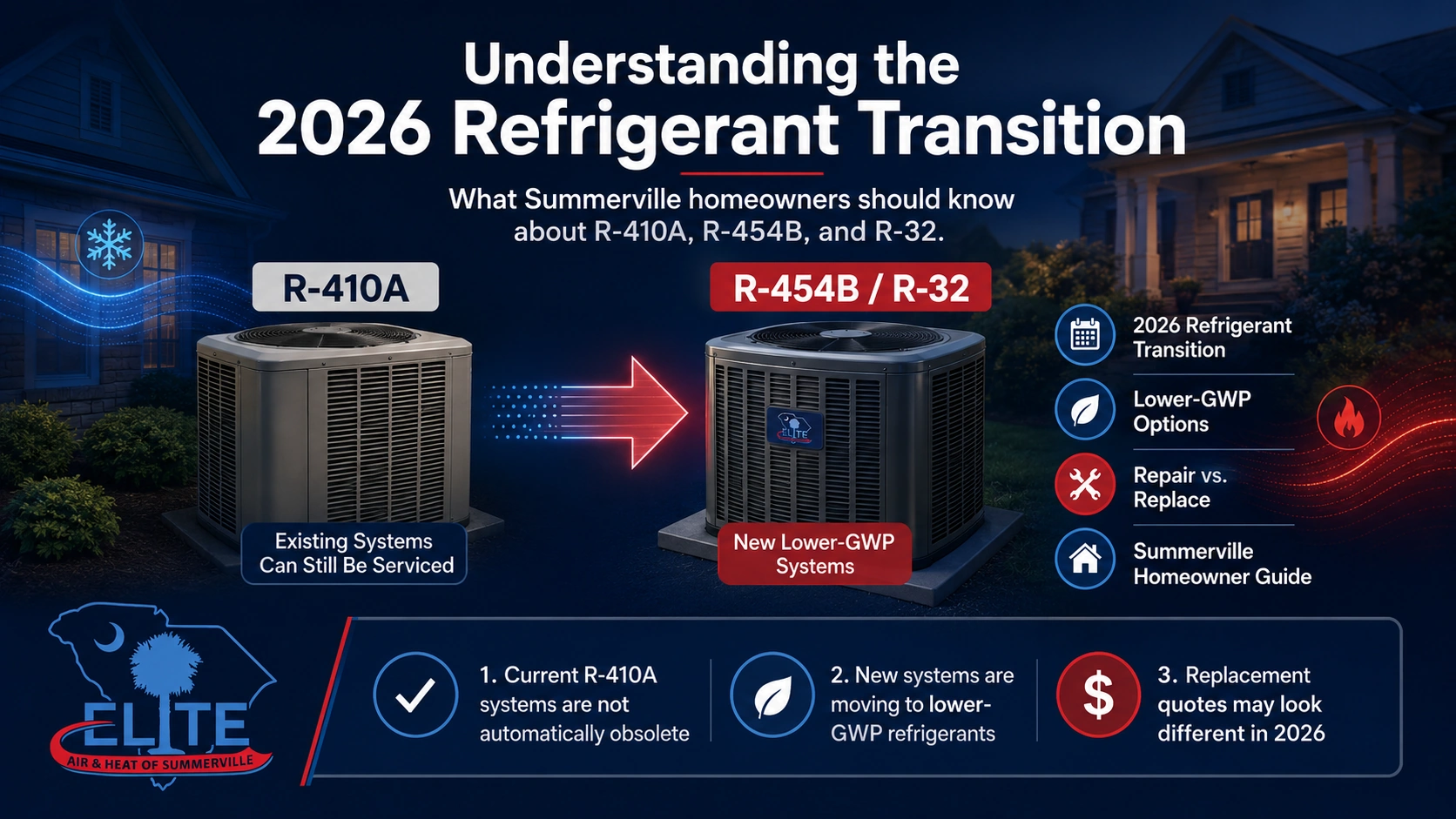
The industry is moving away from older, higher-GWP refrigerants like R-410A and toward newer lower-GWP refrigerants such as R-454B and R-32. EPA rules under the AIM Act restrict the use of higher-GWP HFCs in many types of new air conditioning and heat pump equipment, with restrictions starting as early as January 1, 2025. The EPA also allowed certain residential and light commercial systems made or imported before January 1, 2025, to be installed until January 1, 2026.
For Summerville homeowners, that means three things:
- Existing R-410A systems can still be serviced.
- New systems in 2026 are mostly moving to lower-GWP refrigerants.
- Replacement quotes may cost more because the equipment, tools, safety rules, and installation process changed.
Thinking About Replacing Your AC?
Talk with our Summerville HVAC team about efficient replacement options before the refrigerant transition impacts availability.
What is a refrigerant, and why does it matter?
Refrigerant is the fluid inside your AC or heat pump that absorbs and releases heat.
In cooling mode, it helps move heat from inside your home to outside. In heat pump heating mode, it can reverse that process and bring heat indoors.
For years, many residential systems used R-410A. It worked well, but it has a high global warming potential, often shortened to GWP.
GWP is a measure of how much heat a substance can trap in the atmosphere if it leaks. The newer refrigerants have lower GWP, which is the main reason the industry is changing.
What refrigerants are replacing R-410A?
The two names homeowners will hear most often are:
| Refrigerant | Common use | What to know |
| R-454B | Many new central AC and heat pump systems | Lower-GWP blend used by several major manufacturers |
| R-32 | Some ductless, central, and heat pump systems | Lower-GWP single-component refrigerant |
Both are considered A2L refrigerants.
That means they are low toxicity and mildly flammable. That phrase can sound alarming, but it does not mean the equipment is unsafe when installed correctly. It does mean the equipment, labeling, tools, storage, leak detection practices, and installation procedures are different. AHRI describes the industry’s shift as a safe refrigerant transition to next-generation lower-GWP refrigerants under the AIM Act and related climate rules.
Does this mean your current AC has to be replaced?
No.
This is the part homeowners need to hear clearly.
The 2026 transition does not mean:
- Your current AC is illegal.
- You have to replace a working R-410A system.
- Contractors can no longer service your current equipment.
- Every refrigerant leak means automatic replacement.
- Your system lost all value overnight.
What it does mean is:
- New equipment choices have changed.
- R-410A equipment availability is shrinking.
- R-410A refrigerant may become more expensive over time.
- Major repairs on older systems deserve a closer look.
- Matching old indoor and outdoor components may become harder.
The refrigerant transition changes the repair-versus-replacement conversation. It does not automatically condemn your system.
Why 2026 replacement quotes may be higher
A newer AC or heat pump is not always the same box with a different refrigerant label.
Manufacturers had to redesign, test, and certify equipment around new refrigerants. Contractors also had to prepare for updated safety procedures, tools, recovery equipment, storage practices, and training.
That can affect the price of:
- Outdoor condensers
- Indoor coils
- Air handlers
- Heat pumps
- Refrigerant handling
- Installation labor
- Diagnostic tools
- Safety controls
- Code-compliant installation work
This is why some homeowners are seeing 2026 replacement quotes that feel noticeably higher than what a neighbor paid a few years ago.
The Low-GWP transition is not the only reason prices changed. Inflation, labor, parts, equipment availability, and efficiency standards also matter. But the refrigerant change is a real part of the cost increase.

Best whole-home dehumidifiers for Nexton & Cane Bay residences
Here’s the plain answer: for many newer Nexton and Cane Bay homes, the best whole-home dehumidifier is usually an 80-…

Can R-410A systems still be repaired?
In many cases, yes.
If your AC has a bad capacitor, contactor, thermostat, blower motor, drain issue, weak fan motor, or airflow problem, the refrigerant transition may have little to do with the repair.
Even some refrigerant-related repairs may still make sense, depending on the age and condition of the system.
Repair may be reasonable when:
- The system is under 10 years old.
- The repair is minor.
- The compressor is healthy.
- There is no major coil leak.
- The equipment is still under warranty.
- The system cools and dehumidifies well.
- Repair cost is low compared with replacement.
Replacement becomes more reasonable when:
- The system is 12–15+ years old.
- The compressor has failed.
- The evaporator coil is leaking.
- Refrigerant repairs are expensive.
- The system has repeated breakdowns.
- The home still feels humid or uneven.
- Repair cost is getting close to replacement cost.
The goal is not to replace equipment just because the industry changed refrigerants. The goal is to decide whether your current system is still worth maintaining.
Why you usually should not mix old and new equipment
This is where homeowners sometimes get into trouble.
A new R-454B or R-32 outdoor unit is not meant to be casually matched with an older R-410A indoor coil.
The refrigerant, metering device, oil, pressures, ratings, safety requirements, and manufacturer approvals all have to match.
Mismatched systems can cause:
- Poor cooling
- Weak humidity control
- Compressor damage
- Efficiency loss
- Warranty problems
- Failed inspections
- Shortened equipment life
A good quote should clearly say whether you are getting a matched system.
That means the outdoor unit and indoor coil or air handler are designed to work together.
How this affects Summerville homes specifically
Summerville’s climate makes this more than a refrigerant conversation.
Here, an AC system has to handle:
- Long cooling seasons
- Heavy humidity
- Hot attics
- Pollen and indoor air quality concerns
- Drain line clogs
- Mold and moisture risk
- Short winter heating needs
- Heat pump performance in mild weather
A system that is technically new but poorly sized can still leave the house sticky.
In the Lowcountry, comfort is not just about temperature. It is about moisture removal, airflow, duct condition, and system runtime.
That is especially important in newer communities with tighter homes and older neighborhoods where ductwork may be undersized, leaky, or difficult to access.
What should you ask before approving a 2026 HVAC replacement?
Before you sign a replacement estimate, ask these questions:
- What refrigerant does the new system use?
- Is it R-454B, R-32, or something else?
- Is the indoor and outdoor equipment properly matched?
- Does the quote include a new coil or air handler?
- Are the refrigerant lines being reused, flushed, or replaced?
- Does the ductwork support the new system?
- Was the system sized for the home, or just matched to the old unit?
- Will the system help with humidity control?
- What warranties apply to parts and labor?
- Are permits and code requirements included?
- What startup readings will be documented after installation?
A good technician should be able to answer those questions without making you feel like you are being difficult.
What should a good contractor inspect?
A proper 2026 replacement conversation should include more than brand and tonnage.
A good technician should inspect:
- Existing system age and condition
- Refrigerant type
- Indoor coil condition
- Outdoor unit condition
- Electrical disconnect and breaker sizing
- Drain pan and float switch protection
- Refrigerant line condition
- Duct sizing and leakage
- Return air capacity
- Static pressure
- Airflow
- Humidity complaints
- Hot and cold rooms
- Attic or crawlspace access
- Thermostat compatibility
If the technician only looks at the outdoor unit and gives a price, that is not enough information for a good replacement decision.
What homeowners can safely check themselves
You do not need to diagnose refrigerant problems yourself, but you can gather useful information.
Check:
- The age of your system
- Whether the data plate says R-410A
- How often repairs are happening
- Whether the house feels humid
- Whether some rooms are hotter than others
- Whether the system runs short cycles
- Whether the air filter is clean
- Whether the outdoor unit is blocked by debris
- Whether the drain line has backed up before
- Whether your thermostat shows indoor humidity
Write these things down before the service visit. It helps the technician separate a simple repair from a bigger system issue.
When not to DIY
Do not try to handle refrigerant yourself.
That includes:
- Adding refrigerant
- Releasing refrigerant
- Opening refrigerant lines
- Replacing coils
- Swapping outdoor units
- Modifying electrical circuits
- Installing A2L equipment without training
A2L systems require updated tools and procedures. This is not a place to learn by watching a few videos.
Should you replace your system early because of the transition?
Not automatically.
If your current AC is working well, keeping the house comfortable, controlling humidity, and not costing you repeated repairs, there may be no reason to rush.
But it is worth planning ahead if your system is older.
Start paying closer attention if your AC is:
- Over 12 years old
- Using R-410A
- Needing refrigerant every season
- Struggling in summer
- Leaving the home sticky
- Making unusual noises
- Running longer but cooling less
- Requiring repeated service calls
At that point, replacement may not be urgent today, but it should be part of your planning.
How much should this affect your 2026 budget?
For a full AC or heat pump replacement in Summerville, many homeowners should expect pricing to be higher than pre-transition systems.
A realistic 2026 replacement may cost more because of:
- New refrigerant equipment
- Updated safety requirements
- Higher equipment costs
- More expensive parts
- Labor and training costs
- Duct or electrical corrections
- Humidity-focused system design
A suspiciously low quote may leave out important items like the indoor coil, drain safety, permit requirements, thermostat compatibility, duct corrections, or startup commissioning.
The cheaper quote is not always wrong. But it should make sense.
The bottom line
The 2026 refrigerant transition does not mean your current AC is obsolete.
It does mean the HVAC industry has changed.
New systems are moving toward lower-GWP refrigerants like R-454B and R-32. Existing R-410A systems can still often be repaired, but major refrigerant repairs on older equipment deserve a careful repair-versus-replace discussion.
If you only remember one thing, remember this: do not let anyone use the refrigerant transition as a scare tactic.
A good technician should show you what refrigerant your system uses, what failed, whether the repair makes sense, what a new system would include, and how the recommendation affects comfort, humidity, warranty, and long-term cost.
Don’t Wait Until Your Old AC Becomes a Bigger Problem
Learn how the 2026 refrigerant transition may affect repairs, replacements, and long-term cooling costs in Summerville.