
If you’re dealing with mold concerns in your home, you’ve probably seen HVAC companies recommend either a UV light or a whole-home air purifier.
The problem is that many homeowners assume they’re the same thing.
They’re not.
Here’s the plain answer:
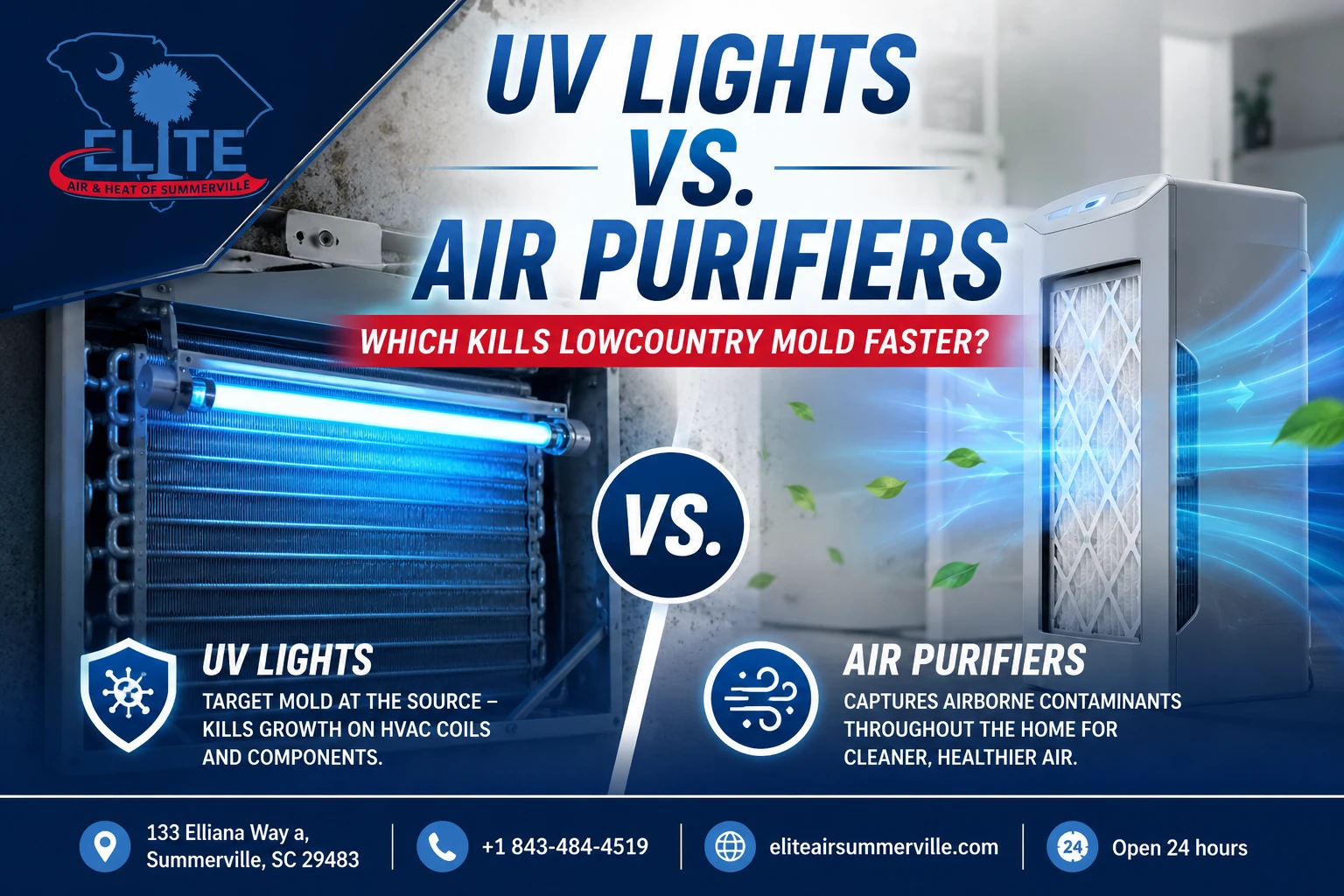
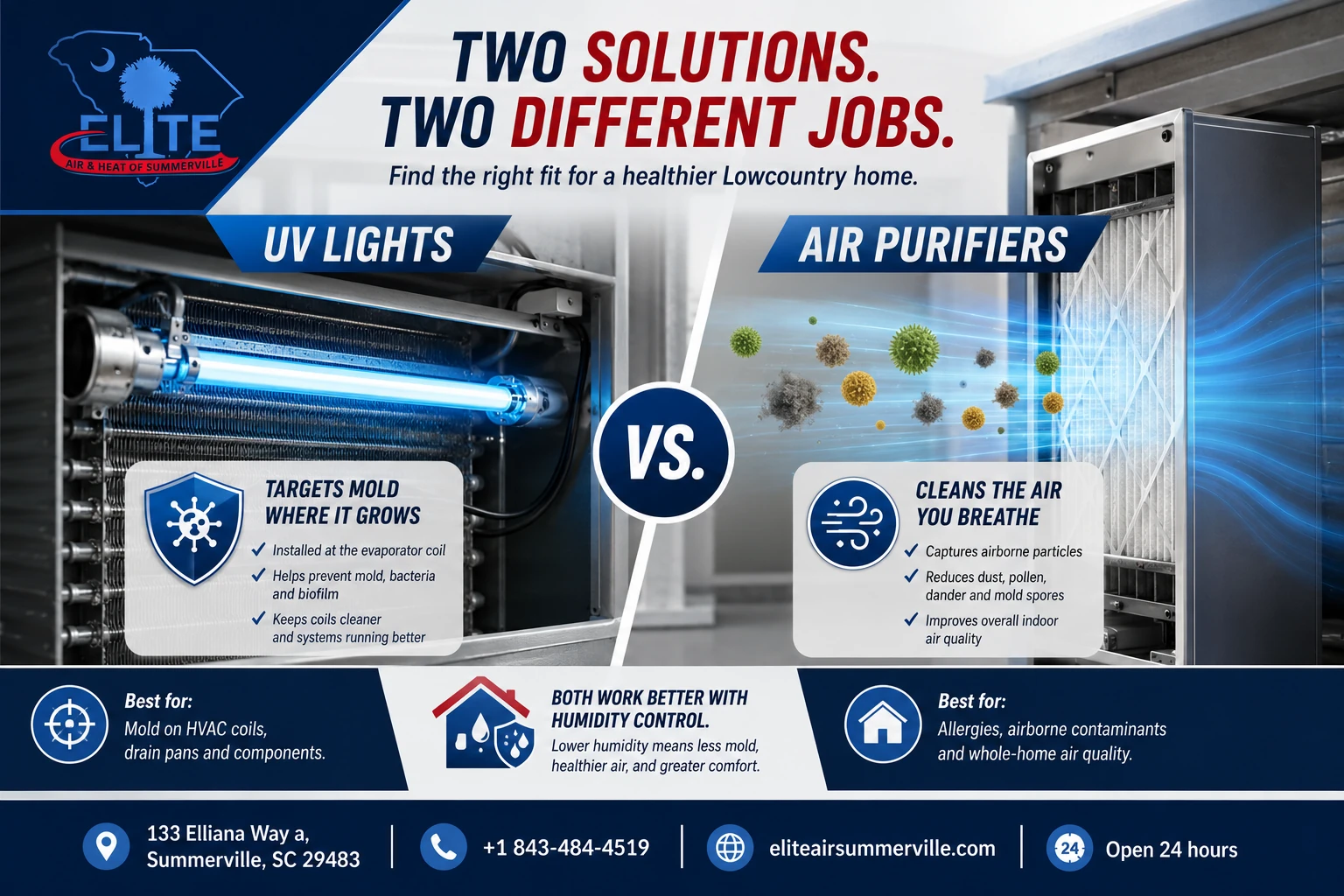
If your goal is specifically to stop mold growth inside the HVAC system, a UV light is usually the more direct tool. If your goal is improving overall indoor air quality throughout the home, an air purifier is often the better choice.
The right answer depends on where the mold problem actually exists.
Stop Mold at the Source
Breathe cleaner with the right indoor air solution. Call now for professional recommendations and installation.
First, Let’s Clear Up a Common Misunderstanding
Neither a UV light nor an air purifier is a substitute for fixing a moisture problem.
This is where homeowners sometimes get into trouble.
If you have:
- High indoor humidity
- Water leaks
- Poor drainage
- Wet insulation
- Duct condensation
no air-cleaning device will permanently solve the problem.
Mold needs moisture to grow.
Remove the moisture source, and you remove the conditions mold needs to survive.
Why Mold Is Such a Common Issue in the Lowcountry
In Summerville and throughout the Charleston area, we deal with:
- Long cooling seasons
- High humidity
- Heavy rainfall
- Warm temperatures for much of the year
Even when your air conditioner is working properly, moisture control is a constant battle.
In a humid climate, comfort is not just about temperature.
It’s also about keeping indoor humidity under control.
How UV Lights Work
A UV-C light is typically installed near the indoor evaporator coil.
This location matters because the evaporator coil is one of the dampest areas inside an HVAC system.
The UV light continuously shines on:
- The coil surface
- The drain pan area
- Nearby HVAC components
The goal is to reduce biological growth where moisture naturally accumulates.
Where UV Lights Work Best
UV lights are often effective for:
- Mold growth on evaporator coils
- Biofilm buildup
- Bacteria growth on HVAC surfaces
- Keeping coils cleaner over time
If mold is actively growing on the coil, a UV system directly targets the area where the problem exists.

Financing Your Comfort: Low-Interest HVAC Loans for Nexton and Cane Bay Families
Upgrading or replacing your HVAC system can feel overwhelming, especially when the costs are higher than expected. The plain truth:…

Limitations of UV Lights
A UV light only works where the light reaches.
It does not:
- Clean every room in the house
- Capture dust
- Remove pet dander
- Filter pollen
- Remove particles from the air stream
A UV light is more like a targeted treatment than a whole-home air cleaning solution.
How Whole-Home Air Purifiers Work
The term “air purifier” covers several technologies.
Most whole-home systems work by:
- Capturing particles
- Reducing airborne contaminants
- Treating pollutants as air moves through the HVAC system
Depending on the design, they may help reduce:
- Dust
- Pollen
- Pet dander
- Airborne mold spores
- Certain odors
- Smoke particles
Unlike a UV light, an air purifier focuses on what is moving through the air.
Where Air Purifiers Work Best
Air purifiers are often a better fit when homeowners are concerned about:
- Allergies
- Dust
- Pet issues
- Airborne mold spores
- General indoor air quality
They address contaminants throughout the home rather than focusing on a single HVAC component.
Which Kills Mold Faster?
If we’re talking specifically about mold growing on the HVAC coil, the answer is usually:
UV lights.
That’s because the UV light is continuously treating the exact location where mold growth is occurring.
If we’re talking about mold spores circulating throughout the house, then a quality air purification system may have a larger overall impact on what occupants are breathing.
The question is not which product is better.
The question is:
“Where is the mold problem actually located?”
Should You Install Both?
In some homes, yes.
Many homeowners choose a combination of:
- High-quality filtration
- Air purification
- UV treatment
- Humidity control
The most effective indoor air quality strategies often involve multiple layers rather than relying on a single product.
The Most Overlooked Mold Solution: Humidity Control
If you only remember one thing, remember this:
Lowering indoor humidity often does more to prevent mold than adding any air-cleaning device.
A home consistently running above 60% humidity creates an environment where mold can thrive.
A good HVAC technician should evaluate:
- Indoor humidity levels
- System sizing
- Airflow
- Drainage
- Duct leakage
- Ventilation
before recommending products.
If the issue keeps coming back, adding equipment without addressing humidity usually is not the answer.
What Do These Systems Typically Cost?
While pricing varies, most homeowners can expect:
| Upgrade | Typical Installed Range |
| UV Light System | $500-$1,500 |
| Whole-Home Air Purifier | $1,000-$3,500+ |
| Whole-Home Dehumidifier | $2,000-$5,000+ |
The cheaper option is not always wrong, but it should make sense based on the actual problem you’re trying to solve.
The Bottom Line
For Lowcountry homeowners concerned about mold, UV lights generally work faster at controlling mold growth on HVAC coils and inside the air handler, while whole-home air purifiers are often better at improving overall air quality and reducing airborne contaminants throughout the house.
Neither product should be viewed as a cure-all.
A good technician should first determine whether your problem is:
- Active mold growth
- Airborne mold spores
- Excess humidity
- Poor airflow
- A combination of all four
The goal is not to buy the most expensive indoor air quality upgrade. The goal is to understand why mold is appearing in the first place and choose the solution that addresses the actual cause.
Choose the Right Mold Defense
Not sure whether you need UV lights or an air purifier? Get expert help choosing the best option. Call now.