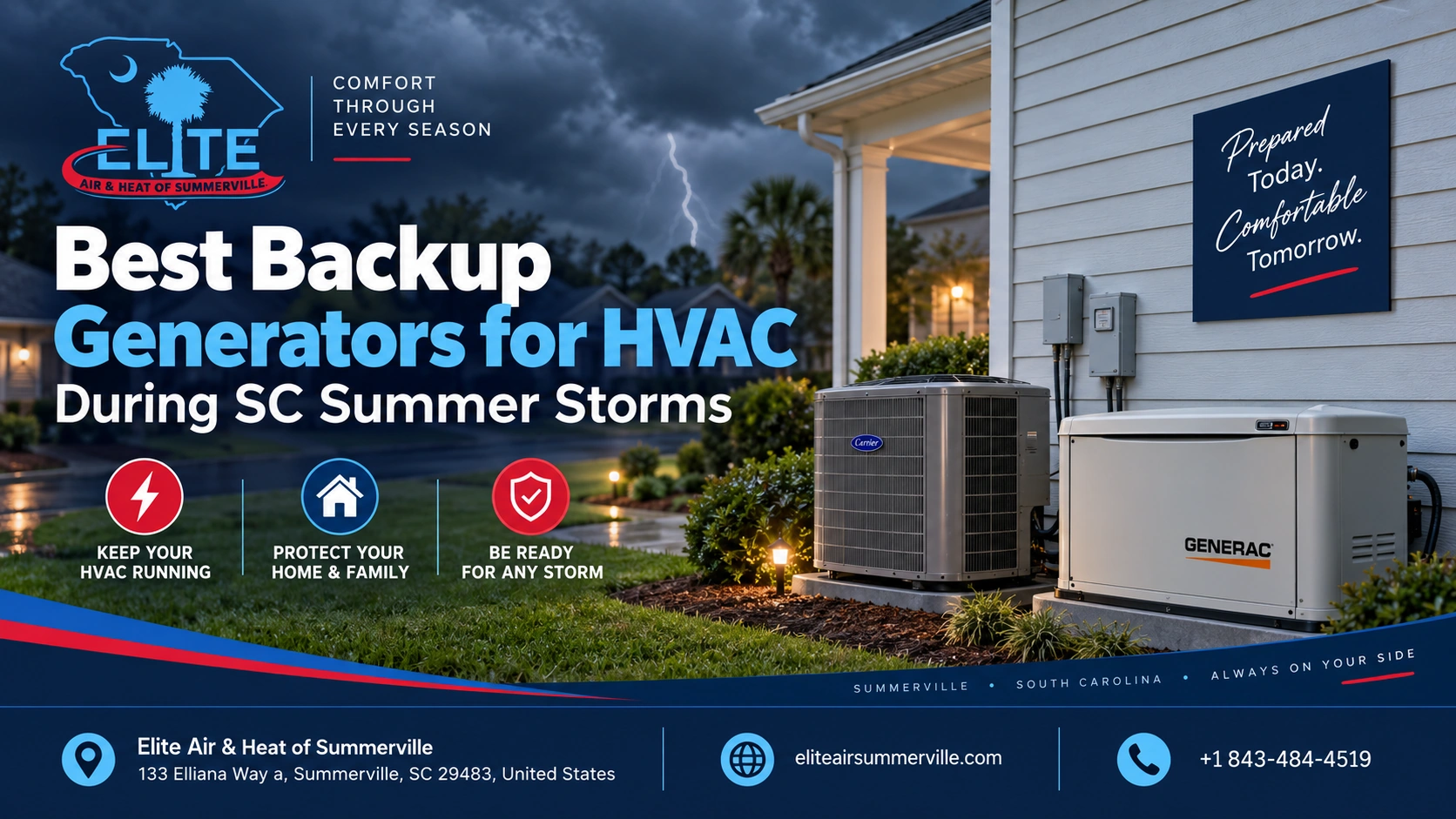

When the power goes out during a South Carolina summer storm, losing the lights is inconvenient.
Losing the air conditioner can become a much bigger problem.
Within a few hours, a Lowcountry house can get hot and humid quickly. That is why homeowners shopping for backup power often start with one question:
“What size generator do I need to run my AC?”
Unfortunately, generator shopping makes that question look easier than it really is.
A 5-ton air conditioner does not have one universal generator requirement.
A 12,000-watt portable generator does not automatically run every 3-ton AC.
And buying the largest generator you can afford is not necessarily the smartest answer either.
Here’s the plain answer.
For homeowners who want central air conditioning to come back automatically during an outage, a properly sized 18- to 26-kW automatic standby generator is usually the strongest solution. For homeowners trying to spend less, a high-output 240-volt portable generator can sometimes run central HVAC but the compressor starting load, fuel type, transfer equipment, and other household loads have to be checked first.
And for some families, the smartest backup plan is not running central air at all.
A smaller generator powering the refrigerator, lights, fans, and one portable or window AC may provide the comfort you actually need for much less money.
The goal is not to buy the biggest generator.
The goal is to know what needs to stay running when the grid goes down.
Why Your AC Is Harder to Start Than It Is to Run
This is the most important generator concept for homeowners to understand.
An air conditioner may consume a manageable amount of electricity once the compressor is operating.
Starting that compressor is different.
Traditional compressors can demand a large burst of current for a short period as the motor starts.
That means a generator may appear large enough when you compare running watts, yet still struggle, bog down, trip, or fail to start the compressor.
A good generator assessment therefore looks at more than the AC’s tonnage.
It should consider the actual outdoor-unit nameplate, compressor characteristics, LRA locked rotor amps, other equipment running at the same time, and the generator manufacturer’s motor-starting capability.
This is why we would be careful with advice like:
“A 10,000-watt generator runs a 3-ton AC.”
Maybe.
But that is not enough information to promise it.
Best Overall Setup for Most Homes: An 18- to 22-kW Automatic Standby Generator
For a typical home with one central HVAC system, refrigerator, lighting, electronics, and ordinary household loads, the 18- to 22-kW standby class is often where we would begin the conversation.
Not where we automatically finish it.
Current examples include the Generac NextGen 18-kW system and Briggs & Stratton’s PowerProtect+ 18-kW platform.
Generac’s current 18-kW NextGen model with transfer switch is rated for 18 kW on liquid propane and 17 kW on natural gas. It includes an automatic transfer switch, cellular monitoring, and a 5-year limited warranty. The current manufacturer starting price for the generator-and-transfer-switch package is $6,769 before site-specific installation.
Briggs & Stratton says its current PowerProtect+ 18-kW standby generator is engineered with motor-starting capability intended to start air-conditioning systems up to 5 tons, although the complete household electrical load still has to be evaluated.
For many homeowners, this size range provides a useful balance:
Enough capacity to operate the AC and essential household equipment without automatically paying for the largest residential generator available.
But the actual answer comes from a load calculation.
Best for Larger Homes or Multiple HVAC Systems: 24- to 26-kW Standby
Move into a larger house with two air conditioners, electric cooking, pool equipment, well pumps, or other large electrical loads and the generator conversation changes.
Now the 24- to 26-kW class can make more sense.
The Briggs & Stratton PowerProtect+ 26-kW, for example, is currently marketed specifically for heavy residential loads and air-conditioning startup. The manufacturer lists a starting MSRP of $7,336 for the generator itself.
Generac also offers current standby systems through the mid-20-kW range. Its standby lineup includes 24- and 26-kW NextGen systems with automatic-transfer-switch options.
The important point is not which brand has the largest number.
It is whether you actually need that capacity.
Load Management Can Be Smarter Than Buying a Giant Generator
Suppose you have:
Two air conditioners.
An electric water heater.
An electric range.
A clothes dryer.
You might assume the generator must be capable of operating all of them simultaneously.
It does not necessarily have to.
Load-management controls can prioritize important circuits and temporarily prevent lower-priority equipment from operating when the generator is heavily loaded.
Generac’s 26-kW transfer-switch platform, for example, can manage multiple air-conditioning and additional 240-volt loads with compatible load-management equipment.
That can let a properly designed smaller generator perform the job that would otherwise require a much larger unit.
A good generator contractor should explain that option before simply selling maximum capacity.
Best Portable Option for Serious Central-Air Backup: 12- to 15-kW Running Capacity
Portable generators can absolutely provide substantial emergency power.
But once the goal becomes running central air conditioning, we stop treating them like ordinary extension-cord generators.
Two current examples show what this category looks like.
Westinghouse WGen14500TFc
The Westinghouse WGen14500TFc is a high-output tri-fuel portable generator.
Its current ratings are:
| Fuel | Running Output | Peak Output |
| Gasoline | 14,500 W | 18,000 W |
| Propane | 13,000 W | 16,000 W |
| Natural gas | 11,600 W | 14,400 W |
It provides 120/240-volt output, including a 50-amp receptacle, and Westinghouse specifically markets it for home-backup applications including air conditioning.
The fuel ratings show something homeowners frequently overlook:
The same generator can have three different capacities depending on what you burn in it.
If you size the system around the gasoline rating and then expect to run it on natural gas, you may have considerably less available output than you thought.
DuroMax XP16000iH
Another serious portable option is the DuroMax XP16000iH inverter generator.
DuroMax currently rates it at 13,000 running watts and 16,000 peak watts on gasoline, or 12,350 running watts and 15,200 peak watts on propane. It provides 240-volt output and two 50-amp connections.
The inverter design also makes it interesting for homes with sensitive electronics.
But neither of these specifications automatically proves the generator will start your particular central AC.
Your compressor still has to be checked.
Why “Peak Watts” Can Get Homeowners Into Trouble
Generator manufacturers typically advertise two numbers:
Running watts and starting/peak watts.
The larger number looks better on the box.
But it only tells part of the story.
Suppose a portable generator says:
18,000 peak watts.
That does not mean it can continuously supply an 18,000-watt house.
The Westinghouse example above is 18,000 peak watts on gasoline but 14,500 running watts.
And switching it to propane or natural gas reduces the rating further.
A good generator recommendation therefore needs to consider both:
Can it start the compressor?
and
Can it continue carrying the AC plus everything else once the compressor is running?
Passing one test does not guarantee it passes the other.
Could a Soft Start Let You Use a Smaller Generator?
Sometimes.
A properly selected soft-start device changes the way a conventional compressor starts, reducing the electrical shock of bringing that motor online.
That can make generator operation considerably easier in some applications.
Micro-Air, for example, markets its EasyStart Flex specifically for helping central air conditioners and heat pumps start from generators and limited-power sources and lists compatibility with conventional HVAC systems up to 6 tons.
That does not mean every AC should receive one.
Variable-speed and inverter-driven HVAC systems may already start differently from a conventional single-stage compressor, and equipment compatibility should be checked before adding aftermarket controls.
We also would not install a soft start simply to rescue an obviously undersized backup-power design.
The proper sequence is:
Understand the AC.
Understand the generator.
Then determine whether a soft start improves the combination.
Variable-Speed HVAC Changes the Generator Conversation
Modern variable-capacity HVAC systems are another reason simple tonnage charts are unreliable.
Many inverter-driven compressors ramp up differently from traditional single-stage compressors.
That can reduce the dramatic startup event associated with conventional compressors.
But these systems also contain more sensitive electronics.
Power quality therefore matters.
Generac’s residential standby specifications, for example, state less than 5% total harmonic distortion and specifically reference operation of sensitive microprocessor-controlled equipment, including variable-speed HVAC.
That does not mean Generac is the only acceptable choice.
It means homeowners with communicating or inverter-driven HVAC equipment should ask the generator installer:
“Has the power quality and compatibility of this generator been confirmed for my HVAC system?”
That is a better question than simply asking whether the generator has enough watts.
The Cheapest Smart Option: Don’t Run the Central AC
This is an option homeowners sometimes overlook.
Suppose your goal during a hurricane outage is not:
“Everything in the house works exactly like normal.”
Your real goal might be:
“Keep the refrigerator cold, charge phones, run some lights, and have one comfortable room where the family can sleep.”
Now the generator can become much smaller.
Instead of starting a 3-, 4-, or 5-ton central compressor, a smaller generator can power essential circuits plus a modest window or portable air conditioner.
For homeowners who experience occasional outages rather than frequent multi-day interruptions, that can be a much better cost/benefit decision.
It is less convenient.
It requires more manual setup.
But you may save thousands of dollars.
The cheaper option is not always wrong.
It should simply match the problem you are trying to solve.
Standby vs. Portable: The Real Cost Difference
Automatic standby generators are substantially more expensive because you are buying an installed system rather than just an engine and alternator.
A standby project can involve:
A generator, automatic transfer switch, electrical work, gas piping or propane infrastructure, site preparation, permits, startup, testing, and sometimes load-management equipment.
Current 2026 national cost data from Angi estimates equipment in the 14- to 18-kW range around $4,000 to $5,500, 20- to 24-kW systems around $5,000 to $6,500, and 26- to 32-kW equipment roughly $6,500 to $15,000 before all site-specific installation variables are considered. Installed project costs vary widely depending on fuel, transfer equipment, electrical work, concrete or pad requirements, and the property itself.
Those are national planning numbers, not Summerville installation quotes.
A portable generator can cost dramatically less.
But if you want it safely integrated with household HVAC, you may still need professional electrical work, an approved power inlet, and transfer equipment.
So compare complete systems, not generator shelf prices.
Why Automatic Standby Is Hard to Beat During a Storm
This is where the higher cost earns its keep.
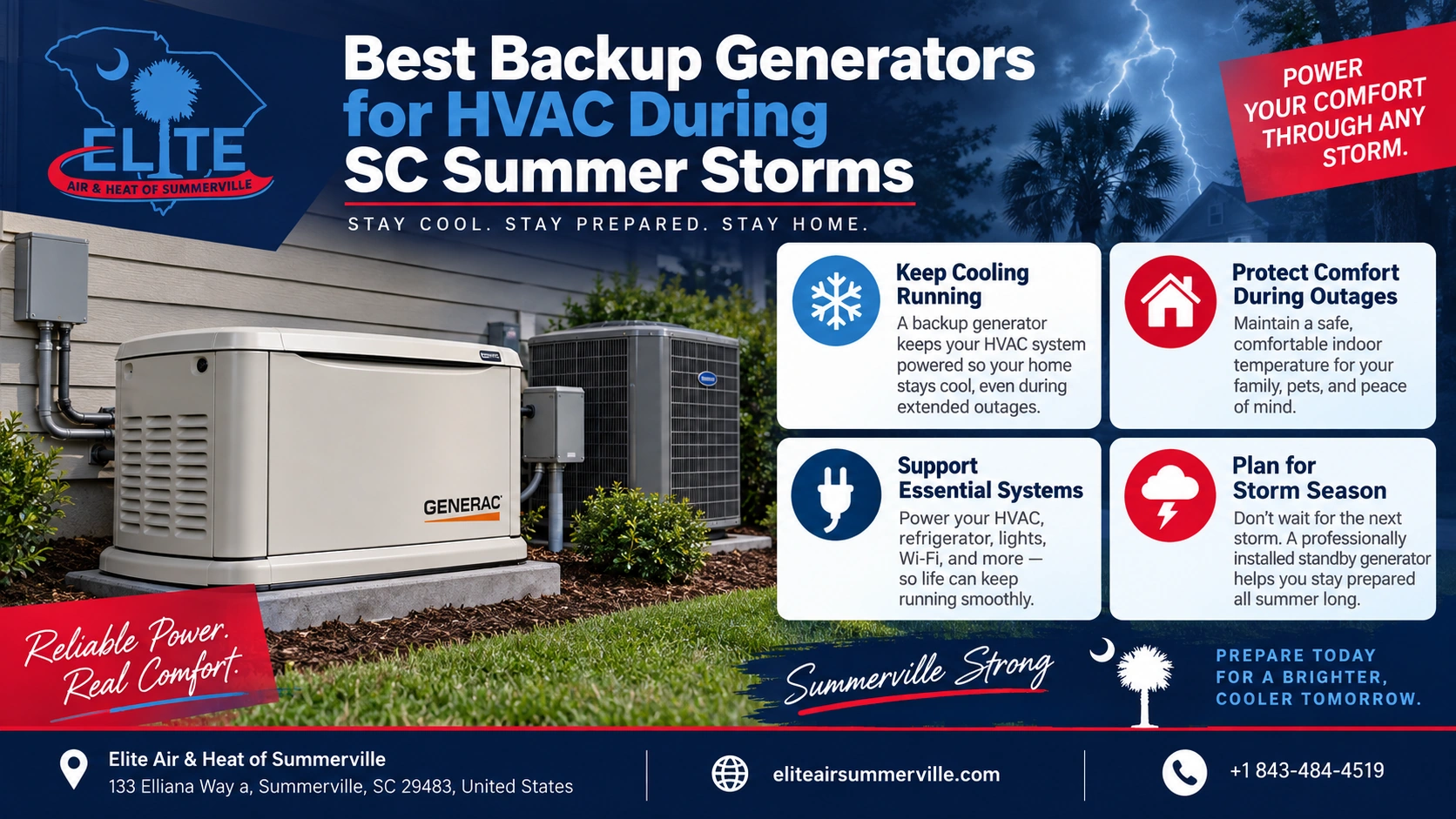
With a properly installed standby generator, the homeowner does not need to pull a 300-pound portable generator out during pouring rain, find fuel, run cords, and manually start equipment.
The system detects the outage, starts automatically, transfers the electrical load, and returns the home to utility power after service is restored.
That can matter if:
You are away from home.
An older family member is home alone.
You rely on temperature-sensitive medical equipment.
You travel frequently.
You simply do not want storm preparation to include moving and fueling a portable generator.
Convenience does not show up on a wattage chart.
But it has real value.
Natural Gas or Propane for a Standby Generator?
Both are common.
Natural gas has the convenience of continuous utility delivery when gas service remains available.
Propane gives you fuel stored physically on the property.
The generator’s power output may differ depending on fuel.
Generac’s current NextGen 18-kW system, for example, provides 18 kW on propane and 17 kW on natural gas. At full load, Generac lists propane use at approximately 2.87 gallons per hour and natural-gas consumption around 235 cubic feet per hour.
That does not mean the unit burns at full-load consumption throughout every outage.
Actual fuel use changes with electrical load.
But if you use propane, tank capacity deserves serious discussion.
A generator without enough fuel is just an expensive lawn ornament when an outage lasts several days.
Portable Generator Safety Is Not Optional
This section matters more than any brand recommendation in the article.
Never run a portable generator inside a house or garage.
Not with the garage door open.
Not “just for a few minutes.”
Not because rain is coming.
The CDC says generators should be operated outside and more than 20 feet from windows, doors, and vents, and homes using a generator should have battery-powered or battery-backup carbon-monoxide detectors.
Carbon monoxide cannot be seen or smelled.
This is not a theoretical warning.
Storm-related generator use is a known source of carbon-monoxide poisoning.
Never “Backfeed” Your House
There is another dangerous shortcut homeowners sometimes hear about:
Connecting a generator to a home in a way that sends electricity backward through household wiring without proper transfer equipment.
Do not do it.
Dominion Energy warns that plugging a portable generator into household wiring without an approved transfer arrangement can backfeed electricity onto utility lines, creating a lethal hazard for lineworkers and potentially damaging electrical equipment.
Dominion states that the safe method for connecting a portable generator to existing household wiring is to have a licensed electrical contractor install a transfer switch.
A transfer switch isolates generator power from utility power.
FEMA likewise explains that proper transfer equipment prevents generator electricity from feeding back onto the commercial power grid.
This is not the part of a generator installation to improvise.
Don’t Size the Generator From House Square Footage
You will see charts online saying things like:
“2,000-square-foot home = 14-kW generator.”
That might work as a rough shopping starting point.
It is not how we would make the final decision.
Consider two identical 2,000-square-foot houses.
House A has a 3-ton AC, gas water heater, gas range, and few large electrical loads.
House B has a 4-ton heat pump, electric water heater, electric range, pool pump, second refrigerator, and EV charger.
Same square footage.
Completely different electrical demand.
Generator sizing should follow loads, not flooring area.
What Should Be Measured Before You Buy?
For an HVAC-focused generator installation, the contractor should identify the exact HVAC equipment and compressor starting characteristics, the generator’s continuous and motor-starting capacity on the fuel you actually plan to use, and the other household loads expected to operate simultaneously.
A good plan should also address whether loads will be shed automatically, whether a soft start is appropriate, whether the electrical service and transfer equipment are correct, whether the natural-gas meter and piping can support the generator, or whether the propane tank provides enough usable fuel.
This is where a proper generator contractor and HVAC contractor sometimes need to communicate.
The generator installer understands the electrical power system.
The HVAC technician understands what the equipment being powered actually needs.
Don’t Forget About Your Air Handler
Homeowners naturally focus on the outdoor AC compressor.
But the indoor side needs electricity too.
Your blower motor, air-handler controls, thermostat, zone panel, condensate pumps, dehumidifier, and indoor-air-quality accessories may all require power.
A generator that starts the outdoor condenser but does not properly power the indoor system does not give you useful air conditioning.
And if your home has a whole-home dehumidifier, remember that it can represent another meaningful electrical load.
In a South Carolina outage, humidity control may become part of the backup-power plan rather than an afterthought.
Heat-Pump Homes Need a Year-Round Conversation
If the generator is intended only to keep the AC operating during hurricane season, we can size around summer conditions.
If you expect it to run your heat pump during winter too, look at the entire heating system.
A heat pump itself may be manageable.
Large banks of electric auxiliary resistance heat can be an entirely different electrical load.
That means a generator sized perfectly for summer cooling may not necessarily operate every winter heating stage.
A good technician should explain that limitation before you assume “HVAC backup” means every HVAC mode.
Our Best Generator Choices by Use Case
For a typical single-system Lowcountry home wanting automatic AC backup, we would start by evaluating an 18- to 22-kW standby system with load management rather than jumping immediately to the largest residential model.
For a large home, multiple HVAC systems, or substantial electric appliances, 24- to 26-kW standby equipment deserves consideration.
For a homeowner who wants serious portable backup and is willing to manage fuel and startup manually, high-output 240-volt units such as the Westinghouse WGen14500TFc or DuroMax XP16000iH are worth evaluating but only after someone confirms the actual AC starting requirement and installs safe transfer equipment.
For the lowest-cost storm plan, a smaller generator running refrigeration, lights, fans, and one room-sized air conditioner can be a very sensible solution.
There is no shame in choosing essential comfort instead of whole-house convenience.
What We Would Not Buy
We would be cautious about any generator purchase based entirely on a salesperson saying:
“This runs a 5-ton unit.”
Ask what that statement means.
Which 5-ton unit?
Traditional compressor or inverter?
What is its starting requirement?
What else can operate at the same time?
Which generator fuel?
Does it require load shedding?
Was the generator’s motor-starting capability actually checked?
A good technician or generator contractor should be able to show you why the combination works.
What About Generator Brand?
Brand matters.
But service support matters more than most homeowners realize.
Generac, Briggs & Stratton, Westinghouse, DuroMax, Kohler, and others all have products that may fit certain applications.
For permanent standby equipment, we would put substantial weight on:
Who can install it correctly and who can repair it after a hurricane?
A generator that looks excellent on paper but has poor local parts or service support can become frustrating when everybody needs generator repairs at the same time.
Before buying, find out who performs warranty work, how routine maintenance is handled, how quickly parts are normally available, and what the installation warranty actually covers.
Is a Whole-Home Generator Worth It?
That is not purely a financial question.
You probably should not expect a standby generator to “pay for itself” through electricity savings.
It is a backup infrastructure.
The value is avoiding the consequences of an outage.
For one homeowner, that means protecting refrigerated food.
For another, keeping medical equipment operating.
For another, working from home.
And in the South Carolina summer, it may simply mean keeping the house habitable when outdoor temperature and humidity are high.
If outages in your area are rare and short, a $10,000-plus backup-power project may be difficult to justify.
If you have experienced repeated multi-hour or multi-day outages and never want to go through another August night without air conditioning, your calculation may be very different.
What Should a Good Generator Estimate Include?
A complete estimate should identify the generator model and its output on the intended fuel, transfer-switch type and rating, circuits or loads being backed up, load-management strategy, HVAC starting requirements, fuel-system modifications, site preparation, electrical work, permits, startup testing, warranty coverage, and ongoing maintenance.
If propane is involved, tank capacity needs to be part of the discussion.
If natural gas is involved, gas piping and meter capacity need to be verified.
If central air is the reason you are buying the generator, the HVAC equipment should appear in the calculation.
Otherwise, you are buying backup power without proving it backs up the thing you care about.
The Bottom Line
So what is the best backup generator for HVAC during a South Carolina summer storm?
For most homeowners who want automatic central-air backup, a professionally sized 18- to 22-kW standby generator is our practical starting point.
Larger 24- to 26-kW systems make sense when multiple HVAC units or other heavy electrical loads need to operate.
High-output portable generators can provide a less expensive path to central-air backup, especially when paired with appropriate transfer equipment and, where technically appropriate, a compressor soft start.
But do not buy based on tonnage or peak watts alone.
If you only remember one thing, remember this:
The hardest moment for your generator may be the second your AC compressor tries to start.
A good backup-power plan accounts for that moment before the storm ever arrives.
And no matter which generator you choose, portable equipment must stay outside and away from the home, and any connection into household wiring should use properly installed transfer equipment.
If keeping your air conditioner running during summer outages is the priority, Elite Air & Heat of Summerville can help identify what your HVAC equipment actually requires so you can take that information to a qualified generator/electrical installer and size the backup system correctly.
The goal is not to buy more generator than you need.
The goal is for the AC to actually start when the lights go out.