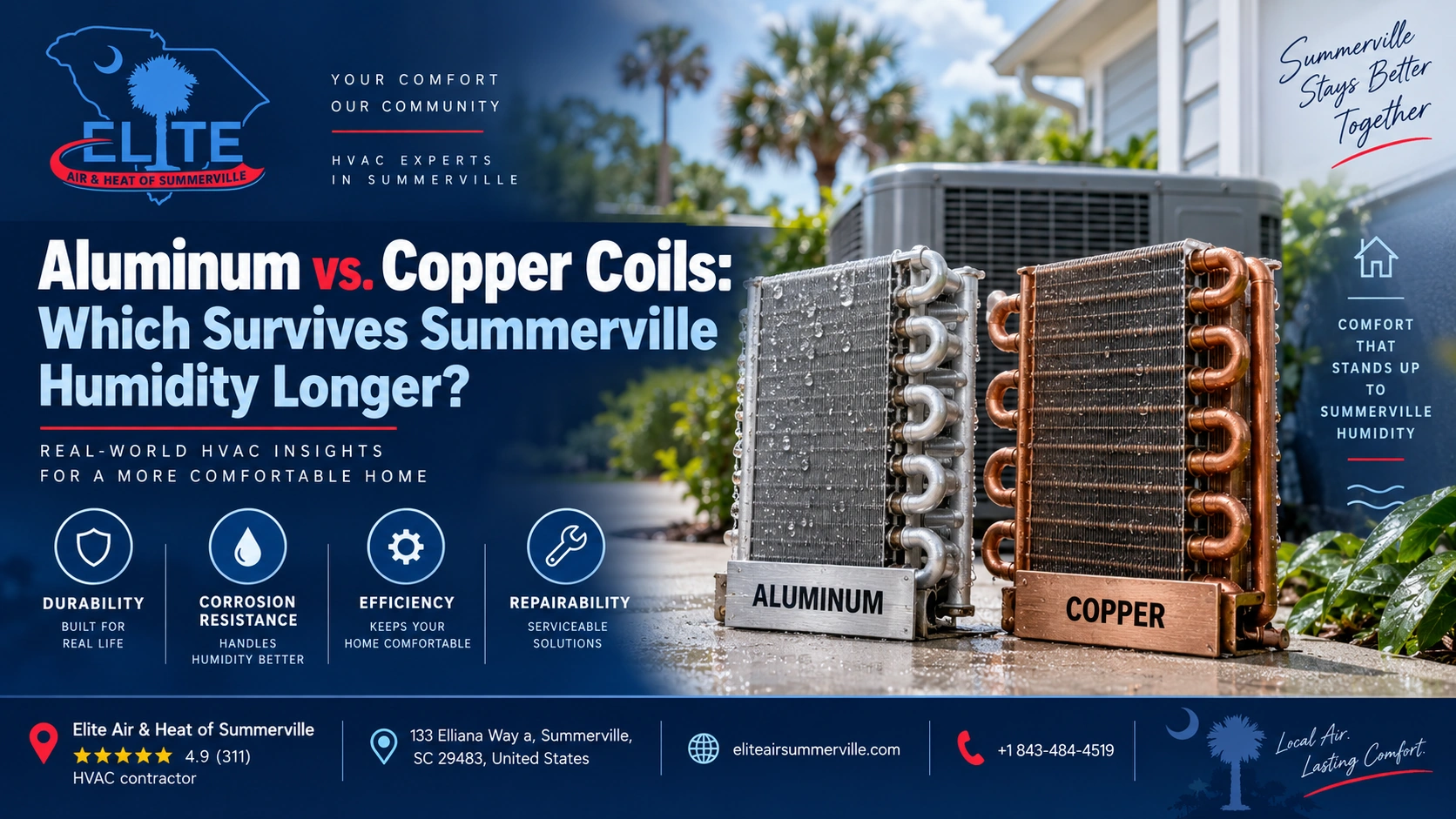

If you are comparing HVAC systems in Summerville, you may hear one contractor praise all-aluminum coils while another insists copper is more durable and easier to repair.
Both can make a convincing argument.
And both can be right depending on what kind of coil they are talking about, how it is built, and the environment around it.
Here’s the plain answer.
For many modern residential HVAC systems in South Carolina, we generally like a well-designed all-aluminum evaporator coil for corrosion resistance. But aluminum does not automatically outlast copper simply because Summerville is humid.
Humidity is only part of the story.
The failures we care about usually involve moisture plus contaminants, salt, dissimilar metals, poor drainage, manufacturing quality, or physical damage.
That distinction matters before you choose an entire HVAC system based on one word in the brochure.
First: What Coil Are We Talking About?
Your HVAC system normally has two major heat exchangers.
The indoor evaporator coil
During the air-conditioning season, refrigerant flowing through this coil absorbs heat from the air inside your home.
The evaporator coil gets cold enough that moisture in humid indoor air condenses on it.
In other words, during a Summerville summer, this coil is supposed to get wet.
That makes corrosion resistance important.
The outdoor condenser coil
The outdoor coil rejects heat from the refrigerant into the outside air.
It deals with a different set of problems:
- Rain
- Humidity
- Dirt
- Grass clippings
- Lawn chemicals
- Irrigation
- Airborne contaminants
- Salt exposure in genuinely coastal locations
You cannot necessarily take an advantage that applies to an indoor evaporator coil and assume it applies exactly the same way outdoors.
So Does Summerville Humidity Destroy Copper Coils?
Not by itself.
Copper is a durable material that has been used successfully in HVAC equipment for decades.
The bigger concern with some copper evaporator coils is a particular failure mechanism called formicary corrosion, sometimes called ant-nest corrosion.
ASHRAE explains that formicary corrosion can occur in copper HVAC tubing when air, moisture, and certain organic compounds are present together. Those compounds can break down into acids such as formic and acetic acid, eventually creating microscopic tunnels and pinhole leaks in copper tubing.
That last part is important:
Humidity alone is not the whole problem.
Moisture helps create the conditions in which certain contaminants can attack the copper.
Where Do Those Contaminants Come From?
They can come from surprisingly ordinary places.
ASHRAE identifies potential sources associated with formicary corrosion including interior paint, engineered wood products, carpet, and adhesives.
Lennox makes a similar point in its coil literature: volatile organic compounds, or VOCs, from products such as paints, carpets, furniture, and household cleaners can combine with moisture to create an aggressive environment for some coils.
That does not mean your new flooring is going to destroy your air conditioner.
It means coil corrosion is a chemistry problem, not simply a humidity percentage problem.
And in a humid climate, the moisture portion of that chemistry is readily available.
Why HVAC Manufacturers Started Moving Toward All-Aluminum Coils
One reason all-aluminum evaporator coils have become common is that they eliminate much of the copper tubing that can be vulnerable to formicary corrosion.
Manufacturers including Carrier, Trane, and Lennox now specifically market all-aluminum indoor coils for improved corrosion resistance. Carrier says its all-aluminum evaporator designs are intended to reduce corrosion and refrigerant leaks, while Trane describes its current Comfort Coils as all-aluminum designs engineered for corrosive environments.
That is meaningful.
It does not prove every aluminum coil will outlive every copper coil.
There are excellent and poor designs made from both materials.
But it explains why we do not automatically view aluminum as the “cheap alternative” to copper.
Modern all-aluminum coils are often an intentional durability decision.
What About Galvanic Corrosion?
This is another reason coil construction matters.
Traditional outdoor coils commonly use copper tubing with aluminum fins.
Putting two different metals together can create the opportunity for galvanic corrosion when the right electrolyte such as salty moisture is present.
Carrier specifically cites eliminating dissimilar-metal galvanic corrosion as one reason it transitioned its coastal equipment from copper-tube/aluminum-fin coils to welded aluminum designs.
An all-aluminum coil removes much of that dissimilar-metal interface.
For homes directly exposed to salty coastal air, that can be a genuine advantage.
But Summerville Is Not the Beach
This deserves some perspective.
Summerville absolutely has the hot, moisture-heavy Lowcountry climate homeowners associate with this part of South Carolina. National Weather Service observations routinely show high summertime dew points and very high overnight relative humidity in the Summerville area.
But a house in Summerville proper does not have the same environment as a condenser sitting a few hundred yards from the ocean.
Carrier notes that the severity of salt-related corrosion depends on factors including distance from the ocean, wind direction, humidity, contaminants, and coil temperature, and says significant airborne salt concerns are especially relevant within roughly two miles of the coastline.
So we would not tell a Summerville homeowner:
“You need coastal equipment because we live near Charleston.”
That is too broad.
If the home is actually closer to the coast, exposed to salt spray, near certain industrial contaminants, or experiencing unusual corrosion already, that changes the discussion.
Can Aluminum Corrode Too?
Absolutely.
This is where the comparison needs some honesty.
Aluminum is corrosion-resistant. It is not corrosion-proof.
Aluminum can suffer from pitting and other forms of corrosion under aggressive environmental conditions. Research comparing aluminum and copper refrigerant piping confirms that corrosion behavior depends heavily on the alloy and the surrounding atmosphere, including salt exposure.
The Copper Development Association also argues strongly that copper retains advantages in many HVAC applications and cautions that aluminum can deteriorate in certain humid and salty environments. That organization represents the copper industry, so we would not treat its material preference as neutral proof but its broader point is fair: material alone does not determine durability.
A poorly designed aluminum coil can fail.
A well-built copper coil can last a very long time.
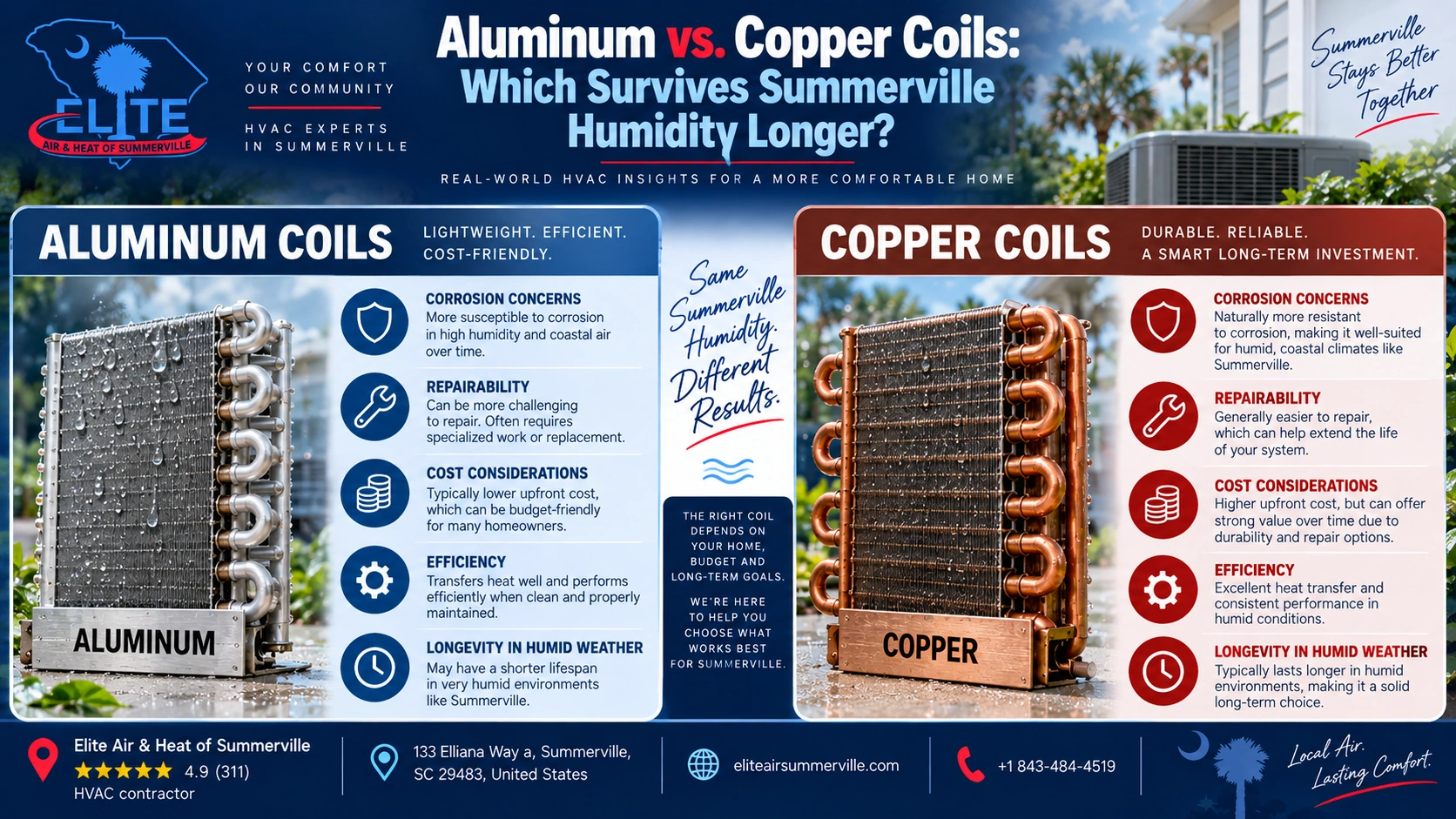
Aluminum vs. Copper: The Practical Homeowner Comparison
| Question | All-Aluminum Coil | Copper-Based Coil |
| Resistance to copper formicary corrosion | Strong advantage | Susceptible under the right moisture/contaminant conditions |
| Dissimilar-metal corrosion | Reduced in true all-aluminum designs | Possible where copper and aluminum are combined |
| General corrosion resistance | Very good with proper alloy/design | Very good in many environments |
| Field repairability | Can be more difficult depending on design | Often easier to braze or repair |
| Weight | Lighter | Heavier |
| Long HVAC track record | Increasingly common | Extensive history |
| Coastal performance | Can be excellent when specifically engineered/coated | Depends heavily on construction and coatings |
| Does material guarantee long life? | No | No |
That last row is the one homeowners should remember.
Isn’t Copper Easier to Repair?
Usually, this is copper’s strongest practical argument.
Copper refrigerant tubing is familiar to HVAC technicians and is highly workable. Certain accessible copper leaks can sometimes be cleaned, brazed, pressure-tested, evacuated, and returned to service.
Aluminum repairs can be more specialized.
Depending on where an aluminum coil leaks and how that particular coil is manufactured, replacing the coil may be more practical than attempting a field repair.
But there is a catch.
“Repairable” Does Not Always Mean “Worth Repairing”
Imagine a copper evaporator coil develops dozens of microscopic formicary corrosion sites.
A technician might be able to repair the hole that is leaking today.
That does not mean another microscopic area will not begin leaking next month.
If the underlying coil is deteriorating, repeatedly brazing individual pinholes is not necessarily a good investment.
A good technician should look at why the coil failed, not simply whether a torch can reach the hole.
What Usually Matters More Than Copper vs. Aluminum?
This is where homeowners sometimes get into trouble.
They compare two complete HVAC systems based solely on coil metal while overlooking factors that may matter considerably more.
Coil design and manufacturing quality
Two aluminum coils are not automatically equal.
Different manufacturers use different:
- Aluminum alloys
- Tube wall designs
- Fin designs
- Joining methods
- Protective coatings
- Drain pans
- Cabinets
The same applies to copper coils.
Proper installation
Installation problems can shorten the life of either material.
A coil can suffer when:
- Refrigerant piping rubs against the cabinet
- Tubing vibrates against another component
- The drain system is installed incorrectly
- Condensate stands where it should drain
- The system is improperly charged
- Airflow is incorrect
Material cannot compensate for bad installation.
Keeping the coil clean
Dirt does more than hurt airflow.
A contaminated coil can hold moisture and debris against metal surfaces.
Regular filtration and proper maintenance help keep the heat exchanger cleaner.
Indoor air chemistry
If a home contains unusually high levels of certain corrosive contaminants, that environment can matter.
This is particularly worth considering when there have been repeated evaporator coil failures that nobody can adequately explain.
Outdoor environment
For an outdoor condenser, pay attention to what is happening around the equipment.
An irrigation sprinkler constantly spraying the condenser, fertilizer exposure, certain chemicals, pet urine, debris, or heavy salt exposure can create harsher conditions than humidity alone.
Does a Coated Coil Make a Difference?
It can.
Protective coil coatings are used specifically to create another barrier between the metal and aggressive environmental conditions.
ASHRAE identifies corrosion-resistant alloys and hydrophobic protective coatings among the measures that can reduce certain corrosion problems.
Coatings are particularly worth discussing in genuinely corrosive environments.
But again, do not assume the word “coated” automatically means one system will last longer.
Ask:
What exactly is coated?
What type of corrosion is that coating designed to resist?
Does the manufacturer provide a corrosion-specific warranty?
Is the coating factory-applied or field-applied?
Those answers are more useful than a salesperson simply saying, “This one has coastal protection.”
Which Would We Choose for a Summerville Home?
If two otherwise comparable systems were sitting in front of us and the choice was between a traditional copper-tube/aluminum-fin indoor evaporator coil and a proven all-aluminum evaporator coil, we would generally be comfortable leaning toward the all-aluminum design for a Lowcountry home.
The reason is not that aluminum magically ignores humidity.
It is that a good all-aluminum design can eliminate some known corrosion mechanisms associated with copper tubing and dissimilar metals, while manufacturers have invested heavily in alloys and coil designs specifically intended to improve corrosion resistance.
But we would not choose an HVAC system solely because its coil is aluminum.
We would also look at:
- Equipment reliability
- Compressor technology
- Proper sizing
- Humidity performance
- Parts availability
- Warranty coverage
- Labor warranty
- Installation quality
- Serviceability
- Manufacturer support
A great coil inside a poorly installed system is still a poorly installed system.
What If You Already Have a Copper Coil?
Do not panic.
That does not automatically mean you should replace it.
Millions of copper-containing HVAC coils have provided long service lives.
If the system is cooling properly, refrigerant charge is stable, the coil is clean, condensate is draining correctly, and there are no indications of leakage, there is no reason to replace a healthy coil merely because it contains copper.
The question becomes different when you have repeated refrigerant leaks.
If a copper evaporator coil has developed multiple pinholes or has already been repaired more than once, ask the technician whether the failure pattern looks like localized damage or broader corrosion.
That distinction can determine whether another repair makes sense.
What Should You Ask When Comparing HVAC Quotes?
If two replacement proposals use different coil designs, ask each contractor:
- Is the indoor evaporator coil copper/aluminum or all-aluminum?
- What material is the outdoor coil?
- Is there a factory corrosion-resistant coating?
- What does the manufacturer warranty against?
- Does the warranty include labor?
- If this coil develops a refrigerant leak, is it normally repaired or replaced?
- How available are replacement coils?
- Is this specific model intended for humid or coastal conditions?
- What installation practices help prevent premature coil failure?
A good technician should be able to answer those questions without turning the conversation into a chemistry lecture.
If You Live Closer to the Coast, Ask a Different Question
For homeowners closer to saltwater, coil material becomes only one part of a larger corrosion-resistance package.
Carrier’s coastal equipment, for example, combines welded aluminum coil technology with changes to fasteners, plating, cabinet coatings, and protection around copper-to-aluminum connections.
That tells you something important:
Manufacturers themselves do not treat coastal durability as a one-material problem.
Neither should homeowners.
If salt corrosion is a genuine concern, evaluate the entire outdoor unit.
The Bottom Line
So, which survives Summerville humidity longer: aluminum or copper?
Our slight preference goes to a proven all-aluminum evaporator coil—but not because aluminum automatically beats copper whenever the humidity rises.
Copper can last for many years and remains highly serviceable.
Modern all-aluminum coils have become attractive because they can reduce susceptibility to formicary corrosion and eliminate much of the dissimilar-metal interface found in traditional copper-tube/aluminum-fin designs.
But the real durability equation looks more like this:
Good coil design + proper installation + clean equipment + correct drainage + the right protection for the environment.
That matters more than choosing a system because someone told you “copper is better” or “aluminum never corrodes.”
Neither statement tells the whole story.
If you only remember one thing, remember this:
Don’t buy the metal. Buy the better-designed, properly installed system with a warranty and service network you can depend on.
If your current system keeps losing refrigerant or you are comparing replacement options, Elite Air & Heat of Summerville can help you identify what type of coil you have, why the existing one may have failed, and whether a different design actually makes sense for your home before you spend the money.