
A higher-efficiency HVAC system sounds good on paper.
But most homeowners want to know the real question:
“When do I actually get my money back?”
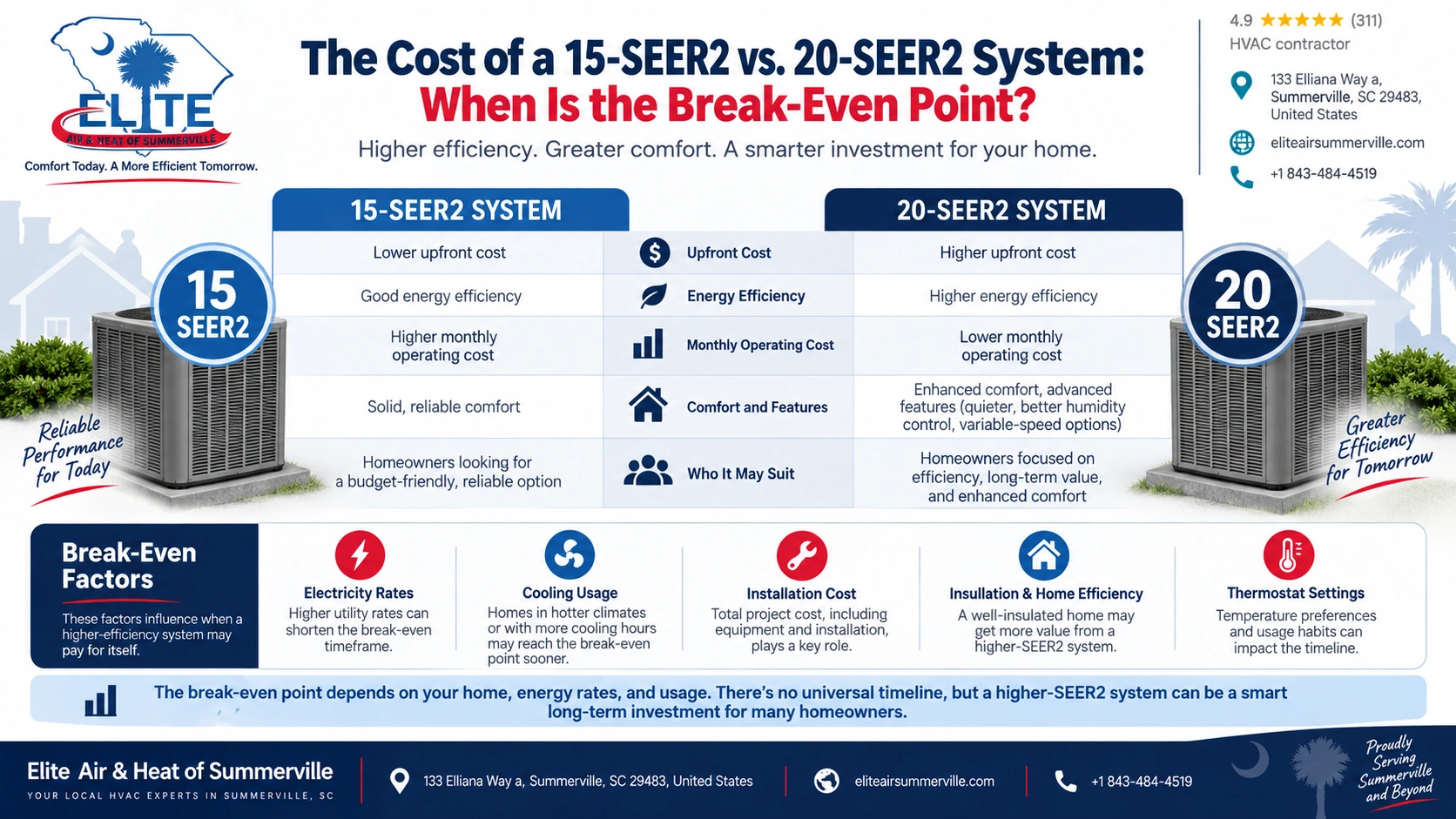
Here’s the plain answer: a 20-SEER2 system can lower cooling costs compared to a 15-SEER2 system, but the break-even point is usually several years away. In many Summerville homes, the payback can land somewhere around 7 to 15 years, depending on the price difference, how much you run the system, electricity rates, ductwork condition, and whether the higher-efficiency system includes variable-speed comfort features.
That does not mean a 20-SEER2 system is a bad choice.
It means you should not buy it based on the efficiency number alone.
What SEER2 Actually Means
SEER2 measures seasonal cooling efficiency.
The higher the number, the less electricity the system should use to produce the same amount of cooling under test conditions.
A 20-SEER2 system is more efficient than a 15-SEER2 system.
But that does not mean it automatically cuts your whole electric bill by 25%.
Your HVAC system is only part of your electric bill. Lights, appliances, water heating, electronics, pool pumps, and other loads still use power.
The savings only apply to the cooling portion of your bill.
How Much More Does a 20-SEER2 System Cost?
The price difference varies by brand, tonnage, equipment type, ductwork, installation difficulty, warranty, and whether the system uses single-stage, two-stage, or variable-speed technology.
As a general homeowner planning range:
| System Type | Typical Installed Cost Difference |
| 15-SEER2 standard system | Baseline price |
| 17-SEER2 mid-efficiency system | Often $1,500–$3,500 more |
| 20-SEER2 high-efficiency system | Often $3,000–$7,000+ more |
That does not mean every 20-SEER2 quote is overpriced.
Higher-efficiency systems often include more expensive compressors, communicating controls, variable-speed blower motors, upgraded outdoor units, and more advanced installation requirements.
But the higher price should be explained clearly.
A good estimate should show you what you are getting besides the SEER2 rating.
The Simple Break-Even Formula
The break-even formula is simple:
Extra upfront cost ÷ yearly energy savings = break-even point
For example:
If a 20-SEER2 system costs $4,000 more than a 15-SEER2 system and saves about $350 per year, the break-even point is:
$4,000 ÷ $350 = about 11.4 years
That is the financial payback.
The comfort payback may be different.
Example: 15-SEER2 vs. 20-SEER2 Break-Even
Here is a simple example for a home with a long cooling season:
| Item | 15-SEER2 System | 20-SEER2 System |
| Efficiency rating | 15 SEER2 | 20 SEER2 |
| Estimated annual cooling cost | $1,200 | About $900 |
| Estimated yearly savings | — | About $300 |
| Added upfront cost | — | $4,000 |
| Estimated break-even | — | About 13 years |
This example is not a quote. It is a way to understand math.
If the system saves more each year, the break-even comes faster.
If the system costs much more upfront, the break-even takes longer.
Why the Savings Are Not Always as Big as Expected
A 20-SEER2 system may be more efficient, but real homes are not laboratory test rooms.
Actual savings can be reduced by:
- Leaky ductwork
- Poor insulation
- Oversized equipment
- Undersized equipment
- Bad airflow
- Dirty coils
- Poor thermostat setup
- Incorrect refrigerant charge
- Long duct runs in a hot attic
- Rooms that never had enough supply air to begin with
This is where homeowners sometimes get into trouble.
They pay for higher-efficiency equipment, but the ductwork and airflow problems stay the same.
In a humid climate, comfort is not just about temperature. If the system is not sized, installed, and commissioned correctly, the SEER2 rating will not fix everything by itself.
When a 20-SEER2 System Can Make Sense
A 20-SEER2 system may be worth considering when:
- You plan to stay in the home for a long time
- Your summer electric bills are high
- The system runs many hours per day
- You want better humidity control
- You have comfort problems with temperature swings
- You are comparing variable-speed systems, not just efficiency labels
- Rebates or incentives reduce the price difference
- Your ductwork and airflow are in good shape
- You value quieter operation
In Summerville’s long cooling season, a system that runs more efficiently at lower speeds can sometimes improve comfort, not just lower the bill.
That matters in homes that feel cool but still sticky.
When a 15-SEER2 System May Be the Smarter Buy
A 15-SEER2 system may make more sense when:
- You want the lowest reasonable upfront cost
- You may sell the home soon
- Your current electric bills are manageable
- Your ductwork needs repairs first
- The price jump to 20 SEER2 is too large
- You do not need advanced comfort features
- You want simpler equipment with fewer premium components
The cheaper option is not always wrong.
A properly sized and well-installed 15-SEER2 system can be a solid choice, especially if the home’s ductwork, airflow, and insulation are addressed.
A poorly installed 20-SEER2 system is not better than a properly installed 15-SEER2 system.
The Real Break-Even Depends on Three Numbers
Before deciding, ask for three things:
1. The Price Difference
Do not just ask, “What does the 20-SEER2 system cost?”
Ask:
“How much more is it than the 15-SEER2 option?”
That difference is the number you need for the break-even calculation.
2. The Estimated Annual Savings
A contractor should be able to give you a reasonable estimate based on your system size, usage, electric rates, and home conditions.
It will not be perfect, but it should be realistic.
Be careful with savings claims that sound too clean or too optimistic.
3. How Long You Expect to Stay in the Home
If the break-even point is 12 years and you plan to move in 3 years, the financial argument is weaker.
If this is your long-term home, the higher-efficiency system may make more sense.
Quick Break-Even Examples
Here is how the math can change:
| Added Cost for 20-SEER2 | Yearly Savings | Break-Even Point |
| $3,000 | $250/year | 12 years |
| $3,000 | $400/year | 7.5 years |
| $5,000 | $300/year | 16.7 years |
| $5,000 | $500/year | 10 years |
| $7,000 | $400/year | 17.5 years |
This is why one homeowner may be smart to choose 20 SEER2, while another may be smart to stay with 15 SEER2.
The right answer depends on the home.
Do Rebates or Tax Credits Change the Math?
Yes, they can.
If rebates, utility incentives, or tax credits lower the upfront price difference, the break-even point can move closer.
For example:
- Added cost before incentive: $5,000
- Incentive or rebate: $2,000
- Net added cost: $3,000
- Estimated annual savings: $350
- Break-even: about 8.6 years
Without the incentive, the same system would take about 14.3 years to break even.
This is why incentives should be part of the conversation, but not the whole decision.
A system still needs to be the right fit for the house.
What a Good HVAC Estimate Should Include
Before approving a 15-SEER2 or 20-SEER2 system, the estimate should explain:
- Equipment size
- Efficiency rating
- Whether it is single-stage, two-stage, or variable-speed
- Indoor and outdoor equipment match
- Thermostat requirements
- Ductwork condition
- Electrical requirements
- Drain and safety switch details
- Warranty coverage
- Labor warranty
- What is included and excluded
- Expected comfort differences
- Estimated energy savings
- Available rebates or incentives
A good technician should be able to show you why the recommendation fits your home.
Not just why the more expensive system is “better.”
If You Only Remember One Thing
A 20-SEER2 system can save money, but the break-even point depends on the price difference and your actual cooling use.
For many homeowners, the better question is not:
“Which system has the highest SEER2?”
The better question is:
“Which system gives me the best mix of upfront cost, comfort, humidity control, warranty, energy savings, and long-term value?”
If your home has airflow problems, duct leakage, or poor humidity control, fix the system design first. Efficiency alone will not solve those issues.
Elite Air & Heat of Summerville can help compare 15-SEER2 and 20-SEER2 options clearly, including upfront cost, expected savings, comfort differences, and whether the higher-efficiency system is likely to pay off in your home.