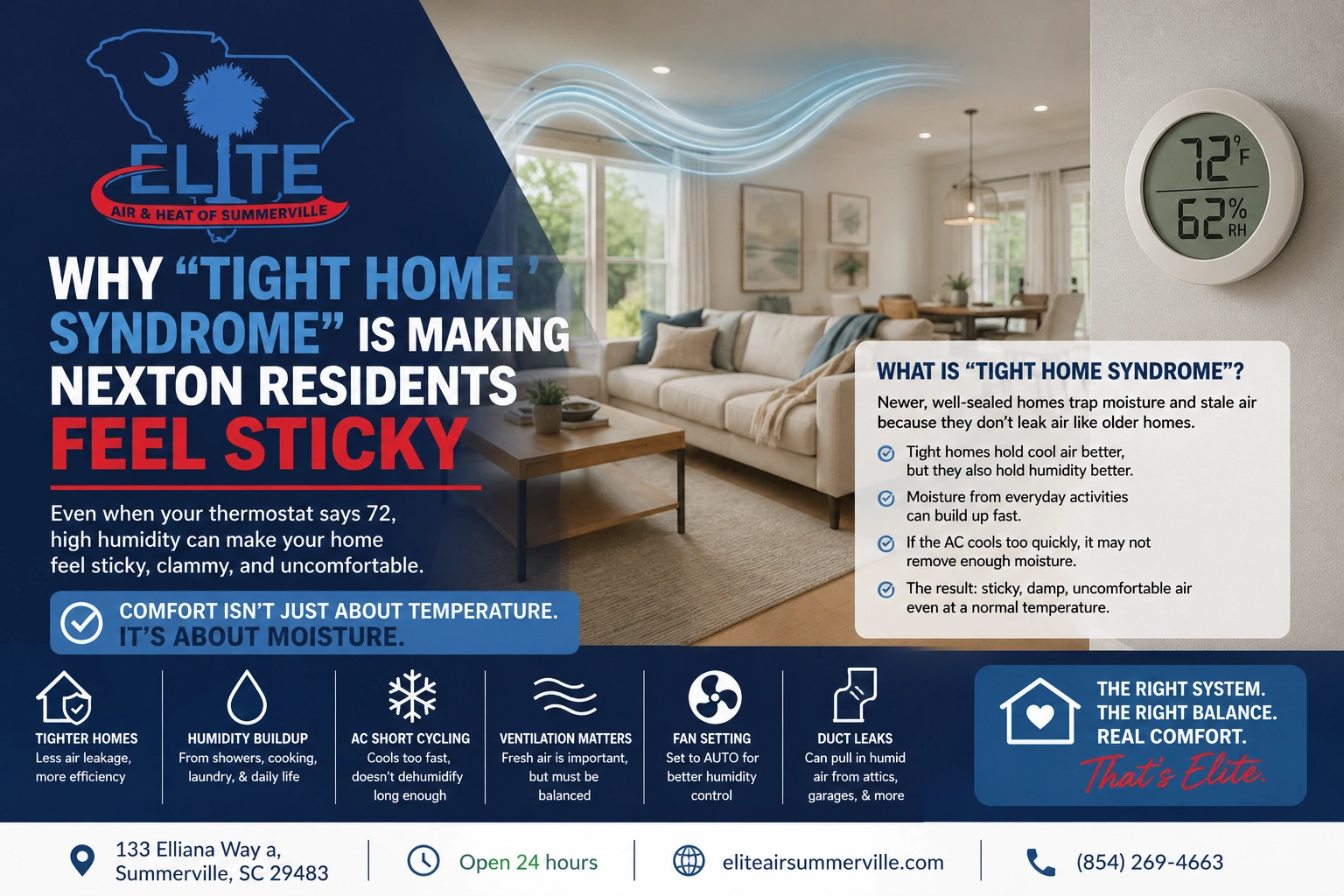

Here’s the plain answer: many newer Nexton homes are built so tight and efficient that the air conditioner may cool the house before it has enough time to remove moisture.
That can leave the home feeling sticky, clammy, or damp even when the thermostat says 72.
This does not automatically mean your AC is broken. It also does not automatically mean the builder did something wrong. It means the home, HVAC system, ventilation, ductwork, and humidity control all have to work together.
In a humid Lowcountry climate, comfort is not just about temperature.
It is about moisture.
Is Your Home Trapping Humidity?
Get professional help for tight home syndrome and restore comfort fast.
What is “Tight Home Syndrome”?
“Tight Home Syndrome” is not a formal medical diagnosis. It is a practical way to describe what happens when a newer, well-sealed home traps moisture and stale air because it does not leak air like older homes did.
Newer homes are often built with:
- Better insulation
- Tighter windows and doors
- Housewrap and air sealing
- More efficient building materials
- Less natural air leakage
- Mechanical ventilation to bring in outside air
That is usually good for energy efficiency.
But in Summerville, outdoor air is often hot and humid. If moisture gets inside and the AC does not run long enough to remove it, the house can feel uncomfortable even at a normal temperature.
Why tight homes feel sticky
Older homes leaked air constantly.
That was wasteful, but it also meant the home was always exchanging air with the outside. Newer homes are different. They are designed to hold conditioned air inside.
The tradeoff is simple:
A tight home holds cool air better, but it can also hold humidity better.
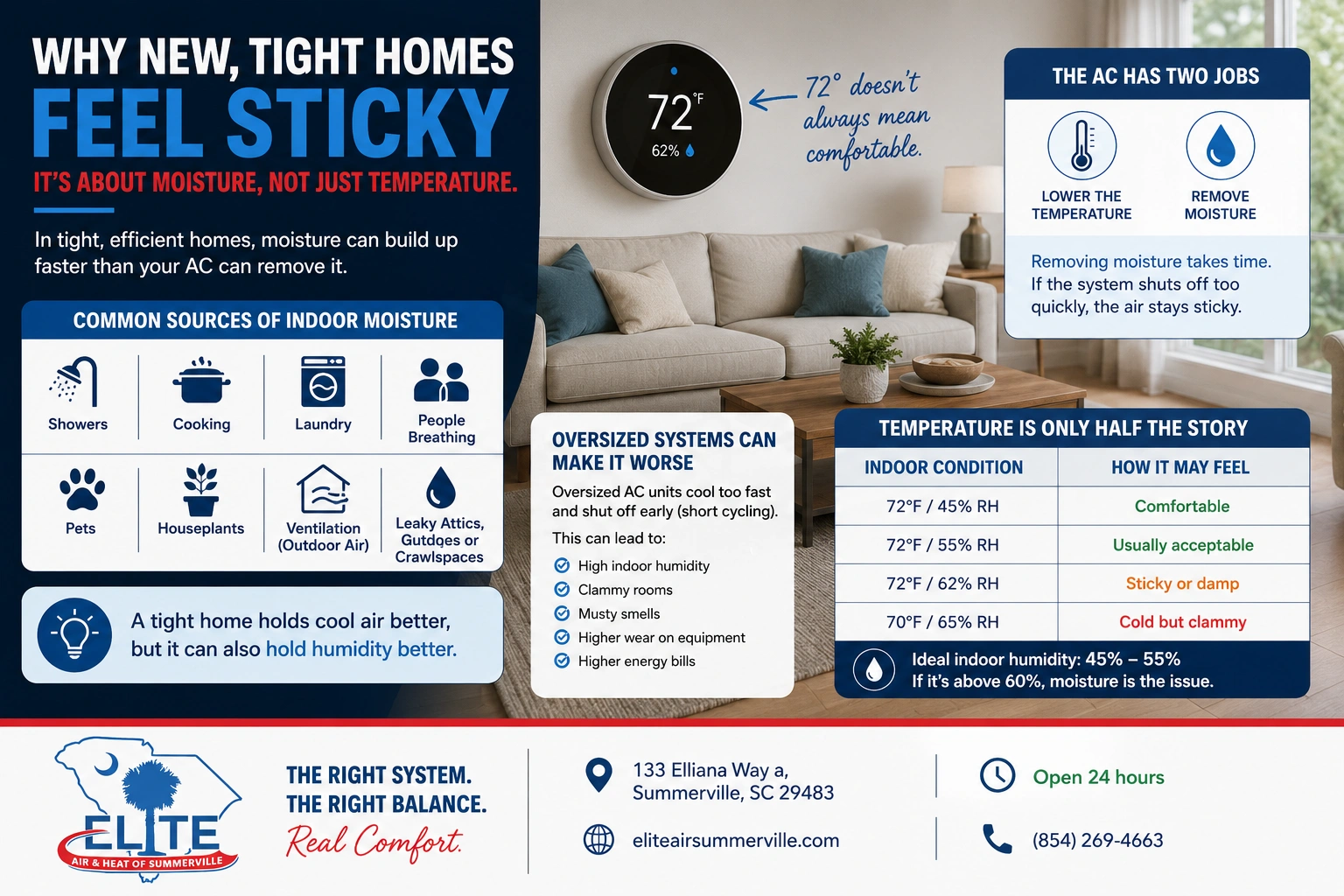
Moisture can come from:
- Showers
- Cooking
- Laundry
- People breathing
- Pets
- Houseplants
- Outdoor air brought in by ventilation
- Humid air leaking from attics, garages, or crawlspaces
- Construction materials drying out in a new home
If that moisture is not removed, the home starts to feel sticky.
The AC may be too efficient at cooling
This sounds strange, but it is common.
Your AC has two jobs:
- Lower the temperature.
- Remove moisture from the air.
The second job takes time.
When warm, humid air moves across the cold indoor coil, moisture condenses on the coil and drains away. But if the system shuts off too quickly, it may cool the house without removing enough moisture.
That is why a homeowner can say:
“My thermostat says 72, but the house still feels damp.”
That usually means the AC is satisfying temperature before it satisfies humidity.
Oversized systems make the problem worse
Bigger is not always better.
An oversized AC can cool a tight home too quickly. It turns on, drops the temperature fast, shuts off, and repeats. That is called short cycling.
Short cycling can lead to:
- High indoor humidity
- Clammy rooms
- Musty smells
- Sweating vents
- Uneven temperatures
- Higher wear on equipment
- Poor air mixing
This is where homeowners sometimes get into trouble. They assume they need a stronger AC, when the system may already be too large for the home’s actual cooling load.
In a tight Nexton home, the right-size system often matters more than the biggest system.
Ventilation can bring humidity inside
Tight homes need fresh air.
That fresh air often comes through some type of mechanical ventilation system. In theory, that is a good thing. Homes need controlled air exchange for indoor air quality.
But if the ventilation system brings in too much outdoor air, runs at the wrong time, or is not balanced correctly, it can add moisture faster than the AC removes it.
In the Lowcountry, this matters because fresh outdoor air is often loaded with humidity.
A ventilation issue may show up as:
- Sticky air after rain
- Higher humidity in the morning
- Musty odors
- Humidity spikes when the AC barely runs
- Rooms that feel damp even when cool
- High humidity during mild weather
A good technician should check how the home is breathing, not just whether the outdoor unit turns on.

Is Your Heater Ready for Winter? How to Stay Cozy All Season Long
As the days get shorter and the temperatures drop, there’s one thing on everyone’s mind: staying warm. And when the…

The thermostat may not be telling the whole story
Temperature alone does not tell you whether the home is comfortable.
A home at 72 degrees and 48% humidity can feel comfortable.
A home at 72 degrees and 64% humidity can feel sticky.
That is why every homeowner dealing with this issue should measure indoor humidity. A simple hygrometer can tell you more than guessing.
A practical comfort range is usually around 45% to 55% relative humidity. If your home is regularly above 60%, moisture should be taken seriously.
| Indoor condition | How it may feel |
| 72°F / 45% RH | Comfortable |
| 72°F / 55% RH | Usually acceptable |
| 72°F / 62% RH | Sticky or damp |
| 70°F / 65% RH | Cold but clammy |
If your house feels sticky, do not just lower the thermostat. Check the humidity.
Your fan setting may be working against you
This is one of the simplest things to check.
If the thermostat fan is set to ON, the blower may run even when the outdoor unit is not cooling. That can pull moisture off the wet indoor coil and push it back into the home.
For humidity control, the fan should usually be set to AUTO.
That way, the blower runs during cooling cycles and stops when the cooling cycle ends.
This one setting can make a noticeable difference in some homes.
Duct leakage can pull in humid air
Even a new home can have duct issues.
If return ducts leak in an attic, garage, or crawlspace, the HVAC system can pull humid, dirty, unconditioned air into the home.
That can make the house feel sticky no matter what the thermostat says.
Duct problems can also create:
- Hot rooms
- Weak airflow
- Dust issues
- Musty odors
- High energy bills
- Sweating ducts or vents
- Pressure problems when bedroom doors close
A good humidity diagnosis should include ductwork, static pressure, and airflow checks.
Just checking refrigerant pressure is not enough.
New homes can carry construction moisture
Brand-new homes may still be drying out.
Concrete, framing lumber, drywall compound, paint, flooring, and other materials can release moisture after move-in.
Some of that is normal.
But if humidity stays high for months, or if you notice condensation, musty smells, or visible microbial growth, it should not be ignored.
The answer may be better runtime, ventilation adjustment, duct correction, or dedicated dehumidification.
Do you need a whole-home dehumidifier?
Maybe.
A whole-home dehumidifier can be a smart solution for tight homes when the AC is sized correctly but the humidity load remains high.
This is especially true during mild, damp weather when the AC does not need to run much. The house may not need much cooling, but it still needs drying.
A whole-home dehumidifier may make sense if:
- Indoor humidity stays above 60%
- The house feels sticky at normal temperatures
- The AC short-cycles
- The home is tight and efficient
- Ventilation is adding moisture
- You notice musty odors
- You have moisture-sensitive rooms or materials
- Lowering the thermostat makes the home cold but not comfortable
But a dehumidifier should not be the first guess. It should come after checking airflow, duct leakage, fan settings, ventilation, equipment sizing, and drainage.
What homeowners can safely check
Before calling for help, check a few simple things:
- Set the thermostat fan to AUTO
- Replace or inspect the air filter
- Buy a small hygrometer and track humidity
- Make sure supply and return vents are not blocked
- Run bath fans during and after showers
- Use kitchen exhaust when cooking
- Look for sweating vents or condensation
- Note whether humidity is worse upstairs, after rain, or during mild weather
- Check whether the AC runs for long cycles or short bursts
Write these observations down. They help a technician diagnose the real cause instead of guessing.
What a good technician should inspect
A proper humidity diagnosis should include:
- Indoor relative humidity readings
- System runtime
- Thermostat settings
- Blower speed
- Airflow across the indoor coil
- Static pressure
- Temperature split
- Drainage and condensate removal
- Duct leakage
- Return air problems
- Fresh-air ventilation settings
- Equipment sizing
- Signs of short cycling
- Whether a whole-home dehumidifier is actually needed
A good technician should be able to show you why the home feels sticky.
When not to DIY
Do not try to adjust refrigerant, blower speed, control wiring, fresh-air dampers, or duct balancing unless you are trained.
This is where small changes can create bigger problems.
For example, closing vents to force air into another room can raise duct pressure and reduce system performance. Lowering the thermostat to 68 may make the house colder, but it may not remove the moisture problem.
If the issue keeps coming back, replacing parts blindly usually is not the answer.
The bottom line
“Tight Home Syndrome” happens when a newer, efficient home holds moisture better than the HVAC system removes it.
For Nexton residents, that sticky feeling is usually tied to one or more of these issues:
- The AC cools too quickly
- The system is oversized
- Ventilation brings in humid outdoor air
- The fan is set incorrectly
- Ducts are leaking or unbalanced
- Construction moisture is still drying out
- The home needs dedicated dehumidification
If you only remember one thing, remember this: in a tight Lowcountry home, comfort is not just about getting the temperature down. It is about controlling humidity.
A good technician should look at the whole system before recommending a fix. That includes the AC, ducts, ventilation, fan settings, drainage, and humidity readings.
Feeling Sticky Inside Your Nexton Home?
Call now for expert HVAC and indoor air quality service that helps your home breathe better.